
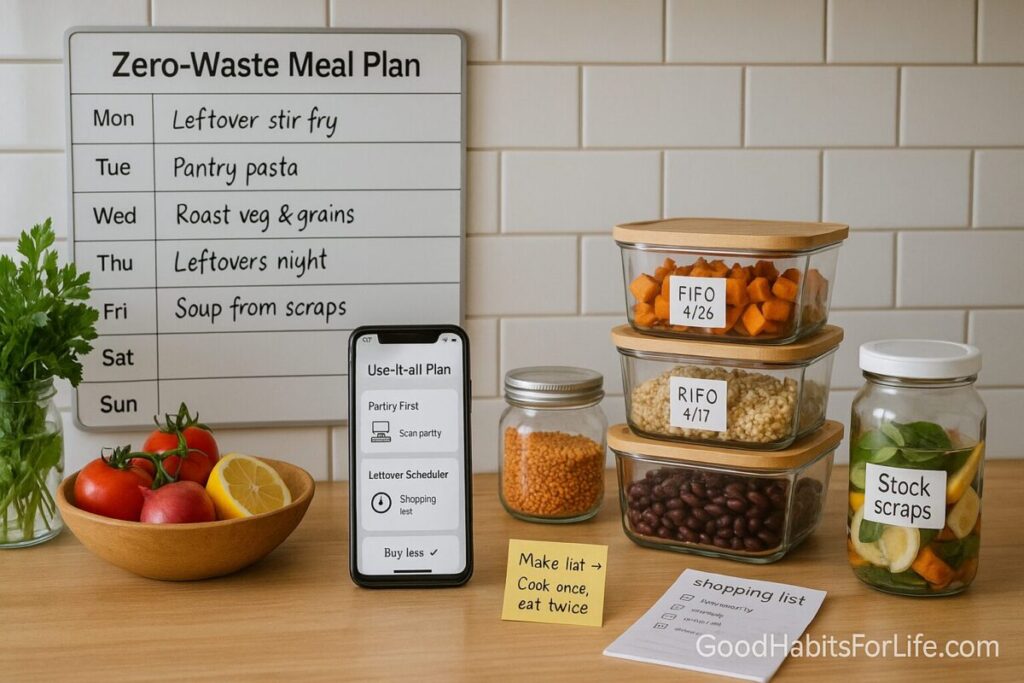
ZeroWaste Meal Plans: Use It All, Save a Lot: AI workflows (2025)
ZeroWaste Meal Plans: Use It All, Save a Lot: AI workflows (2025)
Table of Contents
🧭 What & Why
What is a zero-waste meal plan?
A weekly plan that starts from what you already have, prioritizes perishable items, intentionally schedules leftovers, and matches portions to real life—so ingredients are fully used and bins stay empty.
Why it matters (evidence-backed):
-
Food waste is a major climate and cost issue; households are a significant contributor worldwide. Cutting waste ranks among impactful climate solutions.¹²³
-
Planning meals, making lists, and cooking in batches are consistently associated with better diet quality and reduced waste.
-
Proper storage and FIFO (first in, first out) habits extend shelf life and curb spoilage.
Primary keyword focus: zero-waste meal plans (and close variants: use-it-all meal plan, leftover planning, pantry-first planning).
✅ Quick Start (Do This Today)
Time needed: ~45 minutes
-
Run a 10-minute inventory sweep
Open fridge/freezer/pantry; write down perishables and “orphans” (half onion, lone carrots, cooked rice, etc.). Mark EAT FIRST items (1–3 days).
-
Columns: Item • Quantity • Use-by date • Idea.
-
Feed inventory to AI for a 7-day plan
Prompt (paste your list):
“Create a 7-day zero-waste meal plan that uses these items first, adds minimal extra ingredients, plans intentional leftovers, and outputs: (a) daily meals; (b) one pan/batch ideas; (c) a consolidated shopping list grouped by store section; (d) a ‘use-it-up’ snack/side list.”
-
Schedule leftover meals
Pick 2–3 dinners designed to become tomorrow’s lunches or a remix (e.g., roast veg → grain bowls; dal → parathas; chicken → tacos). -
Label & store smart
Use masking tape + marker: name • cooked/opened date • use-by. Place EAT FIRST bin at eye level. Follow FoodKeeper storage times.⁶ -
Do a 5-minute waste audit on Sunday
Note what you tossed and why (too much, poor storage, forgot to use, didn’t like). Adjust next week’s portions and recipes accordingly.
🧠 30-60-90 Zero-Waste Roadmap
Days 1–30: Foundation
-
Run weekly inventory + AI plan (repeatable template below).
-
Adopt 2 batch anchors per week (e.g., dal + roasted veg) for remix meals.
-
Implement FIFO and labeling; start EAT FIRST bin.
-
Track waste (by item & reason) + rough savings estimate.
Days 31–60: Optimization
-
Portion-correct: downsize recipes or halve batches if leftovers linger.
-
Introduce a Leftover Matrix (protein + base + veg + sauce = 12 quick remixes).
-
Add theme nights (Soup Sun, Stir-Fry Tue, Wrap Wed, Curry Thu, Pasta Fri) to simplify planning.
-
Lock a staples list (grains, legumes, eggs, frozen veg, aromatics).
Days 61–90: Scale & Sustain
-
Build monthly pantry cycles: rotate staples so nothing ages out.
-
Automate with recurring AI prompts + a reusable shopping list.
-
Consider sharing/rescue habits (neighborhood swaps, rescue apps) to keep surplus out of the bin.
Monthly checkpoint:
-
Waste < 10% of purchased food; fridge “Friday clear-out” requires <10 minutes; meals cover 80–90% at home without last-minute takeout.
🛠️ Techniques & Frameworks
1) Pantry-First Planning
-
Start with perishables, then add pantry/freezer support.
-
Use “Use-It-Up Index” (UII) to choose recipes:
| Item | Days Left | Flexibility (1–3) | UII = Days ÷ Flexibility | Priority |
|---|---|---|---|---|
| Spinach (bag) | 2 | 1 | 2.0 | 🔴 Today |
| Cooked rice | 2 | 2 | 1.0 | 🔴 Today |
| Cauliflower | 4 | 2 | 2.0 | 🟠 Soon |
| Frozen peas | 30 | 3 | 10.0 | 🟢 Later |
Lower UII = sooner.
2) Intentional Leftovers
Cook extra on purpose and plan the remix:
-
Roast veg → grain bowls, wraps, frittata.
-
Beans/curry → stuffed parathas, burrito bowls.
-
Grilled chicken/tofu → stir-fry or pita pockets.
3) The Leftover Matrix
Pick one from each column:
-
Protein: beans, lentils, eggs, paneer/tofu, chicken
-
Base: rice, quinoa, millets, pasta, potatoes
-
Veg: roasted mix, sautéed greens, salad kit
-
Sauce: yogurt-mint, peanut-lime, tikka masala, pesto, tomato
4) Batch Anchors (2 per week)
-
Liquid anchor: soup/dal/chili (easy to freeze).
-
Solid anchor: sheet-pan veg, grilled protein, or baked casserole.
5) Smart Storage & FIFO
-
Keep newest items behind older ones.
-
Use clear containers; label with opened/cooked date.
-
Follow FoodKeeper temperature and time guidance.⁶
6) Portion & Plate Strategy
-
Right-size recipes to your household (halve or freeze).
-
Use hand portion cues: ~1 palm protein, 1 cupped-hand grains, 2 fists veg (adjust to needs).
7) End-of-Week “Clear-Out” Ritual
-
Friday: make omelettes, stir-fries, fried rice, quesadillas, or soups with stragglers.
📚 Audience Variations
Students
-
Buy half-size packs; favor eggs, canned beans, frozen veg, tortillas.
-
Use one-pan recipes and 2-ingredient sauces.
Parents & Families
-
Double-batch freezables; set “build-your-own bowl/wrap” nights for picky eaters.
-
Color-code labels by kid or by meal.
Busy Professionals
-
Standardize breakfasts/lunches; vary dinners.
-
Schedule Sunday 60-minute prep + midweek 20-minute top-up.
Seniors
-
Smaller containers to avoid large leftovers; consider shared batch-cooking with neighbors.
-
Favor soft-texture, nutrient-dense options.
Teens
-
Assign one “remix night” per week; give them the Leftover Matrix as a game.
⚠️ Mistakes & Myths to Avoid
-
Myth: “Planning kills spontaneity.”
Reality: Keep 1–2 flexible “wild card” meals each week. -
Mistake: Over-shopping fresh produce.
Fix: Buy for the first 3–4 days; rely on frozen/canned for days 5–7. -
Mistake: Vague labels (“sauce?”).
Fix: Always include name + date + use-by. -
Myth: Freezing ruins quality.
Reality: Most cooked grains, beans, soups, and many veg freeze well if cooled fast and sealed properly.⁶⁷ -
Mistake: No feedback loop.
Fix: Weekly waste audit → portion adjust → recipe swap.
🗣️ Real-Life Examples & Scripts
AI Planning Prompt (copy-paste)
“You are a zero-waste meal planner. Use this inventory (paste list). Create a 7-day plan that uses perishables first, schedules intentional leftovers, minimizes new buys, and outputs: (1) daily meals with prep times; (2) two batch anchors; (3) a grouped shopping list; (4) a use-it-up snack list; (5) storage tips for risky items.”
Label Script
-
“Chana masala • cooked 6 Sep • use by 9 Sep”
-
“Roast veg • 6 Sep • freeze by 7 Sep”
Waste Audit Template
-
Item tossed: half cucumber
-
Reason: forgot; buried in drawer
-
Fix: move to EAT FIRST bin; slice in advance for snacks.
Leftover Remix Mini-Recipes
-
Fried Rice: day-old rice + mixed veg + egg/tofu + soy/ginger.
-
Wraps: leftover chicken/tofu + greens + yogurt-mint.
-
Soup Upcycle: blend roast veg + stock; top with croutons.
🧩 Tools, Apps & Resources
-
Inventory & Planning:
-
Whisk / AnyList / Paprika / Notion / Google Sheets — save recipes, scale portions, share lists.
-
Calendar app — block a weekly 45-minute plan + 60-minute prep.
-
-
Food Storage:
-
USDA FoodKeeper (web/app) — storage times and best-by guidance.⁶
-
Clear containers + masking tape + marker — visibility + labeling.
-
-
Rescue & Sharing (availability varies):
-
Too Good To Go — discounted surplus from stores.
-
Olio — neighbor-to-neighbor sharing.
-
Pros/Cons (quick):
-
Apps centralize lists and reduce impulse buys ✅; learning curve and subscriptions ❌.
-
Freezing increases flexibility ✅; needs labeling discipline ❌.
🧾 Key Takeaways
-
Start from what you already have; plan perishables first.
-
Use AI to convert inventory into a use-it-all, leftovers-on-purpose weekly plan.
-
Label, FIFO, and follow FoodKeeper storage rules to curb spoilage.
-
Audit waste weekly and right-size portions.
-
Over 90 days, you’ll build an easy, repeatable low-waste planning loop.
❓ FAQs
1) Do I need special containers?
Clear, airtight containers (glass or BPA-free) help visibility and shelf life; any container works if labeled and sealed well.
2) How many leftovers are “too many”?
If more than two containers linger past 3 days, halve future recipes or freeze portions on cook day.
3) Are frozen vegetables as good as fresh?
Often comparable in nutrients and ideal for days 5–7; they reduce spoilage risk.⁶⁷
4) Is batch cooking realistic for 1–2 people?
Yes—focus on single-pan batches (dal, soups, tray bakes), freeze in 1–2-portion sizes, and rotate.
5) What if my schedule changes?
Keep 1–2 wild-card meals and maintain a freezer “safety net” (soup, cooked grains, flatbreads).
6) How do I handle picky eaters?
Plan “assembly” meals (wraps, bowls) so each person customizes from shared components.
7) How can I measure savings?
Track weekly spend, items tossed, and a “savings jar” for avoided takeout; compare month-to-month.
8) Are best-by dates the same as safety dates?
Not always. “Best-by” is about quality; safety depends on storage and time after opening/cooking. Check FoodKeeper.⁶
9) What’s the simplest zero-waste breakfast?
Overnight oats (use milk/yogurt nearing date), fruit “orphans,” and seed/nut add-ins.
10) Can AI really cut waste?
Yes—by planning from your inventory, consolidating lists, and scheduling leftovers. The key is keeping the inventory updated.
📚 References
-
United Nations Environment Programme. Food Waste Index Report 2024. https://www.unep.org/resources/report/united-nations-food-waste-index-report-2024
-
Food and Agriculture Organization (FAO). Food Loss and Food Waste. https://www.fao.org/food-loss-and-food-waste
-
Project Drawdown. Reduce Food Waste. https://www.drawdown.org/solutions/reduce-food-waste
-
Ducrot P, et al. Meal planning is associated with food variety, diet quality and body weight status. Public Health Nutrition. 2017. https://www.cambridge.org/core/journals/public-health-nutrition/article/meal-planning-is-associated-with-food-variety-diet-quality-and-body-weight-status/E3F1E9E2F1F2A9B9E8A0F12B7E7B99B8
-
ReFED. Insights: Household Food Waste. https://refed.org/insights/
-
USDA & Cornell. FoodKeeper (storage times & guidance). https://www.foodsafety.gov/foodkeeper
-
US EPA. Reduce Wasted Food Basics. https://www.epa.gov/reducefoodwaste/reduce-wasted-food-basics
-
WRAP (UK). Love Food Hate Waste — Food Storage & Date Labels. https://www.lovefoodhatewaste.com/