
OnePan & SheetPan Dinners: Minimal Mess: AI workflows (2025)
One-Pan & Sheet-Pan Dinners: Minimal-Mess AI Workflows (2025)
Table of Contents
🧭 What & Why
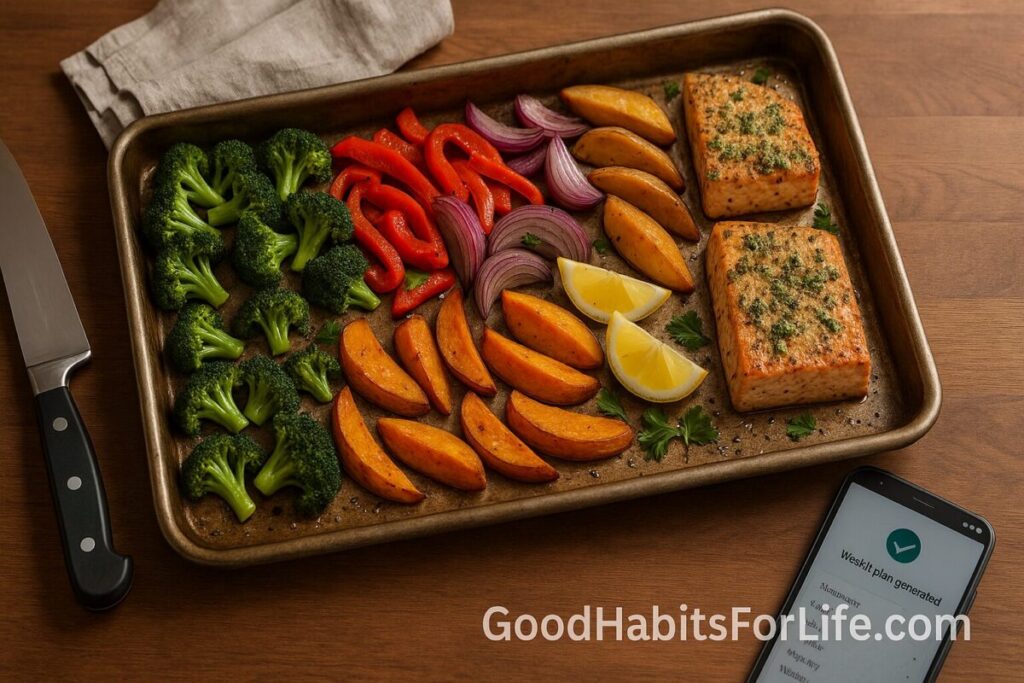
One-pan and sheet-pan dinners are complete meals cooked in a single skillet, Dutch oven, or rimmed baking sheet. They’re ideal for weeknights: fewer dishes, hands-off time, easy batching, and built-in portion control.
Health & planning upside: Following a simple meal-building framework (balanced veg, protein, whole-grain or starchy veg, healthy fats) aligns with reputable healthy-eating models and helps reduce excess sodium and ultra-processed add-ons. Meal planning is linked with better diet quality and weight status in population data, while authoritative bodies recommend plenty of vegetables, whole grains, and appropriate sodium limits (see References).
Why now (2025): AI can remove planning friction—generating your weekly menu, grocery list, swaps for allergies/budgets, and even timing maps so everything finishes together.
✅ Quick Start: Tonight
-
Pick a pan: 1 large rimmed sheet (approx. 46×33 cm/18×13 in) or a 30 cm (12 in) oven-safe skillet.
-
Preheat hot: 220 °C (425 °F). Put the empty sheet in for 5–7 min to preheat for extra crisp veg.
-
Use the 3-2-1 Formula:
-
3 cups mixed vegetables (e.g., broccoli, peppers, onions, green beans).
-
2 portions lean protein (e.g., chicken thighs, firm tofu, salmon, chickpeas).
-
1 portion starch (e.g., potato wedges, sweet potato, cauliflower gnocchi, precooked grains in a foil pouch).
-
-
Season smart: 1 tbsp olive oil + 1 tsp spice blend + ½ tsp salt (adjust to needs). Add acid (lemon/vinegar) after roasting.
-
Stagger timing: Start dense veg/starch, add quick-cook items (fish, cherry tomatoes) later.
-
Roast & finish: Roast 15–30 min, flip once; broil/grill 1–2 min for color.
-
Safety: Use a probe thermometer (see table below). Rest meats; add fresh herbs after cooking.
-
Serve: On the pan with a yogurt-herb or tahini-lemon drizzle. Minimal mess, maximal win.
🛠️ AI Workflows (Prompt Library)
Copy-paste and tweak these. Add your pantry, preferences, budget, portions, and gear.
1) 7-Day Minimal-Mess Menu
“Create a 7-day one-pan/sheet-pan dinner plan for householdsizehousehold size, 30–40 minutes total time, using the 3-2-1 formula. Include 2 vegetarian nights, 1 fish night, and kid-friendly options. Output: table with recipe names, ingredients, oven temps, and estimated cost.”
2) Grocery List + Aisles
“From that plan, generate a consolidated grocery list grouped by aisle (produce, protein, grains, canned, spices). Add metric quantities and a separate ‘use-up leftovers’ mini-list.”
3) Timing Map
“Give minute-by-minute timing for Wednesday’s recipe so everything finishes together in 30 minutes. Include preheating the pan and when to add each ingredient.”
4) Smart Swaps (Dietary/Budget)
“I need gluten-free and dairy-free swaps for Friday’s dish under ₹……/$… per portion. Keep protein ≥25 g and sodium ≤600 mg per serving.”
5) Scale & Batch
“Scale Sunday’s recipe to 8 servings, split across two sheet pans, and add reheating guidance for lunchboxes.”
6) Pantry-First Generator
“Here’s what I have: listlist. Generate 3 one-pan dinners with minimal new items and show the cheapest option.”
7) Nutrition & Safety Check
“Estimate per-portion calories, protein, fiber, and flag any high-sodium items. Remind me of safe internal temperatures and leftover storage times.”
8) Localization
“Convert all measurements to grams and Celsius; list Indian-market equivalents for ingredients and spices.”
🗺️ 30-60-90 Habit Plan
Goal: 2–3 minimal-mess dinners per week, on autopilot.
Days 1–30 (Foundation)
-
Buy kit: 2× half-sheet pans, parchment, wire rack, 30 cm oven-safe skillet, instant-read thermometer.
-
Create a 10-recipe vault using the prompts above (mix 5 omnivore, 3 vegetarian, 2 fish/bean-based).
-
Set a weekly 20-minute “menu slot” (calendar repeat) to generate the week’s plan and list.
-
Run Sunday Prep-30: pre-cube veg, marinate proteins, precook a grain, mix 2 sauces (yogurt-herb; chili-tahini).
Days 31–60 (Consistency)
-
Increase to 3 dinners/week; add a theme wheel (Mediterranean, Indian-inspired, Tex-Mex, East-Asian).
-
Start a results log: time to table, dishes used, family rating, notes on crispness.
-
Build a swap map (chicken ↔ paneer/tofu; potatoes ↔ chickpeas; salmon ↔ mushrooms).
Days 61–90 (Scale & Share)
-
Batch-cook once per fortnight: two sheet pans → 8–10 portions for lunches.
-
Create a guest-ready set (2 elevated pans with herby sauces + citrus finish).
-
Automate checklist in your notes app; archive weekly menus for future reuse.
🍽️ Techniques, Timings & Safety
Crispness rules
-
Preheat the sheet pan.
-
Don’t overcrowd (leave 1–2 cm between pieces).
-
Use convection/fan if available; reduce temp by ~10–15 °C.
-
Pat proteins dry; toss veg in oil properly (about 1 tbsp per sheet).
-
Add watery veg (tomatoes, zucchini) later or in a separate corner.
Roast timing (typical)
-
Dense veg & potatoes: 25–35 min at 200–220 °C (400–425 °F).
-
Chicken thighs (boneless): 20–30 min at 200–220 °C (400–425 °F).
-
Salmon fillets: 10–15 min at 200 °C (400 °F).
-
Firm tofu (pressed): 20–25 min at 200–220 °C (400–425 °F), flip once.
Balanced plate guide (per serving)
-
Veg: 250–300 g; Protein: 100–170 g cooked; Starch/whole grains: 120–180 g cooked.
Safe minimum internal temperatures
Use a thermometer; measure at the thickest part.
| Food | °C | °F |
|---|---|---|
| Poultry (whole/parts) | 74 | 165 |
| Ground meat | 71 | 160 |
| Pork, beef, veal, lamb (whole cuts) | 63 + rest | 145 + rest |
| Fish | 63 | 145 |
| Reheat leftovers | 74 | 165 |
Food safety & storage
-
Cool leftovers quickly; refrigerate within 2 hours (1 hour if >32 °C/90 °F ambient).
-
Store 3–4 days in the fridge; freeze portions for 2–3 months. Reheat to 74 °C (165 °F).
👥 Audience Variations
-
Students: Use one pan, frozen veg, canned beans, spice packets. Cook once → eat twice.
-
Parents: Go mild on heat; finish with a “topping bar” (lemon wedges, grated carrot, yogurt).
-
Professionals: Batch 2 pans Sunday; portion into containers with a sauce cup for the week.
-
Seniors: Softer textures—steam dense veg 3–4 min first; choose fish, legumes, or tender chicken.
-
Vegetarian/Vegan: Tofu, tempeh, seitan, or double-legume (chickpeas + edamame). Add nuts/seeds after roasting.
⚠️ Mistakes & Myths
-
Overcrowding the pan → steaming, not roasting. Split across two sheets.
-
Same-time everything → mismatch. Stagger quick-cook items.
-
No acid at the end → flat flavors. Add lemon/vinegar or pickled onions.
-
Sauce too early → burns. Glaze in last 5 minutes.
-
Myth: “Sheet-pan meals aren’t healthy.” Balanced 3-2-1 builds veg-forward plates aligned with healthy-eating models.
-
Myth: “You must marinate overnight.” A 15-minute toss in a 1-1-1 marinade (oil-acid-aromatics) boosts flavor fast.
💬 Examples, Lists & Scripts
3 ready-to-go dinners (serves 4)
-
Mediterranean Chicken & Veg: 600 g chicken thighs, 800 g mixed peppers/onion/zucchini, 400 g baby potatoes, 2 tbsp olive oil, oregano, garlic, salt. Roast 30 min @ 220 °C; finish with lemon + parsley.
-
Tofu, Broccoli & Sweet Potato: 400 g pressed tofu, 500 g broccoli, 500 g sweet potato wedges. Toss with oil, smoked paprika, cumin. Roast 25–30 min; drizzle tahini-lemon.
-
Salmon, Green Beans & Cherry Tomatoes: 600–700 g salmon, 500 g beans, 300 g tomatoes. Start beans 10 min, add salmon & tomatoes 12–14 min more; finish with capers + dill.
Reusable grocery list (core)
-
Proteins: chicken thighs, salmon/tofu, beans/chickpeas.
-
Veg: broccoli, peppers, onions, green beans, sweet potatoes.
-
Staples: olive oil, lemon, tahini, yogurt, spice blends, garlic, herbs.
-
Extras: parchment, foil, chili flakes, nuts/seeds.
Sunday Prep-30 script
-
Preheat oven; cube potatoes & sweet potatoes; start roasting 15 min.
-
Press tofu; marinate chicken.
-
Chop broccoli/peppers/onions; store separately.
-
Mix two sauces; label.
-
Portion grains; cool & refrigerate.
🧰 Tools, Apps & Resources
Hardware
-
Half-sheet pans (2): Enable spacing; double-up for batches.
-
Parchment or silicone mats: Easy cleanup, less sticking.
-
Wire rack: Elevates protein for airflow/crisp skin.
-
Instant-read thermometer: Accuracy for doneness & safety.
-
12-inch oven-safe skillet/Dutch oven: For one-pan stove-to-oven meals.
Apps/Software (pros/cons)
-
AnyList / Whisk: Clip recipes → auto grocery lists; great for aisle grouping (pro). Learning curve for custom items (con).
-
Notion / Obsidian: Build a recipe vault and weekly board (pro). Manual setup (con).
-
Paprika / Tandoor Recipes: Offline recipe manager with meal plans (pro). Paid or self-hosted (con).
-
ChatGPT & similar: Fast planning, swaps, timing maps (pro). Validate nutrition & safety with trusted sources (con).
🔑 Key Takeaways
-
Minimal-mess dinners thrive on preheat + spacing + staggered timing.
-
The 3-2-1 Formula keeps meals balanced and budget-friendly.
-
AI prompts remove planning friction—menus, lists, swaps, timelines.
-
A simple 30-60-90 plan locks in the habit for the long term.
-
Thermometer + safety basics = confident, juicy results and safe leftovers.
❓ FAQs
1) Can I do sheet-pan dinners without convection?
Yes. Use 220 °C (425 °F), preheat the pan, and avoid overcrowding. Convection just improves browning.
2) Best pan size?
A half-sheet (46×33 cm / 18×13 in) with 2–3 cm sides is versatile for 4 servings. For 1–2 people, a quarter-sheet works.
3) Should I line with foil or parchment?
Parchment or a silicone mat prevents sticking and eases cleanup. Foil is fine for high-sugar glazes; lightly oil it.
4) How do I prevent soggy veg?
Dry veg well, use enough heat, don’t crowd, and add watery veg later. Finish with 1–2 minutes of broil.
5) Glass vs metal?
Metal sheets brown better and heat faster. Glass is fine for casseroles but can run cooler and brown less.
6) How long can leftovers last?
Typically 3–4 days refrigerated; reheat to 74 °C (165 °F). Freeze for 2–3 months.
7) What if I don’t eat meat or fish?
Use tofu/tempeh/seitan or double legumes. Add nuts/seeds after roasting for crunch and healthy fats.
8) Is high-heat roasting unhealthy?
Roasting is compatible with healthy eating patterns. Keep added sodium reasonable and pair with plenty of veg; avoid charring.
📚 References
-
Harvard T.H. Chan School of Public Health — Healthy Eating Plate and guidance on balanced meals: https://www.hsph.harvard.edu/nutritionsource/healthy-eating-plate/
-
FoodSafety.gov (USDA/US HHS) — Safe Minimum Internal Temperatures chart: https://www.foodsafety.gov/food-safety-charts/safe-minimum-cooking-temperature
-
MyPlate (USDA) — Start Simple with MyPlate & vegetables guidance: https://www.myplate.gov/
-
World Health Organization — Healthy diet fact sheet (limits on salt, fat, sugar; fruit & veg guidance): https://www.who.int/news-room/fact-sheets/detail/healthy-diet
-
American Heart Association — How much sodium should I eat per day?: https://www.heart.org/en/healthy-living/healthy-eating/eat-smart/sodium/how-much-sodium-should-i-eat-per-day
-
NHS — Chilling & reheating leftovers safely: https://www.nhs.uk/live-well/eat-well/how-to-store-food-and-leftovers/
-
Ducrot P., et al. (2017). Meal planning is associated with food variety, diet quality and body weight status in a large sample of French adults. Int J Behav Nutr Phys Act. https://ijbnpa.biomedcentral.com/articles/10.1186/s12966-017-0461-7
-
USDA — Kitchen Companion: Your Safe Food Handbook: https://www.fsis.usda.gov/food-safety/safe-food-handling-and-preparation/food-safety-basics/kitchen-companion-your-safe-food
Disclaimer
This article is for general education on cooking and nutrition and is not a substitute for personalized medical or dietary advice.