
Slow Cooker vs Pressure Cooker (2025): Which Fits You?
Slow Cooker vs Pressure Cooker (2025): Which Fits You?
Table of Contents
🧭 What’s the Difference?
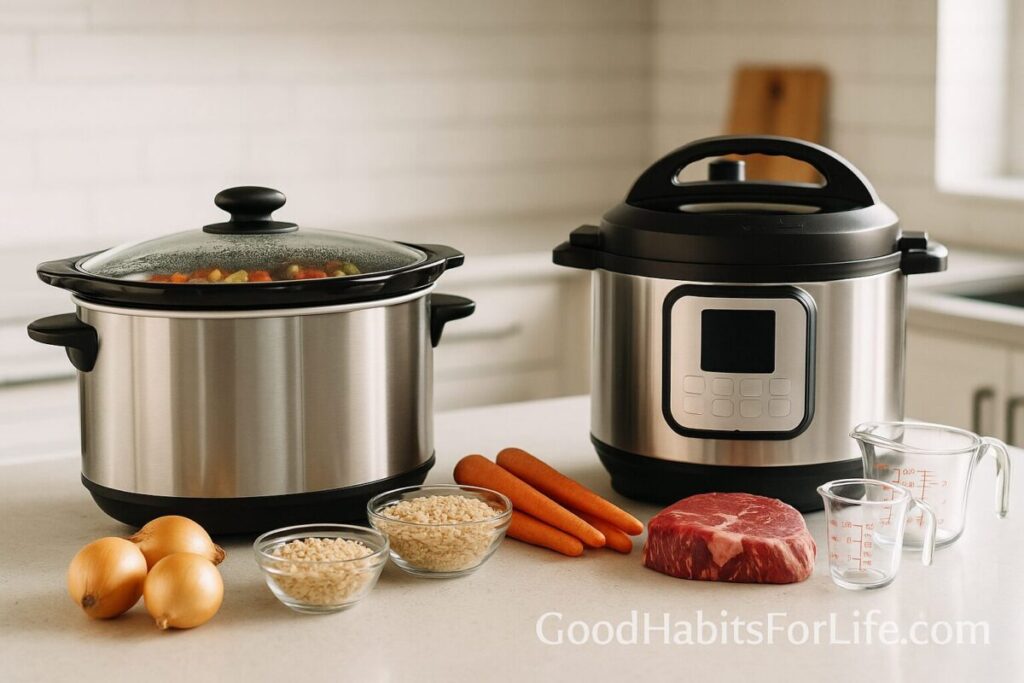
Slow cooker (a.k.a. Crock-Pot): A countertop pot that cooks at low, steady heat over several hours. It shines with braises, soups, shredded meats, and “dump-and-go” recipes. You can walk away for most of the day.
Pressure cooker (stovetop or electric “multi-cooker”): A sealed pot that traps steam and raises the boiling point of water, cooking food at higher temperatures—fast. That’s why dried beans, brown rice, and tough cuts become tender in a fraction of the usual time. (Electric multi-cookers also sauté, steam, yogurt, etc.)
Food safety in one line: For slow cookers, start with thawed meats and keep finished food ≥60 °C (140 °F); for both devices, use a thermometer to verify doneness. USDAFood Safety and Inspection ServiceFoodSafety.gov
✅ Pros & Cons at a Glance
| Factor | Slow Cooker | Pressure Cooker |
|---|---|---|
| Time | Long, hands-off (6–10 h typical) | Short, hands-on upfront (e.g., beans 30–45 min from dry) |
| Texture | Melting, shredded, stewy; thickening often needed at end | Tender with structure; great for legumes, grains, stews |
| Flavor Development | Deep braise-like flavors over time | Intense flavors from sealed environment; browning helps |
| Energy | Low wattage for many hours | Higher wattage for short bursts; often lower total energy than oven/stovetop for many dishes UC Agriculture and Natural ResourcesMECS |
| Batch Cooking | Excellent for big pots & party service | Excellent for rapid batch cycles (beans, rice, stock) |
| Set-and-Forget | Best-in-class; minimal monitoring | Needs attention for pressure build/release |
| Safety Notes | Thaw meats first; keep ≥60 °C (140 °F) when holding USDAFood Safety and Inspection Service | Follow release methods; never force open; adjust for altitude if needed Food Smart Colorado |
| Canning? | No | Do not pressure-can in electric multi-cookers; use a tested pressure canner only. Home Food PreservationPenn State Extension |
| Best For | Soups, shredded beef/pork, curries, potlucks | Beans, chickpeas, whole grains, tough cuts, quick stews |
🛠️ Quick Start: Today/Tonight
If you own a slow cooker (tonight’s plan):
-
Chop onions/carrots; layer veg on the bottom.
-
Add thawed 1 kg beef chuck (or 2–2.5 lb), 1 tsp salt, spices, 400 g tomatoes, 250 ml broth.
-
Cook LOW 8–9 h (or HIGH 4–5 h).
-
Shred meat; switch to WARM and keep ≥60 °C (140 °F). Taste, thicken with a slurry if needed. USDAFood Safety and Inspection Service
If you own a pressure cooker (tonight’s plan):
-
Rinse 500 g dried chickpeas; no soak needed with pressure cooking.
-
Sauté aromatics; add beans + 1.2 L water, 1 tsp salt, spices.
-
Cook 35 min at High Pressure, natural release 15 min.
-
Portion for the week (bowls, salads, curries).
📅 30-60-90 Habit Plan for Busy Homes
Goal: A reliable, low-stress meal rhythm using one primary device (and learning the other later).
Days 1–30 (Starter):
-
Pick your device fit (see quiz below).
-
Cook 3 “core” recipes on repeat (e.g., slow-cooker chili, shredded chicken, lentil curry or pressure-cooker beans, brown rice, beef stew).
-
Build a Freezer 5: freeze 5 two-portion packs for fallback dinners.
-
Track outcomes: time taken, texture, leftovers.
Days 31–60 (Expand):
-
Add one new technique: browning for slow cooker; natural vs quick release for pressure cooker.
-
Batch on Sundays: 2 mains + 1 grain/legume.
-
Start a “Done List” (what worked and why) to sharpen future choices.
Days 61–90 (Mastery):
-
Swap in the other device for variety (e.g., pressure-cooker risotto; slow-cooker pulled jackfruit).
-
Create a rotating 2-week menu with shopping lists.
-
Add a service plan: keep finished dishes ≥60 °C (140 °F) when holding; cool leftovers fast in shallow containers. Food Safety and Inspection Service
🧠 Techniques & Frameworks That Matter
Slow cooker frameworks
-
Layering logic: Dense veg on bottom → meat → liquids on top (prevents scorching, ensures even heating).
-
Moisture math: Lid stays closed; reduce liquids by ~25% vs stovetop. Thicken at the end (slurry, mash beans, reduce on HIGH lid-off 20–30 min).
-
Safety rules: Start with thawed meats; don’t reheat cold leftovers from the fridge in the slow cooker—reheat to 74 °C (165 °F) on stove/oven/microwave, then hold in the cooker if needed. USDAFood Safety and Inspection Service
Pressure cooker frameworks
-
Browning + deglaze: Sauté for Maillard flavor, then scrape fond with liquid to avoid “burn” warnings.
-
Release choice:
-
Natural Release for meats/legumes (gentler finish).
-
Quick Release for veg/pasta (avoid overcooking).
-
-
Altitude adjustments: At high elevations, add time (and sometimes liquid). CSU Extension provides tested guidance for electric pressure cookers. Food Smart Colorado+1
Nutrition note: Shorter cook times and reduced leaching into water can improve vitamin retention vs long boiling; steaming also performs well. PMC
Energy note: Because cooking time is compressed and heat is insulated, electric pressure cookers often use less total energy than oven or open-pot methods for many dishes. UC Agriculture and Natural ResourcesMECS
👥 Who Should Choose What
Students / Singles (budget, tiny kitchens):
-
Choose pressure cooker if you want fast beans, rice, and soups from scratch (cheap + healthy).
-
Choose slow cooker if you prefer all-day set-and-forget with minimal prep; great for shared meals.
Parents & Caregivers:
-
Slow cooker for school-night, ready-when-you-walk-in dinners and party chilis.
-
Pressure cooker for lightning-fast proteins and legumes to portion for lunchboxes.
Busy Professionals:
-
Pressure cooker dominates if evenings are unpredictable. You can still start dinner at 7:30 pm.
-
Slow cooker works when you can assemble in the morning.
Seniors:
-
Slow cooker offers simplicity and low lifting; keep a thermometer handy to confirm safe temps.
-
Electric pressure cooker can be excellent if you appreciate set-and-forget programs and safety interlocks.
⚠️ Mistakes & Myths to Avoid
-
MYTH: “It’s fine to cook frozen meat in a slow cooker.” → No. It can linger in the temperature “danger zone.” Thaw first. USDA
-
MISTAKE: Reheating leftovers from fridge temp in a slow cooker. → Reheat to 74 °C (165 °F) first, then hold. Food Safety and Inspection Service
-
MYTH: “All pressure cookers are the same.” → Stovetop models reach higher pressures than most electrics (faster), but electrics add convenience and controls. Ask IFAS – Powered by EDIS
-
MISTAKE: Using an electric multi-cooker to pressure-can. → Not recommended; use a tested pressure canner. Home Food Preservation
-
MISTAKE: Ignoring altitude. → High elevations require time/liquid adjustments for pressure cooking. Food Smart Colorado
💬 Real-Life Scripts & Examples
1-Minute Fit Quiz (read aloud to yourself):
-
Do I value hands-off more than speed? → Slow cooker.
-
Do I cook beans/grains weekly and want them fast? → Pressure cooker.
-
Do I host potlucks and need to hold food warm safely? → Either; keep ≥60 °C (140 °F). Food Safety and Inspection Service
-
Do I want one device that can sauté + cook + keep-warm? → Electric pressure cooker.
Shopping script (store aisle):
“I’m cooking for [2/4/6] people. I want [speed/set-and-forget]. My top recipes are [beans, shredded chicken, soups]. Show me [6 L/8 L] models with [programmable timer/saute].”
Batching example (Sunday 2-hour block):
-
Pressure cooker: pot of chickpeas (35 min), then brown rice (22 min), then beef stew (40 min).
-
Slow cooker (runs while you’re out): chili (8 h LOW) + baked potatoes in oven last 1 h.
🧰 Tools, Apps & Resources
-
Food thermometer (instant-read) — non-negotiable for safety and consistency.
-
Meal-planning apps: Paprika, AnyList, Whisk (clip recipes, scale servings).
-
Pressure-cooking timing charts: Your model’s manual + university extension guides for altitude adjustments. Food Smart Colorado
-
Food safety basics: Danger zone chart, safe internal temps. Food Safety and Inspection ServiceFoodSafety.gov
📌 Key Takeaways
-
Pick slow cooker for all-day convenience and big-batch comfort foods; pick pressure cooker for speed and legumes/grains.
-
Confirm doneness and holding temps every time; thaw before slow cooking. USDA
-
Expect good nutrition from both; shorter, sealed cooks can help retain vitamins. PMC
-
Electric pressure cookers can reduce total energy vs oven/stovetop for many meals. UC Agriculture and Natural ResourcesMECS
-
You cannot pressure-can safely in electric multi-cookers—use a tested pressure canner. Home Food Preservation
❓ FAQs
1) Is a slow cooker safe to leave on all day?
Yes—when used correctly, slow cookers cook at temperatures designed to keep food safe. Start with thawed ingredients, avoid overfilling, and verify doneness with a thermometer. University of Minnesota ExtensionUSDA
2) Can I reheat leftovers in a slow cooker?
Not from fridge-cold. Reheat to 74 °C (165 °F) on the stove/oven/microwave first, then hold on WARM or LOW. Food Safety and Inspection Service
3) Are pressure cookers safe?
Modern units have multiple safety interlocks. Follow the manual, ensure enough liquid, and use appropriate pressure-release methods. (At altitude, add time.) Food Smart Colorado
4) Which keeps more nutrients—slow cooker or pressure cooker?
Both can be nutritious. Evidence shows long boiling loses more vitamin C; shorter, sealed pressure cooking or steaming tends to retain more. PMC
5) Can I cook frozen meat in a slow cooker?
No—frozen meat can stay too long in the 4–60 °C (40–140 °F) danger zone. Thaw first. USDA
6) What size should I buy?
For 1–2 people: ~3–5 L; for families and batch cooking: 6–8 L. If you meal-prep, err larger.
7) Can an Instant Pot replace a slow cooker?
Electric multi-cookers can simulate slow cooking, though heat distribution differs by model. Many households still keep a dedicated slow cooker for all-day pots.
8) What about canning in an electric pressure cooker?
Don’t. Use a tested pressure canner and extension-tested processes. Home Food PreservationPenn State Extension
9) How do I hold food safely for parties?
Keep hot foods ≥60 °C (140 °F). Slow cookers work well as warmers; verify temp with a thermometer. Food Safety and Inspection Service
10) I live at high altitude—what should I change?
Increase pressure-cooking time (and sometimes liquid). Follow CSU Extension’s tested guidance for electric pressure cookers. Food Smart Colorado
📚 References
-
USDA FSIS. Slow Cookers and Food Safety. https://www.fsis.usda.gov/food-safety/safe-food-handling-and-preparation/food-safety-basics/slow-cookers-and-food-safety Food Safety and Inspection Service
-
USDA. Four Important Slow Cooker Food Safety Tips. https://www.usda.gov/about-usda/news/blog/cook-slow-save-time-four-important-slow-cooker-food-safety-tips USDA
-
USDA FSIS. “Danger Zone” (40 °F–140 °F). https://www.fsis.usda.gov/food-safety/safe-food-handling-and-preparation/food-safety-basics/danger-zone-40f-140f Food Safety and Inspection Service
-
FoodSafety.gov. Warm Up with a Safely Slow-Cooked Meal. (safe temperatures & thermometer use). https://www.foodsafety.gov/blog/warm-safely-slow-cooked-meal FoodSafety.gov
-
National Center for Home Food Preservation (UGA). Canning in Electric Multi-Cookers (Not Recommended). https://nchfp.uga.edu/newsflash/canning-in-electric-multi-cookers Home Food Preservation
-
Penn State Extension. Pressure Canner Updates (why pressure cookers aren’t canners). https://extension.psu.edu/pressure-canner-updates/ Penn State Extension
-
Colorado State University Extension. Adjusting for Elevation When Preparing Foods in an Electric Pressure Cooker. https://foodsmartcolorado.colostate.edu/adjusting-for-elevation-when-preparing-foods-in-an-electric-pressure-cooker/ (PDF guidance: https://foodsmartcolorado.colostate.edu/wp-content/uploads/2020/12/Adjusting-For-Elevation-When-Preparing-Foods-in-an-Electric-Pressure-Cooker.pdf) Food Smart Colorado+1
-
University of Minnesota Extension. Slow cookers and food safety. https://extension.umn.edu/preserving-and-preparing/slow-cookers University of Minnesota Extension
-
Lee S et al. Effect of different cooking methods on the content of vitamins… Preventive Nutrition and Food Science (2017). https://pmc.ncbi.nlm.nih.gov/articles/PMC6049644/ PMC
-
Güzel D et al. Effect of cooking methods on selected physicochemical properties of beans. J Food Sci Technol (2011). https://pmc.ncbi.nlm.nih.gov/articles/PMC3550881/ PMC
-
UC ANR (Univ. of California). It’s electric?! Breaking down electric pressure cookers. https://ucanr.edu/blog/food-blog/article/its-electric-breaking-down-electric-pressure-cookers UC Agriculture and Natural Resources
-
MECS (Modern Energy Cooking Services). Comparing energy consumption and costs across cooking methods. (2023 report). https://mecs.org.uk/wp-content/uploads/2023/03/Comparing-energy-consumption-and-costs-from-cooking-across-the-MECS-programme.pdf MECS