
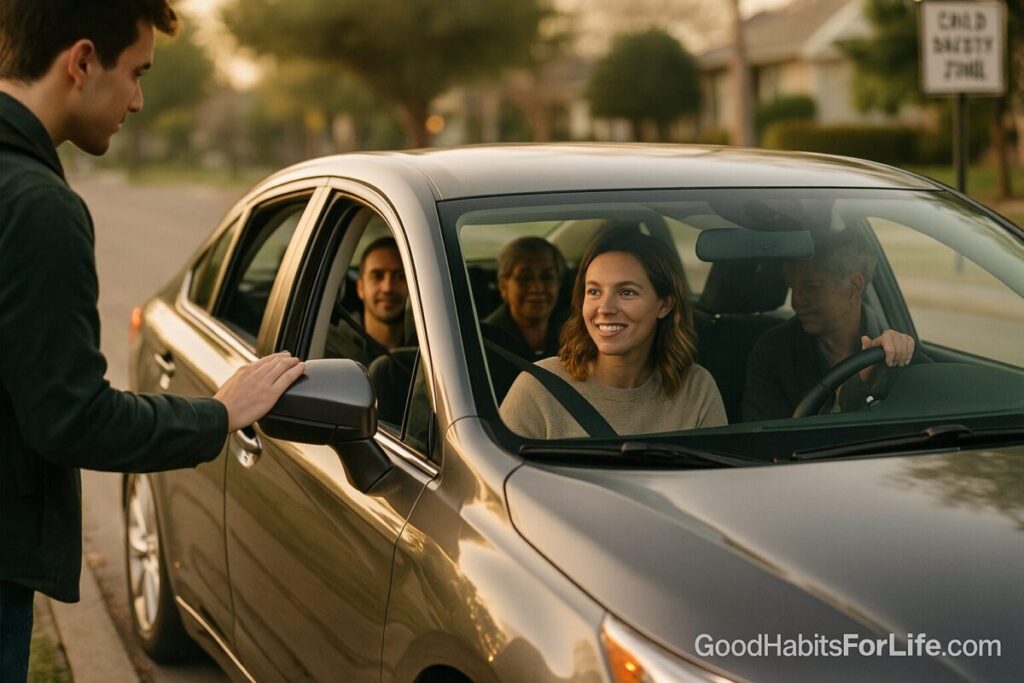
Carpools & Courtesy: Be a Driver People Trust
Carpools & Courtesy: Be a Driver People Trust
Table of Contents
🧭 What & Why: Carpool Etiquette = Everyday Trust
Carpool etiquette is the shared set of norms that keep rides predictable, safe, and friendly. It’s less about rigid rules and more about consistent habits: punctuality, clear communication, defensive driving, and transparent cost-sharing. These habits matter because:
-
Safety first. Calm, defensive driving reduces crash risk and stress for everyone in the vehicle.
-
Time reliability. Predictable pick-ups and drop-offs reduce anxiety and lateness downstream (school, work, appointments).
-
Fairness. Clear agreements on fuel/tolls/parking prevent resentment.
-
Greener trips. Fewer single-occupancy vehicles mean lower emissions and less congestion.
-
Better relationships. Courtesy and respect turn carpools into micro-communities people look forward to.
Definition: Carpool etiquette = safety + clarity + fairness + kindness, repeated every ride.
✅ Quick Start: The 10-Minute Setup
You can launch a trustworthy carpool today. Use this quick checklist:
-
Create a one-page Carpool Charter.
-
Days/routes
-
Pickup windows (e.g., 07:45–07:55)
-
Waiting policy (e.g., grace 3 min; then leave)
-
Cost split method (per km, per trip, or fixed weekly)
-
Music/climate defaults & seat rotation
-
No-food/scents policy; seat belts required
-
Backup plan if the driver is sick
-
-
Share contact rules.
-
Primary WhatsApp/Signal group
-
“On my way” and “Running late” message templates
-
Emergency contact for each rider
-
-
Decide payments now.
-
Weekly settle-up via UPI/PayPal/Revolut
-
Shared sheet auto-totalling fuel, tolls, parking
-
-
Safety baseline.
-
Everyone buckled before moving
-
Phone in Do Not Disturb; navigation audio only
-
No speeding; follow local laws strictly
-
-
Pilot one week.
-
Keep notes. After week 1, review what to tweak.
-
🛠️ Habit Plan: 7-Day Rollout (and 30-60-90 Upgrade)
7-Day Starter Plan
Day 1 (Set-up): Draft and circulate the Carpool Charter; collect addresses and preferred pickup points.
Day 2 (Route & timing): Do a dry run. Confirm windows and buffers.
Day 3 (Costs): Choose split method (see table below). Start a shared ledger.
Day 4 (Safety & comfort): Agree on phone policy, music volume, climate defaults.
Day 5 (Etiquette drills): Practice clear boarding order, seat rotation, and door safety (look for cyclists!).
Day 6 (Contingencies): List backups (alt driver, ride-hail, public transit). Set “late fee” or “skip” rules if needed.
Day 7 (Review): 15-min call: what worked, what to change, confirm the monthly cadence.
Common cost-split options
| Method | How it works | Best for | Pros | Cons |
|---|---|---|---|---|
| Even split | Total weekly cost ÷ number of riders | Stable groups | Simple, quick | May feel unfair if routes differ |
| Per-km share | Odometer/app logs km; cost per km | Mixed distances | Precise | Needs tracking |
| Per-trip | Each ride has a set price | Occasional riders | Flexible, fair to drop-ins | More admin |
| Driver-rotates | Each person drives a day | All licensed drivers | Zero money handling | Not possible for non-drivers |
30-60-90 Upgrade
-
Day 30: Add automation—calendar invites, payment reminders, monthly audit of costs vs. reality.
-
Day 60: Formalize rotations (seats, playlist, pick-up order); add a “carpool retro”—quarterly 15-minute feedback ritual.
-
Day 90: Level-up safety (first-aid kit, tyre pressure checks, dash-mounted phone holder, winter/rain prep). Create a welcome note for any new rider.
🧠 Techniques & Frameworks that Keep Rides Smooth
1) “Safety > Preference” rule.
If a choice affects safety, it wins—no debate (e.g., speed, seat belts, phone use).
2) The 3-Minute Window.
Pickup windows reduce waiting resentment. After 3 minutes, you may leave—no hard feelings. Late passenger catches up by other means.
3) The Two-Text Protocol.
-
T-10 min: “Leaving in 10.”
-
T-2 min: “Here.”
If silent at T+3, the car may go.
4) Door-Zone Awareness.
Park safely; check mirrors; open doors with the Dutch Reach (use far hand) to reduce cyclist conflicts.
5) The Calm-Cab Playbook.
Quiet starts; gentle acceleration; wider following distances; anticipate lights; no honking unless essential. This lowers stress and fuel use.
6) The “One Annoyance” Feedback Rule.
Bring up small issues early using the script: “Can we try X from tomorrow? It helps me with Y.”
7) Transparent Money.
Shared sheet with date, from-to, km, fuel price, tolls, parking, per-person total; settle every Friday.
👥 Audience Variations
Students:
-
Use campus ride boards.
-
Add exam-week exceptions.
-
No eating hot food; bags on laps during peak loads.
Parents (school runs):
-
Child seats fitted correctly; hand-off protocol at gate.
-
“Sickness rule”: fever/cough? Skip.
-
Swap driver if toddlers disrupt attention.
Professionals:
-
Calendar holds and recurring invites.
-
“Silent start” for early mornings; coffee stop only if everyone agrees.
Seniors:
-
Extra time buffers; easiest access seat reserved.
-
Remind about meds/motion comfort; keep cabin at moderate temperature.
Teens (with supervision):
-
Parent consent + clear rules on seat belts, music volume, and no phone use.
-
Adults drive until legal age; no peer pressure to rush.
⚠️ Mistakes & Myths to Avoid
-
Myth: “If I’m a great driver, I can multitask.”
Reality: Hands-free still distracts. Navigation audio only; no texting. -
Mistake: Letting lateness slide “just this once.”
Fix: Apply the 3-minute window every time; kindness + consistency. -
Myth: “The driver pays more because it’s their car.”
Reality: Agree costs upfront. If the driver bears maintenance, balance with fair splits. -
Mistake: No backup plan.
Fix: Always have an alternate driver or ride-hail/public transit fallback. -
Myth: “Carpool rules kill spontaneity.”
Reality: Light structure creates freedom—fewer last-minute negotiations.
💬 Real-Life Scripts (Copy-Paste)
Setting expectations (kickoff):
“Hey team—same route Mon–Fri, pickup window 07:45–07:55. If you’re not ready by 07:58, we’ll go so we’re not late. Costs split weekly via the sheet. Sound good?”
Running late (passenger):
“So sorry—2 minutes behind. If I miss you, I’ll meet you at [stop]. Don’t wait.”
Music/climate preference:
“Mind if we keep music low until the highway? Helps me ease into the day.”
Cost nudge (Friday):
“Quick tally is ₹480 total—₹120 each. Sending the request now. Thanks!”
Chronic lateness (kind but firm):
“I value riding together, and we’ve left late three times this week. Let’s stick to the 3-minute window, or we should pause your spot next week. What would help?”
Safety boundary (driver):
“I can’t drive over the limit or check messages. If something is urgent, I’ll pull over safely.”
Adding a new rider:
“Welcome! Here’s our 1-page Charter—times, route, and costs. Read now and ask anything; we’ll do a 1-week trial.”
🧰 Tools, Apps & Resources (Pros/Cons)
-
Group chat (WhatsApp/Signal/Telegram)
Pros: Everyone sees updates; voice notes for quick changes. Cons: Chats get noisy—pin key messages. -
Shared Sheet (Google Sheets/Excel online)
Pros: Transparent costs and turns; simple audit. Cons: Someone must maintain formulas. -
Calendar Invites (Google/Outlook)
Pros: Auto reminders; route notes in description. Cons: People may ignore notifications. -
Navigation with Live Traffic (Google Maps/Apple Maps)
Pros: Real-time rerouting; ETA sharing. Cons: Over-reliance can distract—mount phone securely. -
Expense Splitters (Splitwise/Tricount)
Pros: Auto balances over time; multiple currencies. Cons: Another app for the group to install. -
Checklists (Notion/Trello/Notes)
Pros: Track rotation, parking permits, toll tags. Cons: Light admin needed weekly.
(Choose the simplest combo that your group will actually use.)
📚 Key Takeaways
-
Trust = safety + punctuality + clear money.
-
Write it down. A 1-page Charter prevents 90% of friction.
-
Consistency beats intensity. The 3-minute window and two-text protocol keep things on time.
-
Speak up early, kindly. Small feedback prevents bigger conflicts.
-
Review monthly. Ten minutes keeps the system fair and friendly.
❓ FAQs
1) What’s a reasonable wait time if someone is late?
2–3 minutes. After that, it’s fair to leave to keep everyone else on time. Agree this in the Charter.
2) How should we split costs fairly?
Pick a method that matches your pattern: even split for stable groups; per-km or per-trip for varied routes; or rotate drivers.
3) Is it okay to eat in the car?
Only if everyone agrees and it doesn’t distract or leave odors/mess. Many carpools choose water/closed drinks only.
4) What about music and phone calls?
Default to low volume. Phone calls only if essential—and only hands-free. The driver shouldn’t handle the phone while moving.
5) How do we handle fuel price swings?
Set a standard cost per km for the month based on recent receipts; adjust monthly.
6) Can kids ride in carpools safely?
Yes—with age-appropriate restraints, correct installation, and school-gate hand-off rules. Follow local child-seat laws.
7) What if a rider repeatedly cancels last minute?
Apply a “three strikes” or temporary pause. Consider a nominal late-cancel fee if the group agrees.
8) Do we need special insurance?
Personal auto policies usually cover carpooling without profit (check your policy). If money is changing hands beyond cost-sharing, verify coverage with your insurer.
9) How do we add a new member without drama?
Share the Charter, run a one-week trial, and decide as a group after the review call.
10) What’s the safest seating plan?
Everyone buckled; heavier items in the boot (trunk), not laps. Children in age-appropriate seats.
References
-
World Health Organization. Road traffic injuries – Key facts. https://www.who.int/news-room/fact-sheets/detail/road-traffic-injuries
-
National Highway Traffic Safety Administration (NHTSA). Drowsy Driving. https://www.nhtsa.gov/risky-driving/drowsy-driving
-
NHTSA. Aggressive Driving. https://www.nhtsa.gov/risky-driving/aggressive-driving
-
National Safety Council. Defensive Driving Tips. https://www.nsc.org/community-safety/safety-topics/driver-safety
-
U.S. Environmental Protection Agency. Commuter Benefits: Carpooling and Vanpooling. https://www.epa.gov/greenvehicles/what-you-can-do-car
-
Federal Highway Administration. High-Occupancy Vehicle (HOV) Facilities—Benefits and Considerations. https://ops.fhwa.dot.gov/freewaymgmt/hov.htm
-
AAA Foundation for Traffic Safety. Traffic Safety Culture Index. https://aaafoundation.org
-
Centers for Disease Control and Prevention. Child Passenger Safety. https://www.cdc.gov/transportationsafety/child_passenger_safety
-
UK Highway Code (Department for Transport). Rules for Drivers. https://www.gov.uk/guidance/the-highway-code
Disclaimer
This guide is for general information only; always follow local traffic laws and your vehicle/insurance requirements.