
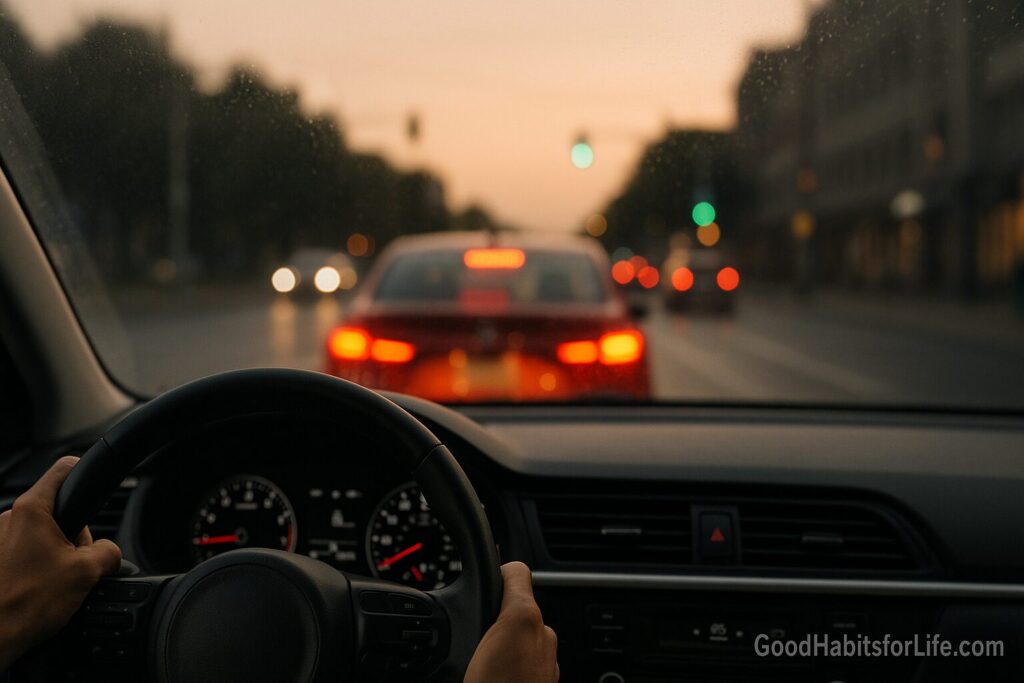
Learning from NearMisses: A Simple Debrief
Near-Miss Driving Debrief: Learn Fast, Stay Safer
Table of Contents
🧠 What is a Near Miss & Why Debriefing Works
Near miss (driving): a situation where a crash almost happened—e.g., hard braking, swerving, horn use, or a sudden stop—but no collision or injury occurred.
Why debrief?
-
It converts an emotional moment into specific, repeatable safety behaviors.
-
Reflection after action improves future performance in high-risk fields (aviation, healthcare, emergency response). A simple debrief helps you spot patterns like speed creep, tailgating, distraction, or poor scanning.
-
Courtesy rises too: you anticipate others’ mistakes and drive defensively rather than reactively.
Goal: Identify one cause and one behavior change you’ll make on your very next trip.
✅ Quick Start: 2-Minute Debrief (Right After the Close Call)
Do this as soon as you’re parked safely.
-
Name it (10s): “Near miss at [location], [time].”
-
What I saw (20s): Facts only. “Vehicle ahead braked; I was 1–2 seconds behind at ~50 km/h (31 mph).”
-
Why it happened (30s): Pick the top cause (e.g., short following gap, hidden junction, distraction).
-
My safety rule (30s): One clear rule: “Keep 3-second gap; 4+ seconds in rain.”
-
Next-time plan (30s): “Lift off earlier when sightlines shrink; cover brake near crossings.”
Record one line in a notes app or paper log. The act of writing makes it stick.
🛠️ The Simple Debrief Checklist (Copy-Paste)
Paste this into Notes and reuse.
-
When/where? (time, road type, weather, traffic)
-
What exactly happened? (facts, sequence)
-
My state: alert / rushed / distracted / tired
-
Distance & speed: following gap (s), approximate speed (km/h & mph)
-
Primary cause I control: gap / speed / scanning / distraction / positioning / signalling / anticipation
-
One rule I will adopt now: e.g., “3-second rule, 4–6 in wet/night”
-
Trigger → Action pair: e.g., “If cresting a hill → ease off throttle and cover brake”
-
Measure: what will prove change? (e.g., “say ‘one-thousand-one…’ for gap”)
-
Next review date: (weekly)
Cue → Action table (examples):
| Cue (Trigger) | Safer Action | Why it Helps |
|---|---|---|
| Visibility drops (curve, hill, parked vans) | Ease off early, increase gap | Buys braking time; reveals hidden hazards |
| Pedestrians/cyclists nearby | Cover brake, scan mirrors | Reduces reaction time |
| Junctions/driveways | Glance left-right-left, hover foot | Anticipates sudden entries |
| Wet/night/traffic | Add 1–3 seconds to gap | Longer stopping distance |
🧭 7-Day Habit Plan (Lock the Learning)
Day 1 (today): Do the 2-minute debrief; decide one rule (e.g., 3-second gap).
Day 2: Drive a familiar route; deliberately count your gap for 10 random cars.
Day 3: Practice early easing: lift off the throttle when sightlines shrink.
Day 4: Scanning drill: every 5–8 seconds, mirrors + far road + near road.
Day 5: Context upgrade: apply your rule at night or in rain (if safe).
Day 6: Courtesy check: signal earlier, leave merge space, avoid blocking.
Day 7 (review): Re-read your log. What improved? What still feels tight? Update your rule if needed.
Keep going: Repeat weekly reviews for a month; add one new rule only when the previous one feels automatic.
📚 Techniques & Frameworks That Work
-
3-Second Rule (+ weather buffer): Maintain at least 3 s gap in dry conditions; add time (4–6 s) in rain, fog, or darkness.
-
AAR (After-Action Review):
-
What was supposed to happen? 2) What actually happened? 3) Why the difference? 4) What will we sustain/change?
-
-
Kolb’s Learning Cycle: Concrete experience → Reflective observation → Abstract rule → Active testing on the next drive.
-
“If-Then” Implementation Intentions: “If I lose sight over a hill, then I lift off and add gap.”
-
Cover-Brake Technique: Foot ready over the brake in high-risk zones (crosswalks, car parks, busy high streets).
-
Hazard Perception Routine (SCAN): Signs → Crossings → Approaches → Next move. Say it out loud early on to build the habit.
👥 Audience Variations
Students/New Drivers: Keep a written log for your first 20 near misses; review with an instructor/experienced adult. Short city hops are great practice.
Parents with Kids Onboard: Build a calm narration: “I’m easing off because the van blocks our view.” It teaches patience and models safe habits.
Professional/Delivery Drivers: Add a start-of-shift brief (route, weather, parking hot spots) and a 2-minute post-shift debrief.
Seniors: Prioritize daylight routes, larger gaps, and avoiding left turns across traffic where possible. Book periodic vision/hearing checks.
Cyclists/Motorcyclists: Use lane positioning to be seen; debrief visibility and escape routes after any close pass.
⚠️ Mistakes & Myths to Avoid
-
Myth: “No crash = nothing to learn.” → Reality: near misses are the cheapest lessons you’ll ever get.
-
Mistake: Blaming others only. → You can’t control them; you can control gap, speed, scanning, positioning.
-
Mistake: Vague takeaways. → Replace “be careful” with one clear rule and a trigger.
-
Myth: “I’ll remember later.” → You won’t. Log it while the details are fresh.
-
Mistake: Adding five new rules at once. → Stack habits one at a time.
💬 Real-Life Examples & Scripts
-
Tailgating wake-up: “I was 1–2 s behind at 70 km/h (43 mph). Rule: never under 3 s; count it out. Trigger: if I can’t see tyre contact ahead → widen gap.”
-
Hidden driveway swerve: “Van blocked view, car nosed out. Rule: off-throttle + cover brake when sightlines shrink.”
-
Phone buzz temptation: “Buzz pulled eyes off road. Rule: Do-Not-Disturb while driving; phone in glovebox.”
-
Wet night brake-check: “ABS kicked in. Rule: 5-second gap in rain + earlier braking.”
Polite self-talk template:
“What happened? What’s my one change? What will prove it?”
With a co-driver:
“Quick debrief: I cut the gap on that downhill. Next time I’m lifting earlier—please nudge me if you see it.”
🛠️ Tools, Apps & Resources
-
Phone settings: Do Not Disturb While Driving / Focus modes; auto-reply to texts.
-
Dashcams: Useful for reviewing distance, positioning, and blind-spot moments.
-
Notes apps: Apple Notes, Google Keep, Notion—pin your checklist.
-
Telematics/usage-based insurance apps: Some provide feedback on harsh braking, cornering, and phone handling.
-
Timers/Widgets: Add a weekly reminder named “Near-Miss Review.”
Pros: immediate feedback and memory aids. Cons: gadgets can distract—set up before you drive.
🔑 Key Takeaways
-
A near miss is a free lesson—capture it with a 2-minute debrief.
-
Choose one controllable cause and one clear rule to change.
-
Use 3-second+ gaps, early easing, and scanning as default safety habits.
-
Log it, review weekly, and add new rules only when the last one sticks.
-
Courtesy and calm anticipation reduce risk for everyone around you.
❓ FAQs
1) What counts as a near miss in driving?
Any close call that required sudden braking or evasive action, or would have crashed if timing were slightly worse.
2) How soon should I debrief a near miss?
As soon as you’re safely parked—ideally within minutes—while the memory is vivid.
3) Is the 3-second rule enough?
In good conditions, yes for light vehicles. Add time (4–6+ s) in rain, fog, night driving, or when following large vehicles.
4) How do I measure a 3-second gap?
Choose a roadside marker. When the vehicle ahead passes it, say “one-thousand-one, one-thousand-two, one-thousand-three.” You should pass the marker after three seconds.
5) I was not at fault—should I still debrief?
Yes. You can’t control others, but you can anticipate and buffer their errors (visibility, gap, speed, positioning).
6) Do dashcams actually help?
They can. Reviewing footage makes patterns clear—like creeping speed or late scanning—provided you don’t watch while driving.
7) How do I keep emotions from taking over after a scare?
Breathe slowly, pull over, and use the checklist. Facts first, feelings second, rule last.
8) Should I report near misses?
Some jurisdictions encourage reporting hazardous locations; fleets often require internal reporting. Check local guidance.
9) Can this reduce insurance costs?
Safer habits (fewer harsh events, clean record) can influence premiums in some programs. Results vary by insurer and region.
10) How do I teach teens this habit?
Model it: debrief aloud after your own close calls and keep a shared driving log for the first months.
References
-
World Health Organization — Road traffic injuries (fact sheet): https://www.who.int/news-room/fact-sheets/detail/road-traffic-injuries
-
UK Government — The Highway Code (stopping distances & following distances): https://www.gov.uk/guidance/the-highway-code
-
NHTSA — Road Safety Topics (distraction, speeding, seat belts, impaired driving): https://www.nhtsa.gov/road-safety
-
AAA Foundation for Traffic Safety — Research & Resources (driver behavior, distraction, drowsiness): https://aaafoundation.org/
-
RoSPA — Defensive Driving & Near-Miss Reporting (road safety guidance): https://www.rospa.com/road-safety/advice/drivers/ and https://www.rospa.com/health-safety/knowledge/accident-investigation/near-miss-reporting
-
AHRQ PSNet — Safety Briefings and Debriefings (learning from incidents): https://psnet.ahrq.gov/primer/safety-briefings-and-debriefings
-
NASA ASRS — Aviation Safety Reporting System (near-miss learning culture, de-identified reports): https://asrs.arc.nasa.gov/