
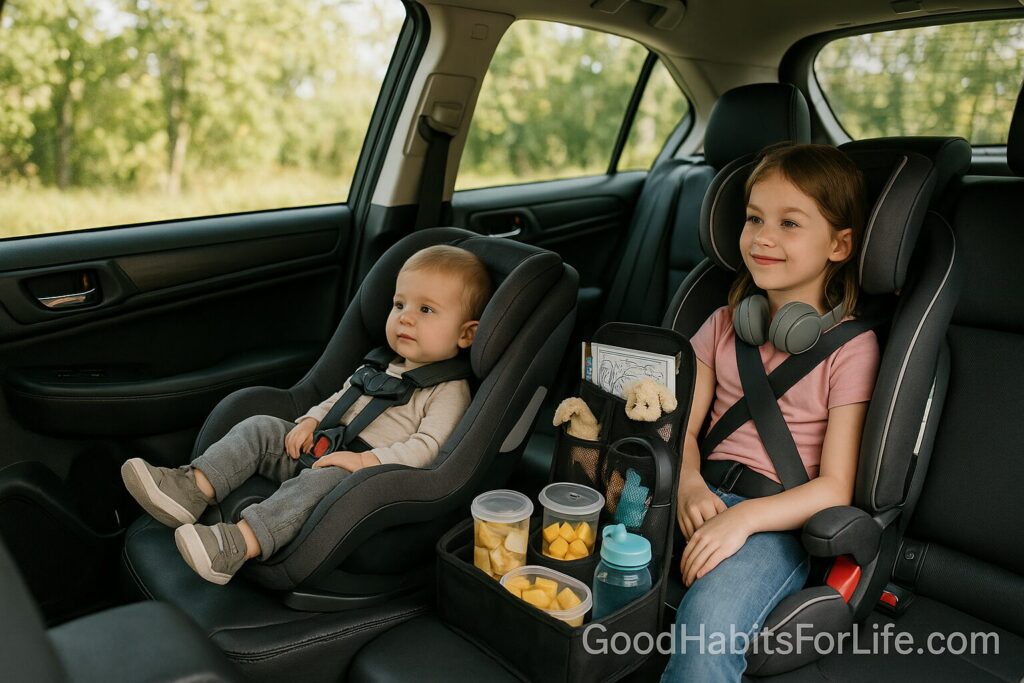
Kids on Board: Seats, Snacks, and Sanity
Kids on Board: Seats, Snacks, and Sanity
Table of Contents
🧭 What “Kids on Board” Really Means & Why It Matters
Family car travel is easier—and far safer—when you design the ride around three pillars: seats, snacks, and sanity.
-
Seats: Correct car-seat choice, installation, and fit slash injury risk in a crash. Rear-facing as long as possible, harnessed forward-facing next, then boosters until the adult seat belt fits correctly. Kids under 13 ride in the back seat.
-
Snacks: Fuel their energy and mood, but choose textures that reduce choking risk and pack for food safety.
-
Sanity: Predictable routines (break rhythm, activity rotation, calm-down plan) keep the cabin cooperative—and the driver focused.
These are not just conveniences; they’re tied to child passenger safety, choking prevention, and driver attention. The sections below turn guidelines from pediatric and transport authorities into a practical road-ready plan.
✅ Quick Start: Do-This-Today Checklist
-
Seat check (10 min): Confirm the right stage (rear-facing/forward/booster), tight install (≤2.5 cm/1 in movement at the belt path), and chest clip at armpit level. Remove bulky coats; use thin layers + blanket over straps.
-
Back-seat rule: All children under 13 ride in the back.
-
Front-seat kit (grab-and-go pouch): Wipes, tissues, sanitizer, small trash bags, zip bags, sick bags, spare t-shirt/leggings/underwear, basic meds (per your pediatrician), and a microfiber towel.
-
Snack box + cooler: Pre-portioned snacks (see “Snack Strategy”), water bottles, ice packs. Follow the 2-hour rule for perishables outside refrigeration.
-
Activity rotation: Prep 3–5 small “packs” (quiet toys, sticker book, fidget, audiobook playlist, tablet with offline downloads, headphones).
-
Break rhythm: Plan micro-stops every 90–120 minutes; schedule one 45–60-minute lunch/play stop.
-
Motion-sickness plan: Cool airflow, horizon view, light snacks, ginger biscuits or approved meds (check with your clinician), sick bags within reach.
-
Emergency & ID: Paper card with parent phone numbers, allergies/conditions, and child’s initials clipped to seat back. Keep first-aid kit in the car.
-
“Never leave them” habit: Put your phone/handbag or left shoe in the back seat so you always open the rear door when you park.
🛡️ Car-Seat Setup & Safety (By Age & Stage)
Rear-Facing (infants/toddlers):
-
Use rear-facing as long as possible within the seat’s height/weight limits. It protects the head, neck, and spine.
-
Harness snug (“pinch test”: you can’t pinch slack at the collarbone). Chest clip at armpit level.
-
Angle per seat indicator; add only manufacturer-approved inserts. No aftermarket pillows.
Forward-Facing with Harness (preschool/early primary):
-
Switch only when the child outgrows rear-facing limits.
-
Top tether attached and tight (reduces head movement).
-
Harness snug; retighten each trip.
Belt-Positioning Booster (primary years):
-
Use until the adult belt fits properly: lap belt low across hips/thighs, shoulder belt across chest/collarbone—not neck or arm.
-
Best practice often keeps kids in boosters until 145 cm (4 ft 9 in), but go by fit.
Adult Seat Belt (pre-teens/teens):
-
Belt fit check: back against seat, knees bend at edge, feet on floor, lap/shoulder belts positioned correctly.
-
Under 13? Still in the back seat.
Install & Use Essentials
-
Choose one install method: ISOFIX/LATCH or seat belt, not both (unless your manual explicitly allows).
-
The seat should not move more than 2.5 cm (1 in) side-to-side/fore-aft at the belt path.
-
Check expiration date and crash history; avoid unknown used seats.
-
Remove puffy jackets in winter; harnesses must sit close to the body.
-
Get a free or low-cost car-seat check from certified technicians in your area.
🍎 Snack Strategy: Safe, Simple, and Spill-Light
Principles
-
Choking-aware: Offer soft, small, easy-to-swallow textures. Avoid high-risk foods while the car is moving for toddlers.
-
Steady energy: Mix complex carbs, protein, and fruit/veg.
-
Food safety: Keep perishables cold; mind the 2-hour room-temperature limit.
Smart Picks (age-appropriate & bite-sized)
-
Soft fruit slices (peeled apple wedges, ripe pear, banana halves), seedless cucumber sticks, cheese sticks, yogurt pouches, mini sandwiches, cooked pasta spirals, mini idlis, chapati rolls with paneer/egg, oat bars broken into small pieces, roasted chickpeas for older kids, plain crackers.
-
Drinks: Water by default. Milk or diluted juice for some kids; minimize sticky, high-sugar drinks.
Avoid in-motion for young kids (choking risks)
-
Whole grapes (halve/quarter by age), nuts, popcorn, hard candies, marshmallows, large chunks of raw veg, hot dogs (unless cut lengthwise then into tiny pieces).
Packing Tips
-
Pre-portion into small containers; label by child/time.
-
One small snack every 60–90 minutes beats constant grazing.
-
Stash wipes, a crumb brush, and a small trash can within reach.
🧠 Sanity Savers: Routines, Games & Calm-Down Tools
The Calm-Car Formula
-
Predictable rotation (45–60-minute loops): snack → quiet activity → audiobook/music → rest/look outside.
-
Timer + choice: “When the timer dings, pick your next pack—stickers or puzzle?”
-
Screen rules: Headphones, brightness low, download offline, and a time cap. Screens are a tool, not the whole plan.
-
Movement stops: At each stop, do 2–3 minutes of “car yoga”: toe touches, shoulder rolls, star jumps (if safe area).
-
De-escalation: Name the feeling, validate, offer a choice. See scripts below.
Zero-cost game ideas
-
“I Spy” with colors/shapes, license-plate bingo, alphabet hunt on signs, storytelling relay, “Would You Rather,” road-trip scavenger list.
Audiobook & music
-
Rotate age-appropriate audiobooks; download via public-library apps (e.g., Libby) or your preferred platform. Create a calming playlist for nap windows.
🗺️ Route & Stop Strategy (Break Rhythm + Sample Day Plan)
Break Rhythm
-
Micro-break every 90–120 minutes: 10–15 minutes to stretch, toilet, fresh air, snack, bin the trash.
-
One longer stop (45–60 minutes) around midday near a park/playground.
-
Aim to finish driving before evening meltdown zones when possible.
Sample 6-Hour Driving Day
| Time | What happens |
|---|---|
| 08:30 | Depart (fresh snacks + audiobook) |
| 10:00 | Micro-break: toilet, stretch, light fruit & water |
| 11:45 | Long stop: picnic + playground (45–60 min) |
| 13:00 | Back on road: quiet activity or nap |
| 14:30 | Micro-break: walk, toilet, reset cabin |
| 15:30 | Arrive / hotel check-in |
Navigation Notes
-
Save offline maps; check live traffic.
-
Avoid routes with prolonged winding roads if your child gets motion-sick; carry sick bags and towels just in case.
👶 Age-Specific Tips (Infants → Teens)
Infants (0–12 months)
-
Prioritize rear-facing with correct recline.
-
Feed and burp before departure; plan more frequent stops.
-
White noise or soft lullabies can help. Never prop bottles.
Toddlers (1–3 years)
-
Rear-facing as long as possible.
-
Shorter activity cycles; simple fidgets, window clings, board books.
-
Snacks: soft, pre-cut pieces; avoid crunchy hazards while moving.
Preschoolers (3–5 years)
-
Harnessed forward-facing until they max out the seat.
-
Involve them in choosing two activities and one snack per loop.
School-Age (6–12 years)
-
Booster until adult belt fits perfectly.
-
Give them a small responsibility (trip journal, map reader, “hydration captain”).
Teens (13+)
-
Back-seat rule lifts at 13 (check local laws); still safer in back on long trips.
-
Encourage them to co-pilot: playlists, P-A announcements for younger siblings, watch for drowsy-driver signs.
⚠️ Mistakes & Myths to Avoid
-
“It’s fine to turn forward early.” Rear-facing longer offers better head/neck protection—follow seat limits.
-
“Big coats are okay under harnesses.” Bulky layers add dangerous slack; use thin layers + blanket over straps.
-
“Any used car seat is fine if it looks good.” Unknown crash history/expired seats are unsafe.
-
“Snacks keep them quiet; any food works.” Some foods are choking hazards in motion.
-
“It’s okay to leave a child for two minutes in a parked car.” Temperatures rise fast even on mild days—don’t do it.
-
“Front seat is fine for tall kids under 13.” Back seat is safer until at least age 13.
💬 Real-Life Scripts & Examples
Calm-down (toddler):
“You’re sad that we have to buckle. I get it. We buckle to stay safe. Do you want the blue sticker book or the animal cards while I click your chest clip?”
Boundary (snacks):
“Snack time is when the timer dings. You can choose apple sticks or crackers then.”
Motion-sick check-in (school-age):
“If your tummy feels wobbly, look at the far trees, sip water, and tell me. We’ll stop for fresh air.”
Sibling fairness:
“Timer says it’s switch time—15 minutes each. After the audiobook, we’ll play ‘I Spy.’”
Arrival routine:
“First, unpack trash and food, then choose a game for 10 minutes. Hydration check!”
🧰 Tools, Apps & Resources
-
Car-seat checkers: Certified inspection stations (search by postcode).
-
Maps: Offline maps, lane guidance, and rerouting (your preferred app).
-
Audiobooks: Library apps (e.g., Libby), or other platforms; download before departure.
-
Timers: Simple phone timer or kid-friendly visual timers.
-
First-aid: Stock age-appropriate meds (as advised by your clinician), plasters, antiseptic wipes, thermometer.
-
Cabin organizers: Back-seat organizers with clear pockets; small bin liners; seat-back protectors.
Pros/cons quick take:
-
Offline entertainment is reliable and battery-light; streaming can fail with poor reception.
-
Paper books are great for many kids; kids prone to motion sickness may do better with audiobooks.
📅 7-Day Prep Plan (Before Your Trip)
Day 7: Check car-seat stage/fit; clean car; locate manuals.
Day 6: Map route; choose playground lunch stop; download offline maps.
Day 5: Build activity packs; test headphones; charge power banks.
Day 4: Buy snacks/ice packs; label containers; freeze water bottles.
Day 3: Assemble front-seat kit + first-aid; print emergency card.
Day 2: Pack clothes in “one cube per kid”; pre-load audiobooks.
Day 1 (evening): Install/retighten seats; load cooler; set break timers.
📌 Key Takeaways
-
The safest ride uses the right seat, correctly installed and used every time.
-
Choking-aware snacks and food-safety rules keep kids healthy on the go.
-
A repeatable rhythm (breaks, activities, de-escalation) makes the drive calmer for everyone.
-
Plan stops, prep kits, and involve kids with choices to boost cooperation.
-
Never leave a child in a parked car—ever.
❓ FAQs
1) When should I switch from rear- to forward-facing?
When your child reaches the maximum height or weight allowed by your rear-facing seat. Many children can rear-face beyond age 2—follow your manual and pediatric guidance.
2) How do I know my car seat is tight enough?
At the belt path, the seat shouldn’t move more than 2.5 cm (1 in) side-to-side or front-to-back.
3) What snacks are safest for toddlers in the car?
Soft, bite-size foods like banana pieces, soft cheese, cooked pasta shapes. Avoid whole grapes, nuts, popcorn, hard candies, and large raw-veg chunks while the car is moving.
4) My child gets carsick—what helps?
Cool airflow, horizon view, frequent fresh-air breaks, light snacks, and audiobooks (instead of reading/screens). Ask your clinician about medications if needed.
5) Is it safe for a 10-year-old to ride in front?
Authorities recommend the back seat for all kids under 13.
6) Can my child wear a winter coat in the car seat?
Avoid bulky coats under the harness; use thin layers and place a blanket over the straps after buckling.
7) How long can yogurt or sandwiches stay out of the cooler?
Follow the 2-hour rule for perishables at room temperature; keep them in a cooler with ice packs on long trips.
8) Do car seats expire?
Yes. Check the label or manual for the expiration date; plastics and safety standards change over time.
9) How often should we stop on a long drive with kids?
Plan a 10–15-minute micro-break every 90–120 minutes, plus one longer stop.
10) Where can I get my installation checked?
Look up certified car-seat technicians/inspection stations near you; many communities offer free checks.
📚 References
-
American Academy of Pediatrics (AAP). Car Seats: Information for Families. https://www.healthychildren.org/English/safety-prevention/on-the-go/Pages/Car-Safety-Seats-Information-for-Families.aspx
-
AAP. Winter Car Seat Safety Tips. https://www.healthychildren.org/English/safety-prevention/on-the-go/Pages/Winter-Car-Seat-Safety-Tips.aspx
-
U.S. National Highway Traffic Safety Administration (NHTSA). Car Seats and Booster Seats. https://www.nhtsa.gov/equipment/car-seats-and-booster-seats
-
NHTSA. Prevent Heatstroke: Look Before You Lock. https://www.nhtsa.gov/heatstroke
-
Centers for Disease Control and Prevention (CDC). Child Passenger Safety. https://www.cdc.gov/transportationsafety/child_passenger_safety/index.html
-
AAP. Choking Prevention. https://www.healthychildren.org/English/health-issues/injuries-emergencies/Pages/Choking-Prevention.aspx
-
NHS. Motion Sickness. https://www.nhs.uk/conditions/motion-sickness/
-
USDA FSIS. The “Danger Zone” and the 2-Hour/4-Hour Rule. https://www.fsis.usda.gov/food-safety/safe-food-handling-and-preparation/food-safety-basics/danger-zone-2-hours-4-hours
-
NHTSA. Car Seat Inspections (Find a Technician). https://www.nhtsa.gov/equipment/car-seats-and-booster-seats#installation-help-inspection
⚖️ Disclaimer
This guide is educational and does not replace personalized medical or safety advice from your clinician or local regulations.