
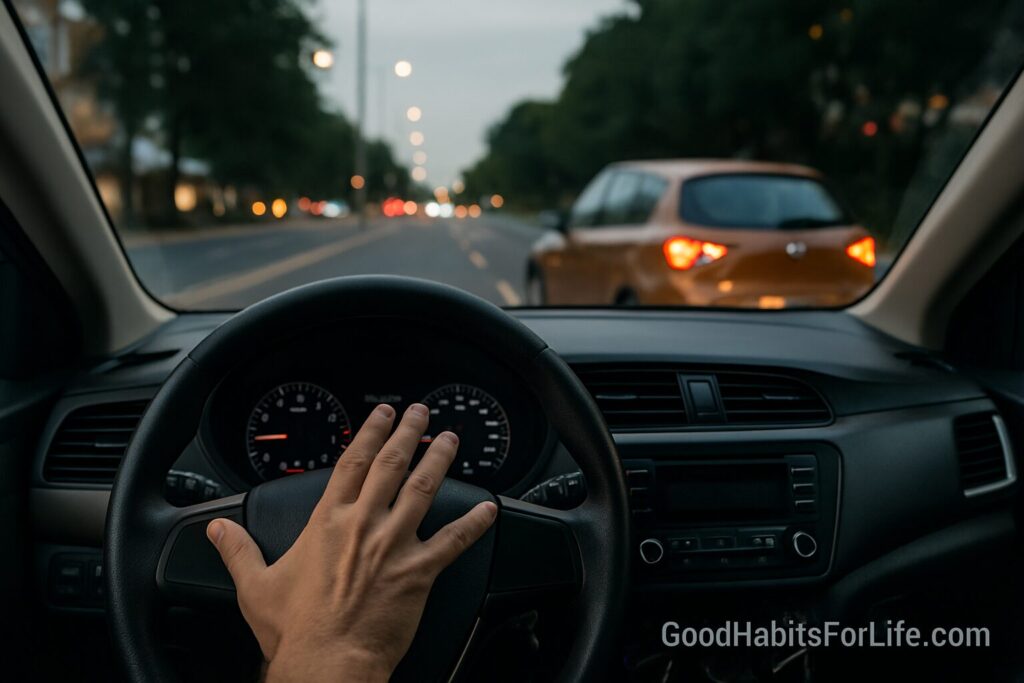
Honking Etiquette: When It Helps, When It Hurts
Honking Etiquette: When It Helps—and When It Hurts
Table of Contents
🧭 What “honking etiquette” means & why it matters
Honking etiquette is the set of safety-first norms for using your horn only when it helps prevent a collision or alert others to immediate risk. It’s not for scolding, stress relief, or “moving traffic along.”
Why it matters
-
Safety: A brief audible warning can prevent side-swipes, unsafe merges, or backing collisions.
-
Health & community: Chronic traffic noise is linked with sleep disturbance and cardiovascular risks; global public-health bodies recommend lowering environmental noise exposure.
-
Law & liability: Many jurisdictions explicitly restrict unnecessary horn use and night honking. Misuse can earn a ticket—and escalate conflict.
✅ The rules at a glance (global patterns + law notes)
While specifics vary by country/state, these patterns are common:
-
Use only as a warning of immediate danger. Examples: a driver drifting into your lane, a car backing out without seeing you, an oncoming vehicle in your lane on a blind curve.
-
Avoid honking when stationary or in slow traffic unless there’s a clear hazard.
-
Respect time-of-day limits. Some places restrict horn use late at night in built-up areas.
-
Obey posted “No Honking/Silence” zones (often near hospitals, schools, courts, places of worship).
-
Light taps > long blasts. Short, polite beeps communicate without provoking or startling.
-
Follow signage. In some mountain or rural regions you may see “Sound Horn” on blind curves; where posted, a gentle tap is appropriate.
-
Know your local code. The safest default: warn, don’t reprimand.
Law notes (illustrative examples):
• UK: The Highway Code advises using the horn only while moving to warn of danger; not in built-up areas between late night and early morning except in an emergency.
• U.S.: State codes commonly require horns be used when reasonably necessary for safety (e.g., to alert of imminent hazard).
• India: Unnecessary honking is prohibited; “Silence Zones” restrict horn use within a set radius of sensitive locations; multi-tone/pressure horns are typically illegal.
• Canada (provincial handbooks): Use the horn sparingly to prevent a collision; it is not a tool for expressing frustration.
(Check the References for official sources and always confirm the rules where you drive.)
🛠️ Quick start: safer signals before the horn
When you feel the urge to honk, run this quick sequence first:
-
Lift-off & cover brake. Create space; speed reduction is a universal de-escalator.
-
Positioning. Adjust lane position to be more visible (don’t lurk in blind spots).
-
Communicate visually.
-
Indicators for intention
-
Gentle brake lights to cue following drivers
-
Headlight flash (where legal) to increase conspicuity
-
-
Gentle tap if needed. One quick “beep-beep” to warn, then stop.
-
Never hold the horn to punish; it’s loud, startling, and often illegal.
🧠 7-Day Honking-Less Habit Plan
Goal: Use your horn only to prevent immediate danger.
Daily baseline: Log (a) situation, (b) action taken, (c) whether a honk was necessary.
Day 1 – Awareness pass
-
Count how many times you want to honk vs. actually do.
-
Add a small sticky on the wheel hub: “Warn, don’t vent.”
Day 2 – Space as strategy
-
Practice 3-second following distance (4+ in rain/night).
-
Rehearse mirror-signal-positioning for lane changes; reduce blind-spot surprises.
Day 3 – Visual cues first
-
Use indicators early (at least 30–50 m before turns at city speeds).
-
Try a headlight flash (if legal) instead of a horn when you’re unsure you’ve been seen.
Day 4 – The polite tap
-
Practice the light double-tap (≤0.3 s) in a parking lot with no one around so it’s second nature in real scenarios.
Day 5 – Trigger mapping
-
Identify your top three honk triggers (e.g., late green, merging scooters, backing cars).
-
Prepare one script for each (see scripts below).
Day 6 – Quiet-zone discipline
-
Pick a route that passes a hospital/school. Commit to zero honks there—use speed and space only.
Day 7 – Review & refine
-
Tally your week. Aim for: fewer urges, more calm responses, and only safety-critical taps.
-
Set a monthly reminder to re-check the habit.
🧩 Techniques & frameworks that work
The S.A.F.E. Framework (use this in every potential honk moment)
-
Space first: increase following distance.
-
Alert visually: indicators, brake lights, eye contact at low speed, headlight flash (where legal).
-
Feathered tap: a short, friendly beep only if risk persists.
-
Exit escalation: disengage; don’t escalate with repeated honking or gestures.
Two-second pause rule
Before honking at a green light, count “one-and-two.” Many drivers are simply finishing a shoulder check. Most will move within this window—no honk needed.
Blind-curve etiquette
If signage says “Sound Horn” on mountain roads, do a brief, measured tap well before the curve apex to alert unseen traffic—then proceed slowly, ready to stop.
Weather & noise
Rain, fog, and busy streets amplify startle risk. Favor visual cues and speed reduction over sound in these conditions.
👥 Variations for different drivers
Parents (with kids on board)
-
Make it a game: “Can we reach home with zero unnecessary honks?”
-
Teach kids: horns are for safety, not anger. Model calm responses.
Professional drivers & delivery partners
-
Build route buffers to avoid schedule-pressure honking.
-
Use a standard tap protocol company-wide; never “lean” on the horn at customer addresses.
Students & new drivers
-
Practice “S.A.F.E.” in quiet neighborhoods.
-
Record 10 common urban scenarios and your chosen response. Confidence kills the impulse to honk.
Seniors
-
Consider larger following gaps and daylight routes to reduce surprise events where honking feels necessary.
⚠️ Mistakes & myths to avoid
-
Myth: “Honking gets traffic moving faster.”
Reality: It often increases stress and aggression without improving flow. -
Mistake: Long blasts to “teach a lesson.”
Fix: A brief tap or no honk + more space. -
Mistake: Honking at pedestrians or cyclists who already have right-of-way.
Fix: Slow down, pass only with ample space, and avoid startling vulnerable users. -
Mistake: Using musical/pressure/air horns on public roads (often illegal).
-
Mistake: Night honking in residential areas; many places restrict this.
-
Mistake: Treating “No Honking/Silence” signs as optional—penalties apply.
💬 Real-life examples & copy-paste scripts
Scenario 1: Adjacent car drifts into your lane at 50 km/h.
-
Do: Brake slightly, move right within your lane, tap-tap, and hold space.
-
Don’t: Lean on the horn or accelerate to “assert” position.
Scenario 2: Driver ahead doesn’t move for 2 seconds at green.
-
Do: Wait two seconds → quick tap.
-
Script (self-talk): “Prompt, not punish.”
Scenario 3: Car backing out of a driveway with limited visibility.
-
Do: Stop, allow space, light tap if the driver hasn’t seen you, then wave “thanks.”
Scenario 4: Hospital zone with a double-parked vehicle.
-
Do: Wait, signal, change lanes slowly. No honk unless there’s a collision risk.
Scenario 5: Mountain hairpin with ‘Sound Horn’ sign.
-
Do: Brief tap before the bend; keep speed low and stay right.
🧰 Tools, apps & resources
-
Decibel meter apps (e.g., Decibel X, NIOSH Sound Level Meter on iOS): understand how loud a horn really is; use sparingly in public.
-
Dashcams (with G-sensor): encourage defensive driving and de-escalation, not retaliation.
-
Phone automation (Shortcuts/IFTTT): send “On my way” messages so pickups don’t rely on honks.
-
Calm-driver routines: 4-7-8 breathing at red lights; soft music; no caffeine surges right before driving.
Pros/cons:
-
Decibel apps help awareness (pro) but shouldn’t distract (con).
-
Dashcams aid accountability (pro) but never justify confrontation (con).
📌 Key Takeaways
-
Purpose: Horns are for preventing collisions, not venting.
-
Practice: Use S.A.F.E.—Space, Alert visually, Feathered tap, Exit escalation.
-
Politeness: Prefer short taps; avoid honking in queues, at pedestrians, or in quiet hours.
-
Law: Always check your local code; respect Silence/No Honking zones.
-
Habit: Track triggers for a week and rehearse scripts.
❓ FAQs
1) Is it ever okay to honk at a green light?
Yes—after a brief wait (about two seconds), a short tap can help if the driver ahead is distracted. Avoid long blasts.
2) Can I honk to greet a friend?
Best not in traffic or residential areas; it’s usually considered unnecessary noise and may be illegal at night.
3) What about honking at animals on the road?
Slow down, give space. A gentle tap may help alert larger animals or herders, but avoid startling skittish animals at close range.
4) Are “musical” or pressure/air horns legal?
Often not for regular road use. Many jurisdictions prohibit multi-tone or excessively loud aftermarket horns.
5) Should I honk when overtaking on highways?
No. Use mirrors, indicators, and safe gaps. In some rural/mountain roads with signage, a light tap before a blind curve is acceptable.
6) Is flashing headlights a legal alternative?
In some places, yes; in others it has specific meanings. Use sparingly and check local guidance.
7) Can the police fine me for unnecessary honking?
Yes, in many regions—especially in Silence/No-Honking zones or during restricted hours.
8) What if someone honks aggressively at me?
Stay calm, maintain speed/space, avoid eye contact or gestures, and let them pass. Do not respond with your horn.
9) Is honking safer than braking?
No. Speed reduction and space are your primary safety tools; the horn is supplementary.
10) Does horn noise affect health?
Chronic exposure to traffic noise is linked with sleep disturbance and cardiovascular impacts; reducing unnecessary honking helps community health.
📚 References
-
UK Government — The Highway Code, Rule 112 (Use of horn). https://www.gov.uk/guidance/the-highway-code/rules-for-driving
-
California Vehicle Code §27001 — Horns; use when reasonably necessary for safety. https://leginfo.legislature.ca.gov
-
Government of Ontario — Official MTO Driver’s Handbook: Signalling and using your horn. https://www.ontario.ca/document/official-mto-drivers-handbook
-
Central Pollution Control Board (India) — Noise Pollution (Regulation and Control) Rules, 2000; Silence Zones. https://cpcb.nic.in/ (see Noise Pollution resources)
-
WHO — Environmental Noise Guidelines for the European Region (2018). https://www.who.int/publications
-
CDC/NIOSH — Noise and Hearing Loss Prevention. https://www.cdc.gov/niosh/topics/noise/
-
AAA Foundation for Traffic Safety — Aggressive Driving/Road Rage (safety guidance). https://aaafoundation.org
-
NHTSA — Avoid Aggressive Driving & Road Rage. https://www.nhtsa.gov/road-safety
-
UNECE Regulation No. 28 — Audible Warning Devices. https://unece.org/transport/standards
-
Transport Canada (and provincial handbooks) — Safe and Responsible Driving (horn guidance). https://tc.canada.ca/en/road-transportation
Disclaimer
This article provides general information, not legal advice—always follow the traffic laws and posted signs in your jurisdiction.