
3Day MicroTrips: Long Weekends with Real Rest: AI workflows (2025)
3-Day Microtrips: Real Rest with AI Workflows (2025)
Table of Contents
🧭 What Are 3-Day Microtrips—and Why They Work
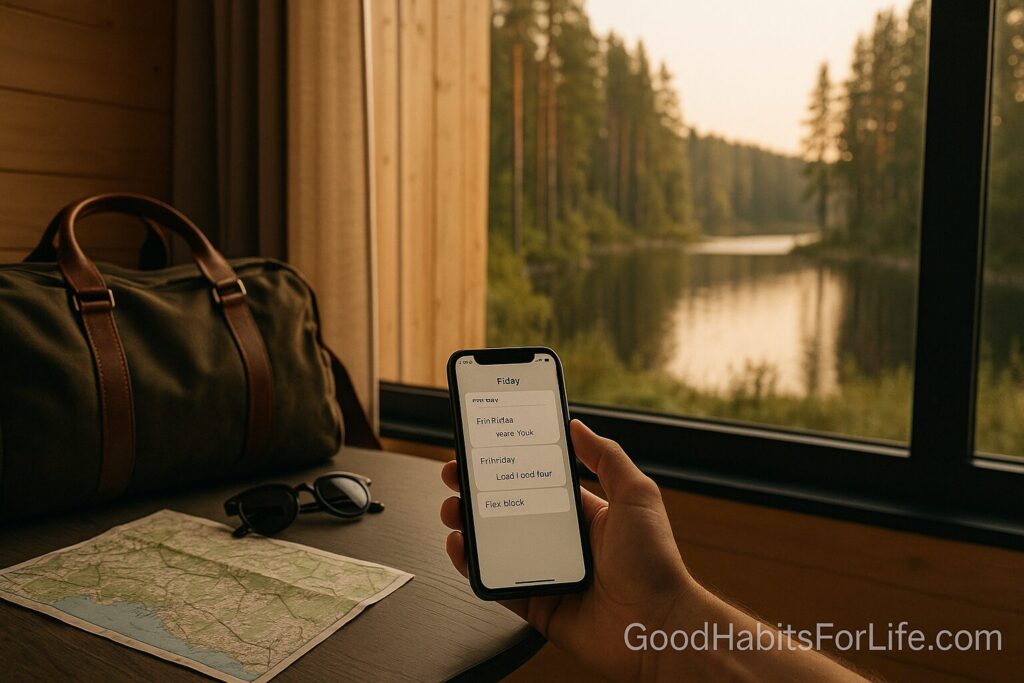
Definition. A microtrip is a 3-day, door-to-door getaway (typically Fri–Sun or Sat–Mon) optimized for psychological recovery and light adventure. Think one home base, two planned anchors (e.g., a nature walk + a food experience), and one flex block for spontaneity.
Why it works. Research on vacations and recovery shows that short, well-designed breaks reliably improve mood, energy, and life satisfaction, especially when they support detachment from work, relaxation, and autonomy. Benefits often come from anticipation and planning as much as from the trip itself, and while effects can fade, regular mini-breaks keep the curve lifted across the year.
Best for 2025 realities. With hybrid schedules, volatile airfares, and calendar debt, long weekends give you rest on repeat without burning PTO or budget.
✅ The “Real Rest” Rulebook
Use these design constraints to make weekends feel like a week off.
-
≤ 3–4 hours door-to-door. Count commute + waits. If you can’t arrive by early afternoon, pick closer.
-
One hub. No hotel-hopping. Book a single base near food + morning coffee.
-
Two anchors, one flex. Pre-plan two highlights (AM and PM), leave ~4–6 hours unstructured.
-
Low cognitive load. Prebook, pre-download, and pre-pack. Fewer decisions = more recovery.
-
Recovery before novelty. Sleep, sunlight, movement, and meals first; sights second.
-
Budget caps. Set a weekend cap (e.g., ₹20k / $250 excluding travel) to remove money stress.
⚡ Quick Start: Your Next Long Weekend in 90 Minutes
Timebox: 3 × 30-minute sprints.
Sprint 1 – Pick & sanity-check (30 min)
-
Choose 2–3 destinations within 3–4 hours door-to-door.
-
Check weather, events, and seasonality.
-
Soft-lock the winner; save the runners-up for future weekends.
Sprint 2 – Itinerary scaffold (30 min)
-
Day 1 (Arrival): Check-in → light walk → early dinner → early sleep.
-
Day 2 (Anchor Day): Morning nature/movement → mid-day chill → evening food/arts.
-
Day 3 (Ease-out): Slow morning → brunch → short cultural stop → train/flight home.
-
Book only the anchors and dining slots that can sell out.
Sprint 3 – Logistics & packing (30 min)
-
Book transport + stay.
-
Create shared note with address, codes, offline maps, tickets.
-
Pack the 3-12-36 kit (below) and set Do Not Disturb windows.
🤖 AI Workflows (2025): From Idea → Itinerary → Done
Use these modular prompts and automations to cut planning from hours to minutes. (Swap in your favorite tools.)
1) Destination shortlisting (10 min)
-
Prompt: “Suggest 3 destinations within 3–4 hours door-to-door from [city] for a Fri–Sun microtrip with low crowding, good coffee, morning nature, and one standout local dining option. Return: travel time, typical cost range, 2 anchors, one rainy-day backup.”
-
Action: Paste into your AI assistant. Save outputs to a shared note/spreadsheet.
2) Weather-aware itinerary (10 min)
-
Prompt: “Draft a 3-day plan with two anchors and one flex block/day for [destination, dates], optimizing for morning sunlight, 8-hour sleep, and minimal commuting. Include addresses, walk times, and offline-friendly notes.”
-
Action: Export to your notes app; mark bookable items.
3) Booking optimizer (10–15 min)
-
Prompt: “Compare 3 stays within 12-minute walk of [neighborhood or landmark] with: quiet rooms, early check-in potential, breakfast nearby, and late checkout option. Summarize pros/cons + total cost.”
-
Action: Book the winner; paste codes & contacts into your trip note.
4) Packing list generator (5 min)
-
Prompt: “Generate a 36-item minimalist packing list for a 3-day [season/climate] trip with one upscale dinner and one outdoor activity. Group by carry-on, personal item, and ‘just in case’ pouch.”
-
Action: Save as a reusable checklist.
5) Budget & split (5–10 min)
-
Prompt: “Estimate total costs (transport, stay, food, activities) for [destination, 2 travelers] with a cap of ₹X / $Y. Add a running tally table I can update on phone.”
-
Action: Paste into your notes sheet; track as you go.
6) Post-trip journal (5 min)
-
Prompt: “Summarize highlights, stressors, and keep/drop ideas from this microtrip using the DRAMMA lens. Output: 6 bullets + next-trip tweak list.”
-
Action: Store in your Microtrip Vault for compounding improvements.
🗓️ The 30-60-90 Habit Plan (Make It Quarterly)
Goal: Institutionalize four restorative weekends per year, planned with near-zero friction.
Day 0–30 (Design & first trip)
-
Build your Microtrip Vault (folder with templates + past trips).
-
Pre-write your AI prompts (above) and save a destination bench of 6 ideas.
-
Run your first microtrip in the next 30 days.
Day 31–60 (Automate & upgrade)
-
Create 3 automations:
-
Quarterly calendar hold (Fri–Sun block).
-
30-day pre-trip reminder with prompts attached.
-
Packing checklist auto-send 48 hours pre-departure.
-
-
Add two niche anchors (e.g., sunrise hike, pottery class) that you love.
Day 61–90 (Scale & share)
-
Nominate a trip captain per quarter (rotates in friend/family group).
-
Build a one-screen dashboard in your notes app: upcoming block, destination options, budget tracker.
-
Codify your 3-12-36 kit:
3 templates
-
Weekend itinerary (one hub, two anchors, one flex)
-
Packing checklist (36 items)
-
Budget sheet
12 automations
-
Quarterly holds, reminders, packing alert, weather check, booking confirmations, offline maps, DND schedule, sunrise/sunset lookup, jet-lag note, grocery restock after return, photo album nudge, post-trip DRAMMA journal.
36 packing items (carry-on + personal)
-
Clothes (8), hygiene (7), tech (6), meds/first-aid (5), docs/money (5), micro-comforts like earplugs/eye mask/water bottle (5).
🧠 Techniques & Frameworks that Boost Recovery
-
DRAMMA lens (Detachment, Relaxation, Autonomy, Mastery, Meaning, Affiliation): design each day to hit at least four of the six.
-
Two-anchor rule: One nature/movement anchor + one social/culinary/arts anchor.
-
Arrival decompression: 20–30-minute unpacked walk + light stretching—resets travel stress.
-
Sleep-first itinerary: Back-solve bedtime/wake times; protect 8 hours on Night 1.
-
Anticipation boost: Read one short piece or watch a mini-video about your destination the week before—anticipatory joy matters.
-
Implementation intentions: “If it rains Saturday afternoon, then we do [indoor anchor].”
-
Digital detachment: Pre-write your OOO; hide work apps; set DND windows.
🎯 Variations by Audience
Students: Budget trains/buses, hostels/private rooms, free walking tours, park picnics, sunrise photo walk.
Parents with young kids: Choose stays with kitchenettes + laundry; anchors = early park, nap window, early dinner; pack a quiet bag.
Professionals: Friday half-day departure; book stays with strong Wi-Fi (just in case) but work apps silenced.
Seniors: Elevators, ground-floor dining, flatter walks; schedule shorter outings with more rest blocks.
Teens: Hands-on anchors (kayak lesson, street-food crawl), give choice autonomy for one flex block.
⚠️ Mistakes & Myths to Avoid
-
Myth: “More sights = more value.” → Reality: Over-scheduling kills recovery.
-
Mistake: Two hubs in 3 days. → Fix: One base, less transit.
-
Mistake: Booking late dinners Night 1. → Fix: Early sleep wins the weekend.
-
Myth: “Short trips don’t help.” → Reality: Effects can be short-lived, but regular microtrips keep the needle up.
-
Mistake: No weather backup. → Fix: Pre-plan a rain plan per day.
💬 Real-Life Examples & Copy-Paste Scripts
Example A: Hills & Coffee (Fri–Sun)
-
Fri: Train 13:00 → check-in 16:00 → 30-min stroll → early thali dinner → sleep.
-
Sat (Anchors): Sunrise walk (90 min) → brunch café → nap/read → pottery class (2 hrs) → local bistro.
-
Sun: Slow breakfast → small museum → 14:30 train home.
Example B: Coastal Ease (Sat–Mon)
-
Sat: Early flight → beachfront check-in → toes-in-sand → seafood shack.
-
Sun (Anchors): E-bike coastal path → afternoon hammock time → sunset tapas.
-
Mon: Lighthouse stop → bakery box → noon flight.
Copy-paste: OOO message
I’m on a short microtrip and offline until [date/time]. If it’s urgent, call [backup person]. Otherwise I’ll reply after I return—thanks!
Copy-paste: Group text to align energy
Two anchors (Sat AM hike, Sun PM food crawl). Everything else is flex. Sleep blocks protected. If rain: pottery class at 3 pm.
🧰 Tools, Apps & Resources (Pros & Cons)
-
Notes/Docs (Notion, Apple Notes, Google Docs)
-
Pros: Free, shareable, offline. Cons: Easy to over-document—stick to one page.
-
-
Maps & Transit (Google Maps, Citymapper, Rome2Rio)
-
Pros: Reliable routes & ETAs. Cons: Offline prep required in patchy areas.
-
-
Stay & Dining (Booking, Airbnb, Resy/OpenTable)
-
Pros: Reviews, filters, easy rescheduling. Cons: Fees; popular spots sell out.
-
-
Budget & Split (Sheets, Splitwise)
-
Pros: Real-time tracking. Cons: Requires consistent input.
-
-
Wellbeing (Headspace, Calm, Apple Health/Google Fit)
-
Pros: Sleep and stress support. Cons: Notifications can intrude—mute during anchors.
-
-
AI Assistants (for prompts above)
-
Pros: Speed + ideation. Cons: Verify hours/closures before you go.
-
✅ Key Takeaways
-
Microtrips are a repeatable way to bank real rest without heavy planning or PTO burn.
-
Keep it close, single-hubbed, and lightly structured with two anchors/day.
-
Use AI workflows to compress destination → itinerary → booking into under 60–90 minutes.
-
Make it a habit with the 30-60-90 plan and the 3-12-36 kit.
-
Design every day with DRAMMA so recovery isn’t left to chance.
❓ FAQs
1) Is a 2-day trip ever better than 3?
Yes—if travel time is long or flights are at awkward hours, a tight Sat–Sun can be more restorative than a rushed 3-day.
2) How much should I pre-book?
Book sleep + two anchors + key meals. Leave one flex block/day for weather and mood.
3) What if we all have different interests?
Use choice architecture: agree on morning anchor together, split for afternoon flex, reunite for dinner.
4) Can microtrips help burnout?
They can support recovery (detachment, relaxation, autonomy), but they’re not a cure. Pair with workload and boundary changes.
5) How do I avoid overspending?
Set a weekend cap before planning. Prepay stays and anchors; use a running tally that everyone can see.
6) Solo vs group—what changes?
Solo: lean into autonomy + mastery (classes, trails). Group: favor affiliation anchors (food crawl, workshop).
7) Best departure time?
Midday Friday or early Saturday. Aim to be checked in by late afternoon to protect Night-1 sleep.
8) What do I pack in a personal item?
Earplugs, eye mask, meds, refillable bottle, charger, scarf/hoodie, mini-snacks, tiny umbrella, pen + mini-notebook.
9) Rain ruins plans—now what?
Pre-plan one indoor anchor/day (gallery, workshop, cooking class). Book refundable slots.
10) How often should I do microtrips?
Quarterly is the sweet spot: enough to maintain benefits without calendar or budget strain.
📚 References
-
Sonnentag, S., & Fritz, C. (2007). The Recovery Experience Questionnaire. Journal of Occupational Health Psychology, 12(3), 204–221. https://doi.org/10.1037/1076-8998.12.3.204
-
de Bloom, J., Geurts, S., & Kompier, M. (2013). Vacation (after-)effects on employee health and well-being. Journal of Happiness Studies, 14(2), 613–633. https://doi.org/10.1007/s10902-012-9345-3
-
Nawijn, J., Marchand, M. A., Veenhoven, R., & Vingerhoets, A. J. (2010). Vacationers happier, but most not happier after a holiday. Applied Research in Quality of Life, 5(1), 35–47. https://doi.org/10.1007/s11482-009-9091-9
-
Newman, D. B., Tay, L., & Diener, E. (2014). Leisure and Subjective Well-Being: The DRAMMA Model. Journal of Happiness Studies, 15, 555–578. https://doi.org/10.1007/s10902-013-9435-x
-
Killingsworth, M. A., & Gilbert, D. T. (2010). A wandering mind is an unhappy mind. Science, 330(6006), 932. (Supports detachment benefits.) https://www.science.org/doi/10.1126/science.1192439
-
Gollwitzer, P. M. (1999). Implementation intentions: Strong effects of simple plans. American Psychologist, 54(7), 493–503. https://doi.org/10.1037/0003-066X.54.7.493
-
Kumar, A., Killingsworth, M. A., & Gilovich, T. (2014). Waiting for Merlot: Anticipatory consumption of experiential vs material purchases. Psychological Science, 25(10), 1924–1931. https://doi.org/10.1177/0956797614546556
-
Harvard Health Publishing. How to reset your internal clock (Circadian basics useful for early sleeps). https://www.health.harvard.edu/staying-healthy/how-to-reset-your-internal-clock
Happy microtripping—may your long weekends feel like real rest, not rushed tourism.