
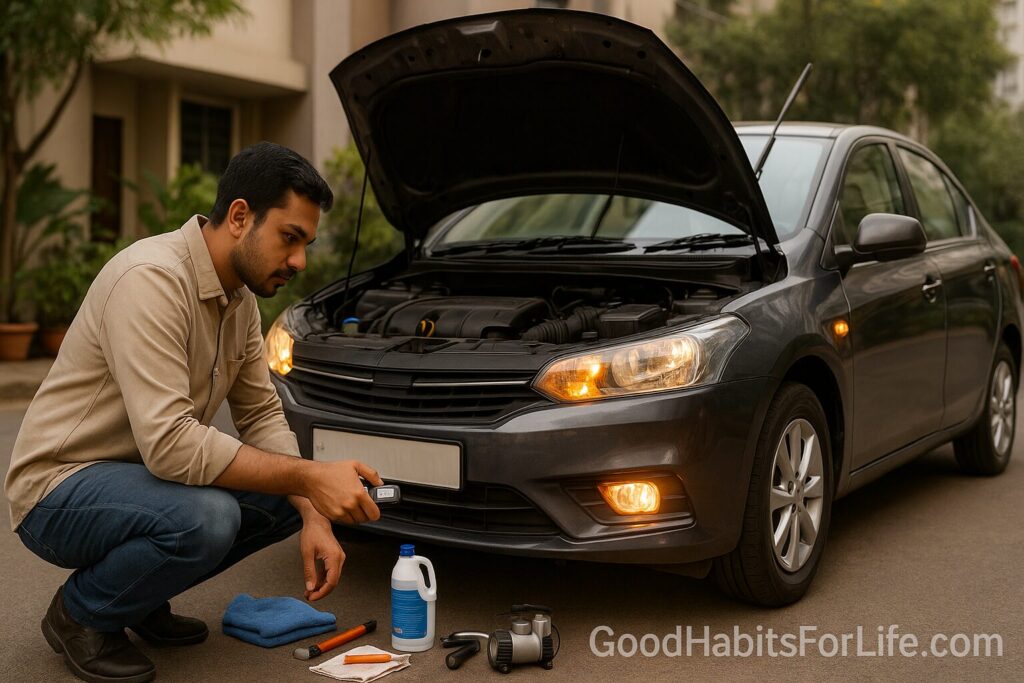
DIY Checks Before a Long Trip: A 15Minute Protocol
DIY Checks Before a Long Trip: A 15-Minute Protocol
Table of Contents
🧭 What This Is & Why It Matters
A quick, do-it-yourself pre-trip inspection reduces the biggest road-trip risks: tire failures, fluid-related overheating, poor visibility, and avoidable breakdowns. You don’t need a workshop—just a gauge, your eyes, and this protocol.
Benefits backed by data:
-
Fuel economy: Properly inflated tires can improve fuel economy (on average) and reduce wear; under-inflation wastes fuel and increases heat buildup.
-
Safety & visibility: Working lights, clean glass, and healthy wipers improve reaction time and night/wet-weather safety.
-
Reliability: Checking oil/coolant levels and belts/hoses (quick visual) can flag issues before they strand you.
-
Cost savings: Preventive care (e.g., topping up fluids, fixing a slow leak) is cheaper than roadside rescue and repairs.
⚡ Quick Start: The 15-Minute Protocol
Do this when the car is cold and parked on level ground. Use your owner’s manual for specs.
Phase A — Tires & Fluids (≈7 minutes)
-
Set tire pressures (cold).
-
Use door-jamb placard pressures (kPa/psi). Adjust all four.
-
Inspect tread: no cords showing; aim for ≥3.0 mm tread for wet trips (legal mins vary; 1.6 mm/2⁄32″ is a common minimum).
-
Check sidewalls for cuts/bulges.
-
Spare or repair kit: Ensure spare is inflated; if your car has a sealant/inflator kit, confirm it’s present and not expired.
-
-
Engine oil level:
-
Dipstick method: wipe → dip → read. Top up with the recommended grade only if near the low mark.
-
-
Coolant level (engine cold):
-
Look at the expansion tank; level should sit between “MIN” and “MAX.” Never open a hot radiator cap.
-
-
Washer fluid:
-
Fill to prevent dry wipes and streaking.
-
Phase B — Lights, Controls & Visibility (≈5 minutes)
5. All lights:
-
Headlights (low/high), DRLs, indicators, brake lights, reverse lights, plate lamp. Ask a helper or use a wall reflection.
-
Wipers & windshield:
-
Run wipers/washer; replace blades if streaking or frayed. Clean the inside of the glass to reduce night glare.
-
-
Controls check (30-second feel test):
-
Horn, seatbelts, mirrors, parking brake hold, pedal feel (no spongy brake).
-
-
Dashboard scan:
-
No warning lights? If a light remains (ABS, TPMS, MIL), address before departure.
-
Phase C — Load, Route & Documents (≈3 minutes)
9. Load & balance:
-
Heavy items low and forward; nothing loose that can become a projectile. If roof-loading, respect weight limits and recheck tire pressures for load.
-
Fuel & cap:
-
Fuel up; ensure cap clicks tight.
-
Docs & essentials:
-
Licence, registration, insurance. Carry a triangle, reflective vest (where required), first-aid kit, flashlight, power bank, water, paper towels.
-
Route & weather:
-
Download offline maps, save charging stops (EV), and check weather/traffic. Share your ETA with a contact.
If anything seems off (leaks, smells, steering pull, noises), postpone the trip and get a professional inspection.
🛠️ Techniques & Micro-Frameworks
1) T.I.R.E. Method for fast tire health
-
Tread: ≥3 mm for wet; even wear.
-
Inflation: set cold to placard; recheck after 10–15 km if you used a station pump.
-
Rotation clues: inner/outer edge wear suggests alignment or rotation is due.
-
Emergency: confirm spare/kit + jack, wheel-nut wrench, locking key.
2) F.L.U.I.D. glance (oil, coolant, washer)
-
Fill washer.
-
Levels: oil on dipstick; coolant between marks (cold).
-
Under-hood quick look: belts/hoses intact; no frayed edges or “wet” seep.
-
Indicators: dashboard warnings clear.
-
Drip check: look under the car—fresh puddles warrant attention.
3) V.I.S. visibility triad
-
Vitreous (glass): clean inside/out; defog works.
-
Illumination: all lamps including rear fog (if equipped).
-
Squeegee (wipers): no chatter; replace seasonally or if streaking.
4) E.V. note (if driving electric)
-
Precondition the battery (if available) and plan fast-charge stops with buffer. Carry the right charge cables, RFID/app access, and a plan B station.
5) Rental-car add-on (5 minutes at pickup)
-
Photograph each side, alloys, windscreen; note existing damage on the agreement.
-
Verify tire pressures, spare/kit, and documents. Check fuel type on the cap.
📅 Habit Plan: 7-Day Pre-Trip Prep (Optional)
If your trip is significant (≥300 km / 185 mi), spread prep across a week:
-
Day −7: Service history check; book maintenance if due (oil change, brake pads, coolant service).
-
Day −5: Tires: inspect tread, order replacements if borderline.
-
Day −3: Emergency kit refresh: first-aid, triangle, vest, torch, power bank, basic tools, tyre repair kit or spare check.
-
Day −2: Run VIN for open recalls; address if applicable.
-
Day −1: Deep clean glass inside; download offline maps; pack and secure load.
-
Morning of travel: Execute the 15-Minute Protocol.
-
En-route habit: Every fuel/charge stop, do a 30-second walkaround (tires, lights, leaks).
👤 Audience Variations
Families with kids
-
Pack medications, motion-sickness aids, wet wipes, snacks, extra water. Child seats: verify correct installation and harness height.
-
Plan more frequent breaks; sunshades and window locks on.
Professionals / Solo drivers
-
Dual chargers and a hands-free mount. Keep work gear low/secured; no items on the parcel shelf.
Seniors
-
Bring spare glasses; adjust seat ergonomics to reduce fatigue. Discuss route and rest breaks in advance.
Students / New drivers
-
Practice using a tire gauge and topping up at a forecourt. Save insurer roadside number; learn how to place a triangle safely.
EV road-trippers
-
Target 10–80% SOC fast-charge windows for best time efficiency; add a cold-weather buffer if applicable.
⚠️ Mistakes & Myths to Avoid
-
Myth: “Max pressure on the tire sidewall is best.”
Reality: Use the vehicle placard pressures (front/rear); sidewall is a maximum rating, not the target. -
Mistake: Checking pressures after a long drive.
Fix: Measure when cold (car parked ≥3 hours or driven <2 km). -
Mistake: Mixing coolant types “just to top up.”
Fix: Use the specified type; if unsure, distilled water as a short-term top-up (in warm conditions) beats a wrong chemistry mix. -
Myth: “If the car starts, the battery is fine.”
Reality: Slow cranking, dim lights at idle, or a >3-year-old battery before a long trip warrants a test. -
Mistake: Overloading the roof box.
Fix: Respect roof and gross vehicle weight limits; heavy items go inside, low and between axles. -
Mistake: Ignoring small warning lights.
Fix: TPMS, ABS, or MIL lights merit diagnosis before a long run.
💬 Real-Life Scripts & Checklists
A) 60-Second Pre-Departure Script (read out loud)
“Mirrors set, seat and head restraint good. Belt on—everyone buckled? Fuel cap clicked. No warnings on the dash. Lights on auto or dipped. Route and offline maps ready, phone on hands-free. Let’s roll.”
B) Phone-a-Mechanic Script
“Hi, I’m planning a [date] trip of about [distance]. Today I saw [symptom: brake squeal / coolant just above MIN / tire shoulder wear]. Can I come by for a quick check? The car is a [year/make/model], last serviced at [mileage/date].”
C) Glovebox Checklist (print and keep)
-
Registration, insurance, breakdown cover
-
Owner’s manual, locking wheel-nut key
-
Pressure gauge, torch, paper towels, fuses
-
Triangle, reflective vest, first-aid kit
-
Phone cable, power bank
-
Spare tyre or repair kit + inflator
-
Water and basic snacks
🧰 Tools, Apps & Resources
Basic tools to own
-
Accurate digital tire pressure gauge and portable inflator
-
OBD-II scanner (optional) to read/reset non-critical codes
-
Wiper blades (spare set) and washer fluid concentrate
-
Microfiber cloths + glass cleaner (interior haze fix)
Helpful apps
-
Maps with offline areas; traffic & incident alerts
-
Weather and air-quality apps for route planning
-
EV route planners (for CCS/CHAdeMO/NACS, as relevant)
-
Manufacturer app (remote status, preconditioning, door-lock check)
When to see a pro before a long trip
-
Brakes pulsing, steering vibration, persistent fluid loss, overheating history, or timing belt/chain service due by time/mileage.
🔑 Key Takeaways
-
A 15-minute, three-phase DIY routine catches most trip-stoppers.
-
Cold tire pressure and fluid levels are non-negotiables.
-
Verify lights, wipers, dash warnings, and documents.
-
Secure the load and plan the route with contingencies.
-
For longer trips, use the 7-Day Prep to reduce surprises.
❓FAQs
1) How exact do tire pressures need to be?
Aim within ±3–5 kPa (±0.5–0.7 psi) of the placard. Recheck cold. Add a few kPa if carrying full passengers/luggage as your manual advises.
2) Is the coin test reliable for tread?
It’s a quick proxy; a tread depth gauge is better. Replace tires earlier for heavy rain (around 3–4 mm) even if the legal minimum is lower.
3) Can I mix different tire brands?
It’s allowed but not ideal. Keep axle pairs identical and match size, load, and speed ratings. Mixing patterns can affect handling.
4) Should I top up coolant before a long trip?
If cold level sits near MIN, top up with the correct type. If level drops again or there’s a sweet smell/visible leak, see a technician.
5) How often should I replace wiper blades?
About every 6–12 months depending on climate. If they streak, chatter, or the rubber splits, replace now.
6) Do I need a spare if I have a repair kit?
Many modern cars rely on a sealant/inflator kit; it works for small punctures only. For remote routes or heavy loads, a spare is safer.
7) What about battery checks?
If cranking is slow, lights dim at idle, or the battery is older than ~3 years, get a load test done before the trip.
8) Is it okay to overfill engine oil “just a bit”?
Avoid overfilling. Keep between MIN–MAX; excess oil can cause foaming and catalytic-converter issues.
9) Do I need to check alignment before a trip?
Not routinely. But if the car pulls, the wheel is off-center, or tires show uneven wear, schedule an alignment.
10) How often should I do the quick walkaround on the trip?
Every fuel/charge stop: 30 seconds for tires, lights, and leaks. It’s a powerful safety habit.
📚 References
-
National Highway Traffic Safety Administration (NHTSA). Tire Safety (tread depth, inflation, maintenance). https://www.nhtsa.gov/equipment/tires
-
NHTSA. Car Seats and Seat Belts Safety (general occupant protection guidance). https://www.nhtsa.gov/road-safety/seat-belts
-
NHTSA. Vehicle Safety Recalls (VIN lookup). https://www.nhtsa.gov/recalls
-
U.S. Department of Energy, FuelEconomy.gov. Keeping Your Car in Shape (tire pressure & fuel economy). https://www.fueleconomy.gov/feg/maintain.jsp
-
AAA. Road Trip Ready: Vehicle Checklist & Tips. https://exchange.aaa.com/safety/roadway-safety/road-trip-tips/
-
Consumer Reports. Tire Buying Guide & Tread Depth Advice. https://www.consumerreports.org/tires/
-
Road Safety Foundation / Highways guidance on breakdown safety and triangles. https://www.roadsafetyfoundation.org/ (and local highway code where applicable)
-
CDC. Heat & Hydration Safety for Travel (packing water/heat illness basics). https://www.cdc.gov/disasters/extremeheat/heattips.html