
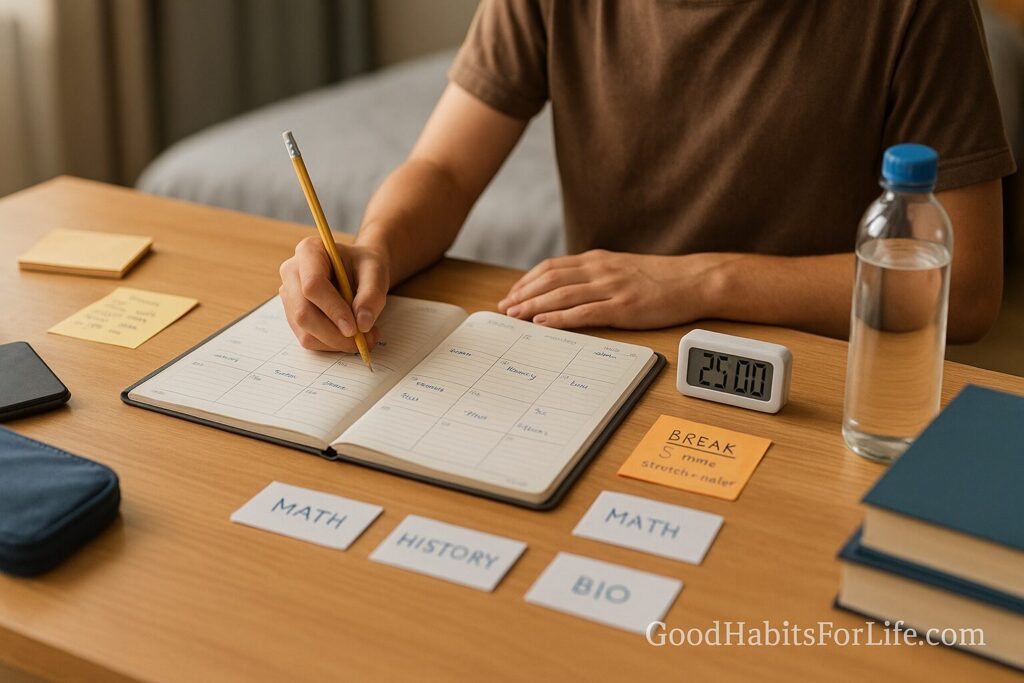
Teen Study Systems 2025: Planner Blocks Breaks
Teen Study Systems 2025: Planner, Blocks & Breaks
Table of Contents
🧭 What This System Is & Why It Works
The Planner–Blocks–Breaks system is a simple, repeatable way for teens to handle homework, revision, projects, and tests:
-
Planner: one weekly view with classes, sports, tutoring, and due dates.
-
Blocks: focused study blocks (25–50 minutes) scheduled into open time.
-
Breaks: brief, intentional resets (3–10 minutes) between blocks.
Why it works (the science bit):
-
Retrieval practice (self-testing, flashcards, practice questions) improves long-term learning more than rereading. SAGE Journalspsychnet.wustl.edu
-
Spacing reviews across days/weeks boosts retention—especially for tests weeks away. PubMedSAGE Journals
-
Interleaving (mixing topics/problem types) improves discrimination and transfer. ERICSpringerLink
-
Short, rare breaks prevent attention decline and help the brain consolidate learning. PubMedNational Institutes of Health (NIH)
-
Sleep (8–10 h for teens) supports attention, memory, and grades. PMC
-
Phone presence alone reduces available cognitive capacity—keep it out of sight. Chicago Journals
✅ Quick Start (Do This Today)
-
Create one weekly planner (paper or app). Add classes, commute, sports, fixed commitments.
-
List deadlines/tests for the next 2–4 weeks.
-
Time-block two study windows today (e.g., 6:00–6:50 pm, 7:10–8:00 pm).
-
Pick your task per block: “Math practice set B,” “Biology flashcards Ch.4,” “History outline.”
-
Set a phone rule: silent + out of room/locked drawer. Chicago Journals
-
Run the block: 25–50 min focus → 5–10 min break (walk, water, stretch). PubMed
-
End with retrieval: 5–10 questions from memory or 10 Anki cards. SAGE Journals
🛠️ 7-Day Starter Plan
Goal: install the habit with minimal willpower.
-
Day 1 (Sun): Build your weekly planner. Mark non-negotiables. Choose two 50-min study blocks Mon–Fri.
-
Day 2 (Mon): Math block (interleaved set of skills), then short break; English outline + retrieval quiz. SpringerLink
-
Day 3 (Tue): Biology flashcards + practice recall; History timeline from memory; break after each. SAGE Journals
-
Day 4 (Wed): Review weakest topic (spaced from earlier day); 10-minute parent update (“what I did, what’s next”). SAGE Journals
-
Day 5 (Thu): Practice test (closed book) → check answers → tiny corrections list. SAGE Journals
-
Day 6 (Fri): Light review block + tidy backpack; plan next week’s deadlines.
-
Day 7 (Sat): Morning 50-min block; free after. Protect 8–10 h sleep nightly. PMC
Checkpoint (end of week): Are two blocks/day realistic? Keep, shrink to 2×25, or grow to 3×40 based on sports/exams.
🧠 Techniques & Frameworks That Actually Work
Retrieval Practice (Self-Testing)
-
Use past papers, end-of-chapter questions, or make 5–10 Qs after each lesson.
-
“Closed-book first, then check” to maximize memory strength. SAGE Journals
Spaced Practice
-
Revisit units multiple times across weeks (e.g., Day 1, Day 3, Day 7, Day 21).
-
Plan review dates for any test ≥2 weeks away. PubMed
Interleaving
-
Mix problem types (e.g., algebra + geometry + word problems) in one set. SpringerLink
Note Systems That Support Retrieval
-
Cornell Notes → turn margins into practice questions, then recite from memory. Learning Strategies CenterNazareth University
Block Lengths & Breaks
-
Try 25/5 or 50/10. The key is a brief reset to avoid vigilance decrements. PubMed
If-Then Planning (Implementation Intentions)
-
“If it’s 6:00 pm, then I sit at the desk and start the Math set.”
-
These plans make start-up more automatic. Prospective PsychologyNYU Scholars
Sleep & Screens
-
Target 8–10 h; avoid phones in the last hour to protect quality. PMC
👥 Variations: Teens, Parents, Busy Schedules, Exams
For Teens with full schedules: Use micro-blocks (2×25 min) before/after practice; keep one longer block on weekends.
For Parents:
-
Co-create the weekly planner every Sunday; ask, “Which two study blocks fit Mon–Fri?”
-
Provide a phone charging spot outside the study area. Chicago Journals
During Exam Weeks: -
Increase to 3 blocks/day; prioritize retrieval practice and spaced reviews; cap daily total to avoid sleep loss. PMC
⚠️ Mistakes & Myths to Avoid
-
Myth: “Rereading = learning.” → It feels fluent but underperforms retrieval. SAGE Journals
-
Myth: “Long marathons beat breaks.” → Short breaks sustain focus. PubMed
-
Mistake: Studying with the phone on desk. → Even silent, it drains focus. Chicago Journals
-
Mistake: Cramming the night before. → Spacing wins for long-term retention. SAGE Journals
💬 Real-Life Scripts & Examples
Daily Study Card (copy-paste):
-
Block 1 (18:00–18:50): Algebra mixed set (10 Qs) → check answers → mark 3 weak ones.
-
Break (10 min): water + stretch.
-
Block 2 (19:00–19:40): Biology Ch. 5 flashcards (30 Anki) → 5 Qs from memory.
Parent Check-in (60-sec):
“Today I did 10 algebra questions and 30 bio cards. Tomorrow I’ll redo the 3 I missed and outline English para 2. Friday is light review.”
If-Then Plan Examples:
-
If it’s after dinner, then I set a 25-minute timer and do 10 practice Qs. Prospective Psychology
🧰 Tools, Apps & Resources (Pros/Cons)
-
Google Calendar / Apple Calendar — easy weekly view; alerts for blocks. Con: can get cluttered.
-
Notion / Obsidian — flexible planner + notes + task boards. Con: setup overhead.
-
Anki — spaced flashcards, science-backed. Con: learning curve. PubMed
-
Forest / Focus To-Do — simple timers; lock mode discourages phone use. Con: requires discipline.
-
Paper planner — low-friction, no notifications. Con: no auto reminders.
-
Cornell Notes sheets — supports question-driven review. Con: some setup. Learning Strategies Center
📌 Key Takeaways
-
Schedule when you’ll study, not just what.
-
Use retrieval, spacing, and interleaving for durable learning. SAGE JournalsPubMedSpringerLink
-
Protect focus with phone-free blocks and brief breaks. Chicago JournalsPubMed
-
Keep sleep non-negotiable (8–10 h). PMC
❓ FAQs
How long should a study block be?
25–50 minutes works for most teens; add a 5–10 minute break between blocks. PubMed
What if I only have 30 minutes?
Run a 25/5 micro-block (retrieval first); small, consistent reps beat zero. SAGE Journals
Is Pomodoro required?
No—any focused block + brief break that prevents attention decline is fine. PubMed
How many hours per day should teens study?
Quality beats quantity. Two focused blocks on school days, 1–2 longer blocks on weekends, adjusted near exams. SAGE Journals+1
Best way to review notes?
Convert notes to questions (Cornell style) and answer from memory; then check the book. Learning Strategies Center
Phones on silent are OK, right?
Better to keep them out of sight/out of room; presence alone reduces available cognitive resources. Chicago Journals
Do breaks waste time?
Planned short breaks prevent vigilance drops and may aid consolidation. PubMedNational Institutes of Health (NIH)
Should I cram the night before?
A short spacing review is better; keep your sleep to protect memory. SAGE JournalsPMC
📚 References
-
Dunlosky, J., et al. Improving Students’ Learning With Effective Learning Techniques. Psychological Science in the Public Interest (2013). SAGE JournalsWestern Kentucky University
-
Roediger, H. L., & Karpicke, J. D. Test-Enhanced Learning: Taking Memory Tests Improves Long-Term Retention. Psychological Science (2006). SAGE JournalsPubMed
-
Cepeda, N. J., et al. Spacing Effects in Learning (large-scale spacing research, including 1-year tests). Psychological Science (2008). SAGE JournalsPubMed
-
Rohrer, D. Interleaving Helps Students Distinguish Among Similar Concepts. Educational Psychology Review (2012) and follow-ups in math learning. ERICSpringerLink
-
Ariga, A., & Lleras, A. Brief and Rare Mental “Breaks” Keep You Focused. Cognition (2011). PubMedScienceDirect
-
NIH News Release. Short breaks may help our brains learn new skills (2021). National Institutes of Health (NIH)
-
American Academy of Sleep Medicine. Teen Sleep Duration Health Advisory (2016/2019). PMCAASM
-
Ward, A. F., et al. Brain Drain: The Mere Presence of One’s Own Smartphone Reduces Available Cognitive Capacity. Journal of the Association for Consumer Research (2017). Chicago Journals
-
Cornell University Learning Strategies Center. The Cornell Note-Taking System. (accessed 2025). Learning Strategies Center