
TyrePressure Monitoring: Safety, Savings, Setup: Dopamine Detox (2025)
Tyre Pressure Monitoring: Safety, Savings, Setup (2025)
Table of Contents
🧭 What Is TPMS & Why It Matters
A Tyre Pressure Monitoring System (TPMS) alerts you when a tyre is significantly under-inflated so you can act before handling worsens or the tyre fails. In many markets (e.g., the U.S.), TPMS must warn drivers when pressure drops to 25% below the recommended cold inflation pressure. eCFR
Benefits backed by data
-
Fewer dangerous under-inflations. Vehicles with TPMS are ~55.6% less likely to have a severely under-inflated tyre. Crash Stats
-
Better fuel economy. Keeping tyres at spec can improve mileage ~0.6% on average (up to 3%). Under-inflation roughly –0.2% fuel per 1 psi drop across all tyres. Alternative Fuels Data Center
-
Longer tyre life & safer braking. Both under- and over-inflation harm grip and accelerate wear, increasing stopping distance and instability. Crash Stats
Global context: In the EU, TPMS has been mandatory for M1 passenger vehicles since 2014, with extensions from 2022–2024 to buses, vans, heavy trucks and trailers. Publications Office of the EUInterregs
🧠 How TPMS Works (Direct vs Indirect)
Direct TPMS (dTPMS)
-
Pressure/temperature sensors inside each wheel send readings to the car.
-
Pros: exact pressures per wheel; can show live values; detects multiple low tyres.
-
Cons: sensor batteries (often 5–10 years) eventually die; sensors can be damaged during tyre work. Crash StatsREDI-Sensor
Indirect TPMS (iTPMS)
-
Uses ABS/ESC wheel-speed data to infer smaller rolling radius in a low tyre; newer systems apply spectral analysis to detect multi-tyre losses.
-
Pros: no in-wheel sensors or batteries; cheaper to maintain.
-
Cons: shows relative warnings (not absolute kPa/bar); requires driver reset after corrections; more sensitive to tyre types and road surfaces. WikipediaCrash Stats
Standards snapshot
-
U.S. FMVSS No. 138: TPMS must warn within 20 minutes of detecting the threshold under-inflation or system malfunction. eCFR
-
UNECE R141 (used across EU and many other markets): defines response time and detection thresholds (e.g., warn within ≤60 minutes of cumulative driving when pressure drops by ≥20% or to ≤150 kPa, whichever higher). unece.org
🛠️ Quick Start: Set Up & Use Today
Before you begin
-
Find your cold tyre pressure (door-jamb placard or owner’s manual). Use kPa/bar (and note psi equivalents).
-
Check “cold” (after the car sits for ≥3 hours). Temperature drops cause pressure drops (~1 psi per 10°F / 5.6°C). NHTSA
Step-by-step
-
Measure all tyres with a reliable digital gauge; compare to placard (e.g., 230 kPa / 2.3 bar ≈ 33 psi). NHTSA
-
Inflate/deflate to match spec. Refit valve caps.
-
Reset/calibrate if your car uses indirect TPMS (via button or infotainment). Don’t reset until all tyres are correctly set. Wikipedia
-
Drive 10–20 minutes; the TPMS should clear the warning if pressures are correct. If the light blinks then stays on, that’s a malfunction—not low pressure. eCFRblog.johndow.com
-
Recheck weekly; pressures change with seasons and seepage. (Natural air permeation ~1 psi/month.) NHTSA
When the light comes on
-
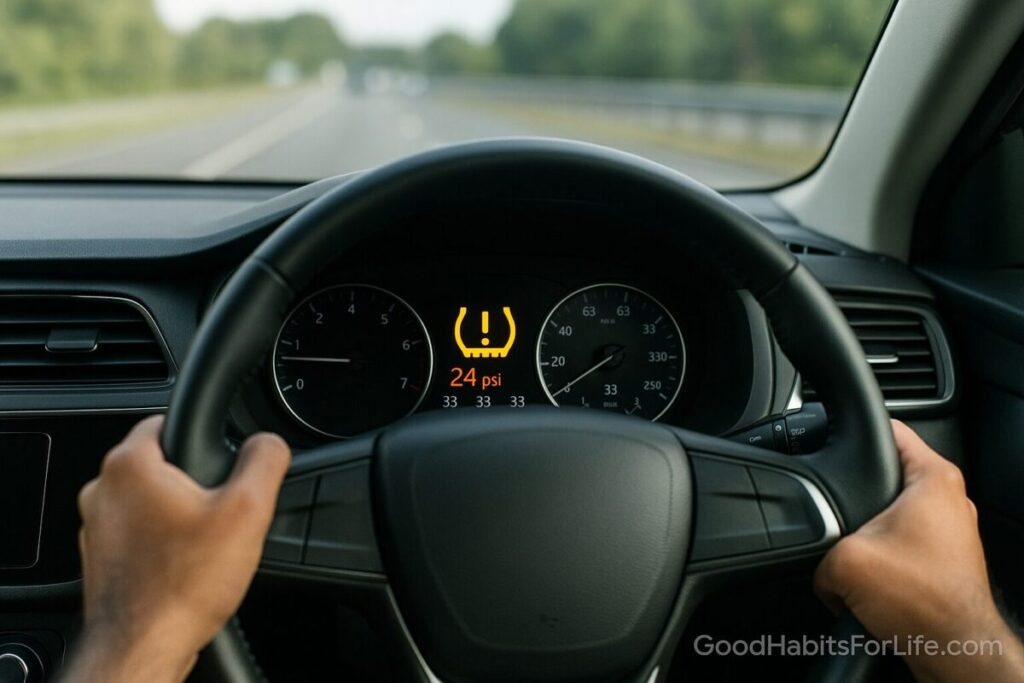
Solid TPMS light: at least one tyre is significantly low—inflate ASAP. NHTSA
-
Flashing light on start-up (then solid): system malfunction—service sensors or control unit. blog.johndow.com
✅ 7-Day TPMS Starter Plan
Day 1 – Baseline: Read placard, measure all tyres (incl. spare if monitored). Log front/rear targets in notes. NHTSA
Day 2 – Correct & Reset: Inflate/deflate to spec; reset iTPMS if applicable; short test drive. Wikipedia
Day 3 – Learn Your Trend: Measure cold pressures again; note any slow leaks (~1 psi/month natural is typical). NHTSA
Day 4 – Temperature Check: Compare morning vs afternoon readings; observe how ambient temperature influences pressure. NHTSA
Day 5 – Fuel Focus: Track trip computer or refuel log; aim for smoother driving + correct pressures to notice efficiency gains. Alternative Fuels Data Center
Day 6 – Rotate Awareness: Inspect tread wear patterns; schedule rotation if due (usually 8,000–10,000 km). NHTSA
Day 7 – Routine: Set a monthly reminder to check pressures and a seasonal reminder post-temperature swings.
🧩 Techniques & Frameworks for Reliable Inflation
-
“Placard-First” Rule: Always aim for the manufacturer’s cold pressure (door placard), not the maximum on the tyre sidewall. NHTSA
-
Seasonal Swing Protocol: As weather drops, expect the TPMS to ping; proactively add air as temperatures fall (~1 psi per 10°F). NHTSA
-
Direct vs Indirect Reset Discipline: Only reset iTPMS after corrections; never “teach” the system a wrong baseline. Wikipedia
-
Battery-Aware Maintenance: Plan to replace dTPMS sensors around 5–10 years (or when malfunctions start). REDI-Sensor
-
Road-Trip Checkpoints: Measure pressures the night before and at each 1,000 km interval; altitude/temperature shifts matter. NHTSA
👥 Variations by Audience
-
Students / New drivers: Learn the TPMS icons and where the placard is. Keep a pocket digital gauge in the glovebox. NHTSA
-
Parents: Show teens the reset menu (iTPMS) and practice using a forecourt inflator safely. Wikipedia
-
Professionals / High-mileage drivers: Log pressures weekly; consider a portable inflator to minimise downtime.
-
Seniors: Choose gauges with large displays and auto-hold readings. Ask service centres to print current pressures at each visit.
-
Teens: Pair fuel-savings goals with correct inflation to make an immediate, measurable habit. Alternative Fuels Data Center
⚠️ Mistakes & Myths to Avoid
-
Myth: “The TPMS shows my exact pressure.”
Fact: Only direct systems show exact kPa/bar; indirect systems show warnings, not numbers. Crash Stats -
Mistake: Resetting iTPMS with tyres still low. This “normalises” a bad state and delays warnings. Wikipedia
-
Myth: “I can ignore a flashing light; it’s just cold weather.”
Fact: A flashing TPMS light indicates malfunction; a solid light indicates low pressure—both require action. blog.johndow.comNHTSA -
Mistake: Using sidewall “max” pressure for road use. Use the door-jamb placard. NHTSA
📋 Real-Life Examples & Scripts
-
At the pump (indirect TPMS):
“Front target 230 kPa, rears 220 kPa. Set all four. Press ‘TPMS Reset’ → ‘Store pressures’ in the car menu. Drive 15 minutes; warning should clear.” Wikipedia -
Cold-snap morning:
“The light’s on; temps fell 8–10°C overnight. Add ~10–20 kPa (1–3 psi) to reach placard. Recheck next cold morning.” NHTSA -
Suspected slow leak:
“Log daily cold readings for three days. If one tyre drops >10–20 kPa (>1–3 psi) vs others, visit a tyre shop to inspect for puncture/bead leak.” NHTSA
🧰 Tools, Apps & Resources
-
Digital tyre pressure gauge: More accurate and easier to read for cold checks.
-
12V portable inflator: Quick top-ups at home or during trips.
-
OBD/infotainment menu: For iTPMS resets and sensor status. Wikipedia
-
Official guidance:
-
U.S. TireWise (NHTSA) tyre safety hub. NHTSA
-
ECFR 49 CFR §571.138 (FMVSS No. 138 details). eCFR
-
UNECE R141 (TPMS performance requirements). unece.org
-
DOE/AFDC Fuel-Saving Tips (pressure & mpg). Alternative Fuels Data Center
-
📌 Key Takeaways
-
Keep tyres at placard cold pressure; check monthly and before trips. NHTSA
-
Understand your system type (direct vs indirect) and reset behaviour. Crash Stats
-
Expect pressure drops with colder weather; act proactively. NHTSA
-
TPMS reduces severe under-inflation and saves fuel and tyres. Crash StatsAlternative Fuels Data Center
❓ FAQs
1) What pressure should I use—sidewall or door-jamb?
Use the door-jamb placard (or owner’s manual) “cold” pressure, not the tyre sidewall max. NHTSA
2) How often should I check tyres if I have TPMS?
At least monthly and before long trips—TPMS is a safety net, not a replacement for routine checks. NHTSA
3) Why did my TPMS light come on during a cold snap?
Pressure drops ~1 psi per 10°F (5.6°C) as air contracts; top up to placard and recheck. NHTSA
4) Do EVs need different pressures?
Follow the placard for your specific EV; correct inflation is crucial because EVs are often heavier, increasing tyre load—TPMS helps maintain safe margins. (General guidance; always use the vehicle placard.) NHTSA
5) My TPMS light flashes at start-up—what does that mean?
Flashing indicates a TPMS malfunction (e.g., dead sensor battery). Get it serviced; a solid light is low pressure. blog.johndow.comREDI-Sensor
6) How long do TPMS sensors last?
Typical sensor battery life is ~5–10 years, depending on driving and environment. REDI-Sensor
7) Can indirect TPMS show exact kPa/bar?
No—indirect systems infer relative changes and require a reset after setting pressures. Wikipedia
8) Will higher than placard pressure save more fuel?
Over-inflation can reduce grip and increase stopping distance—stick to placard for safety and balanced wear. Crash Stats
9) How fast will TPMS warn me of a leak?
Standards set maximum detection times (e.g., U.S. ≤20 minutes at speed; UNECE defines cumulative-driving windows). Rapid punctures may trigger quicker. eCFRunece.org
10) Is TPMS mandatory where I live?
In the EU (M1) since 2014 and extending to more vehicle classes by 2024; in the U.S., TPMS is required on light vehicles since 2007 model years. Check your local rules. Publications Office of the EUInterregsCrash Stats
📚 References
-
U.S. Department of Energy, Gas-Saving Tips (AFDC). https://afdc.energy.gov/files/u/publication/gas-saving_tips.pdf Alternative Fuels Data Center
-
NHTSA, Evaluation of the Effectiveness of TPMS in Proper Tire Inflation (DOT HS 811 681). https://crashstats.nhtsa.dot.gov/Api/Public/ViewPublication/811681 Crash Stats
-
49 CFR §571.138 — Tire Pressure Monitoring Systems (ECFR). https://www.ecfr.gov/current/title-49/subtitle-B/chapter-V/part-571/subpart-B/section-571.138 eCFR
-
UNECE Regulation No. 141 — Tyre Pressure Monitoring Systems. https://www.unece.org/fileadmin/DAM/trans/main/wp29/wp29regs/2017/R141e.pdf unece.org
-
EUR-Lex, UN/ECE Regulation No. 64 (tyre equipment incl. TPMS). https://eur-lex.europa.eu/LexUriServ/LexUriServ.do?uri=OJ:L:2010:310:0018:0040:EN:PDF EUR-Lex
-
InterRegs, Scope of UN ECE TPMS Regulation Extended (2022–2024). https://www.interregs.com/articles/spotlight/237/scope-of-un-ece-regulation-on-tyre-pressure-monitoring-systems-extended Interregs
-
NHTSA TireWise — Tyre Safety & TPMS Basics. https://www.nhtsa.gov/vehicle-safety/tires NHTSA
-
NHTSA, Federal Motor Vehicle Safety Standards; TPMS Final Rule (Federal Register, 2005). https://www.federalregister.gov/documents/2005/09/07/05-17661/federal-motor-vehicle-safety-standards-tire-pressure-monitoring-systems Federal Register
-
NHTSA, Temperature & Pressure Changes (TPMS rulemaking excerpts). https://www.nhtsa.gov/sites/nhtsa.dot.gov/files/fmvss/TPMSfinalrule.pdf NHTSA