
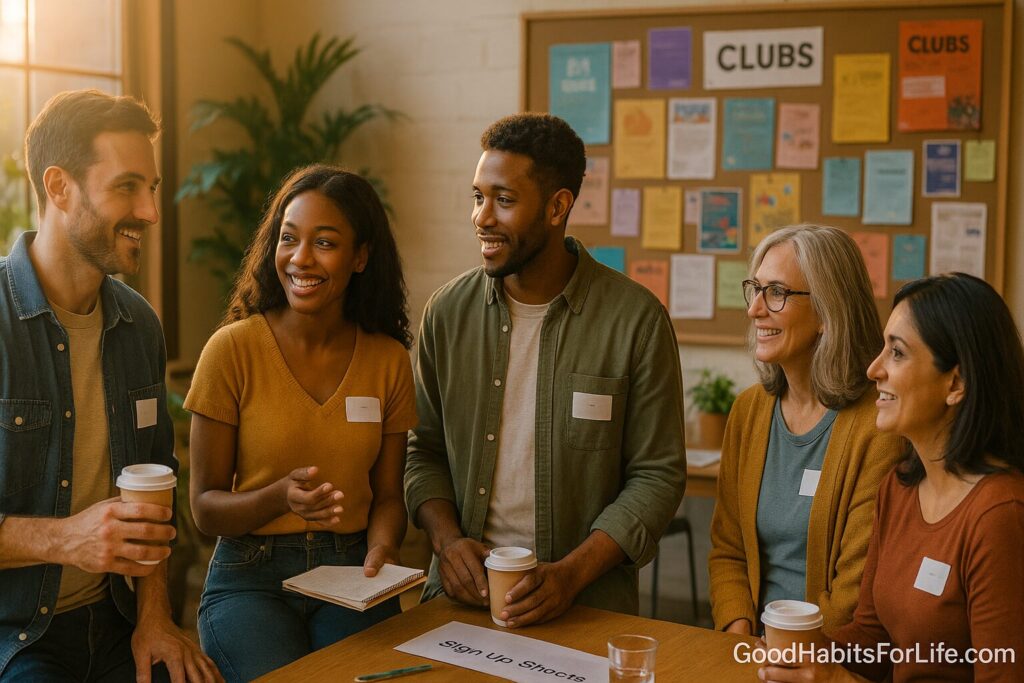
Finding Your People in 2025: Groups, Clubs, Communities
Finding Your People in 2025: Groups, Clubs, Communities
Table of Contents
🧭 What “Finding Your People” Means (and Why It Matters)
Finding your people is the deliberate habit of joining and investing in groups, clubs, and communities where shared interests and values make friendship easier. It’s not luck; it’s a repeatable process.
Why it matters: Strong social connection improves mental health, resilience, and even longevity. Large reviews show people with robust relationships have lower mortality risk, and public-health leaders now treat lack of connection as a serious concern. Community ties also increase wellbeing and civic participation (see References).
Principles
-
Belonging beats browsing. Commit to a few communities, don’t endlessly sample.
-
Consistency compounds. The same faces, places, and times build trust.
-
Contribution creates connection. Show up early, help, ask good questions, volunteer.
✅ Quick Start: Do This Today
-
Name 3 interests (e.g., morning running, public speaking, creative coding).
-
Search 15 minutes for one group per interest: Meetup/Eventbrite, Facebook Groups, Discord, library boards, recreation centers, university clubs, volunteer hubs.
-
Pick 3 dates within the next 30 days (1 per group). Put them on your calendar.
-
Set a 2-event rule. Attend each group twice before judging fit.
-
Prepare a 10-second intro: “Hi, I’m [Name]. I’m new here and into [topic]. How did you get into this?”
-
Offer one micro-help (stack chairs, share notes, bring an extra water bottle).
-
Follow up within 24 hours: “Great to meet you—going again next week; want to join?”
🗺️ 30-60-90 Day Habit Plan
Days 1–30 (Explore)
-
Attend 3 different groups at least once each.
-
Keep a fit score (1–5) for vibe, values, logistics (time, location, cost).
-
Capture two names per event and one next step.
Days 31–60 (Focus)
-
Double down on the best 2 groups.
-
Move from attendee → contributor: volunteer for check-ins, photo recaps, or a 5-minute lightning talk.
-
Schedule one 1:1 coffee/walk per week with someone from the group.
Days 61–90 (Root)
-
Take a small role (host a warm-up, manage the WhatsApp/Discord thread).
-
Start a micro-tradition: post weekly wins, a shared playlist, or a Friday lunch.
-
If gaps remain, start a micro-group (3–6 people) that meets biweekly.
Checkpoints
-
30 days: 3 events attended, 6+ names collected.
-
60 days: 2 groups selected, 4 one-to-ones done.
-
90 days: at least one role and one micro-tradition established.
🌍 Where to Look in 2025 (Online → Offline)
Local & in-person
-
Libraries & community centers: book clubs, maker labs, language exchanges.
-
Parks & recreation: running clubs, pickleball, hiking meetups, fitness classes.
-
Universities & adult education: public lectures, continuing-ed workshops.
-
Coworking spaces: show-and-tells, founder breakfasts, skill-swap nights.
-
Skill & craft clubs: Toastmasters, Rotary, coding meetups, photography walks, dance socials, choir.
-
Service & volunteering: food banks, animal shelters, environmental clean-ups.
-
Faith/spiritual & cultural groups: festivals, study circles, community kitchens.
Online that bridges to offline
-
Meetup, Eventbrite: recurring, searchable events.
-
Facebook Groups/Reddit/Discord: niche interests; look for posts about IRL meetups.
-
Nextdoor/local forums: neighborhood initiatives, buy-nothing groups.
-
VolunteerMatch & local NGOs: easy on-ramps to serving together.
Tip: Favor recurring gatherings over one-off events; they create repeated contact.
🧠 Techniques & Frameworks that Work
1) Proximity × Frequency × Openness (P × F × O)
-
Proximity: choose groups close to home/work or on your daily route.
-
Frequency: weekly beats monthly.
-
Openness: small acts—arrive early, smile, ask names, share a bit of yourself.
2) “Interests × Values × Logistics” Fit
-
Interests: Does the activity energize you?
-
Values: Is the vibe inclusive/kind/ambitious/faith-based—whatever matters to you?
-
Logistics: Can you attend 80% of the time without stress?
3) Give–Ask Ratio (2:1)
-
For every ask (“Join me next week?”) offer two gives (share notes, introduce people).
4) The 3-Question Opener
-
“What brought you here?” → “What do you like most about it?” → “What’s happening next I shouldn’t miss?”
5) The Ladder of Involvement
-
Attend → participate → contribute → host micro-segment → co-organize.
👥 Variations by Audience
Students
-
Join one academic, one hobby, one service group; try debate, hackathons, theatre crew, peer tutoring.
-
Use campus bulletin boards + department newsletters.
Professionals
-
Industry associations, meetups, Toastmasters, mastermind breakfasts.
-
Block a standing weekday slot (e.g., Wed 7–9 pm) to remove decision friction.
Parents
-
Parent-teacher associations, library story time, playground meetups, family hiking clubs.
-
Offer kid-friendly micro-events (park picnic after school).
Seniors
-
Senior centers, walking groups, choir, intergenerational volunteering.
-
Prioritize daylight, nearby venues, and accessible spaces.
Teens
-
School clubs, esports, music groups, youth service projects.
-
Keep adults informed; meet in public places.
⚠️ Mistakes & Myths to Avoid
-
Myth: “If it’s right, it’ll click instantly.” Truth: community chemistry grows with repetition.
-
Mistake: Joining too many groups → shallow ties. Choose two and go deep.
-
Mistake: Only consuming (listening, watching). Contribute something small every time.
-
Myth: “Introverts can’t network.” Many introverts excel with small, recurring groups.
-
Mistake: Skipping safety basics—always meet in public, tell someone, verify hosts.
🗣️ Real-Life Scripts You Can Copy
Warm approach at an event
“Hey, I’m [Name]; first time here. What do you usually come for?”
Bridge to next time
“I’m planning to be here next Thursday at 7. Want to meet by the coffee table at 6:55?”
Follow-up message (24-hour rule)
“Great meeting you at [Group]! I’m going again on [Day/Time]. If you’re free, want to walk in together?”
Invite to 1:1
“Loved your take on [topic]. Coffee near the venue next week? 20 minutes—my treat.”
Start a micro-group
“A few of us are testing a 30-day [habit/skill] sprint. Low-pressure, meets Sundays for 45 minutes. Want in?”
Exit politely
“Thanks for hosting me the last few weeks. I’m focusing on another group that fits my schedule better—cheering you all on!”
🔧 Tools, Apps & Resources
-
Meetup / Eventbrite: Big directories of recurring events. Pros: easy discovery. Cons: quality varies.
-
Discord / Reddit / Facebook Groups: Niche communities. Pros: constant chatter. Cons: can stay online-only unless you nudge IRL.
-
Nextdoor / local forums: Hyper-local neighbors. Pros: nearby. Cons: mixed signal/noise.
-
VolunteerMatch / local NGO portals: Service with strangers → friends. Pros: purpose + people. Cons: scheduling can be rigid.
-
Toastmasters / Rotary / hobby associations: Built-in rituals and roles. Pros: structure, leadership pathways. Cons: dues, formality.
-
Shared calendars & chats (WhatsApp/Telegram/Signal): Keep momentum with reminders and mini-plans.
📌 Key Takeaways
-
Choose recurring, nearby groups you can attend often.
-
Use the P × F × O formula: proximity, frequency, openness.
-
Commit to a 30-60-90 plan; give before you ask.
-
Follow up within 24 hours and schedule the next touchpoint.
-
Safety and kindness are non-negotiable.
❓ FAQs
1) I’m introverted. What’s the lowest-stress starting point?
Pick small, structured groups (book clubs, classes, volunteer shifts). Arrive early to chat 1-on-1 before the crowd.
2) How many groups should I try at once?
Three in 30 days is ideal. Then pick two to deepen.
3) What if the group feels cliquey?
Give it two tries with different sub-activities. If it still feels closed, move on—fit matters.
4) Is paying for a club worth it?
Often yes. Dues can increase commitment and consistency. Try a trial month first.
5) How do I stay safe meeting new people?
Public places, share your plan with a friend, verify event hosts, arrange your own transport, trust your instincts.
6) How long until it feels like I truly belong?
Expect 6–10 touchpoints with the same people. Roles (e.g., greeting, note-taking) speed it up.
7) I moved cities. What’s step one?
Join a volunteer shift and a skills/hobby class in week one. You’ll meet values-aligned locals immediately.
8) What if I’m neurodivergent or socially anxious?
Choose predictable, rule-based settings (board games, coding groups). Prepare a few scripts and opt for shorter sessions.
9) How do I keep momentum?
Put a standing weekly slot on your calendar and keep an active group chat.
10) How do I leave a group without burning bridges?
Thank the organizers, share one positive takeaway, and explain your schedule change. Offer a small handover if you had a role.
📚 References
-
U.S. Surgeon General. Our Epidemic of Loneliness and Isolation (2023). https://www.hhs.gov/surgeon-general/priorities/loneliness/index.html
-
Holt-Lunstad J, et al. Social Relationships and Mortality Risk: A Meta-analytic Review. PLoS Med. 2010. https://journals.plos.org/plosmedicine/article?id=10.1371/journal.pmed.1000316
-
World Health Organization. Commission on Social Connection. https://www.who.int/initiatives/commission-on-social-connection
-
American Psychological Association. Social Support. https://www.apa.org/topics/healthy-relationships/social-support
-
National Institute on Aging. Social Isolation and Loneliness. https://www.nia.nih.gov/health/social-isolation-loneliness
-
OECD Better Life Index. Community & Social Connections. https://www.oecdbetterlifeindex.org/topics/community/
-
Harvard Health Publishing. The Health Benefits of Strong Relationships. https://www.health.harvard.edu/blog/the-health-benefits-of-strong-relationships-2019090617448
-
AmeriCorps. Volunteering and Civic Life in America. https://americorps.gov/about/agency/volunteering-civic-life-america
-
Survey Center on American Life. The State of American Friendship (2021). https://www.americansurveycenter.org/reports/the-state-of-american-friendship/
Disclaimer: This guide is for general information and is not a substitute for professional mental-health advice.