
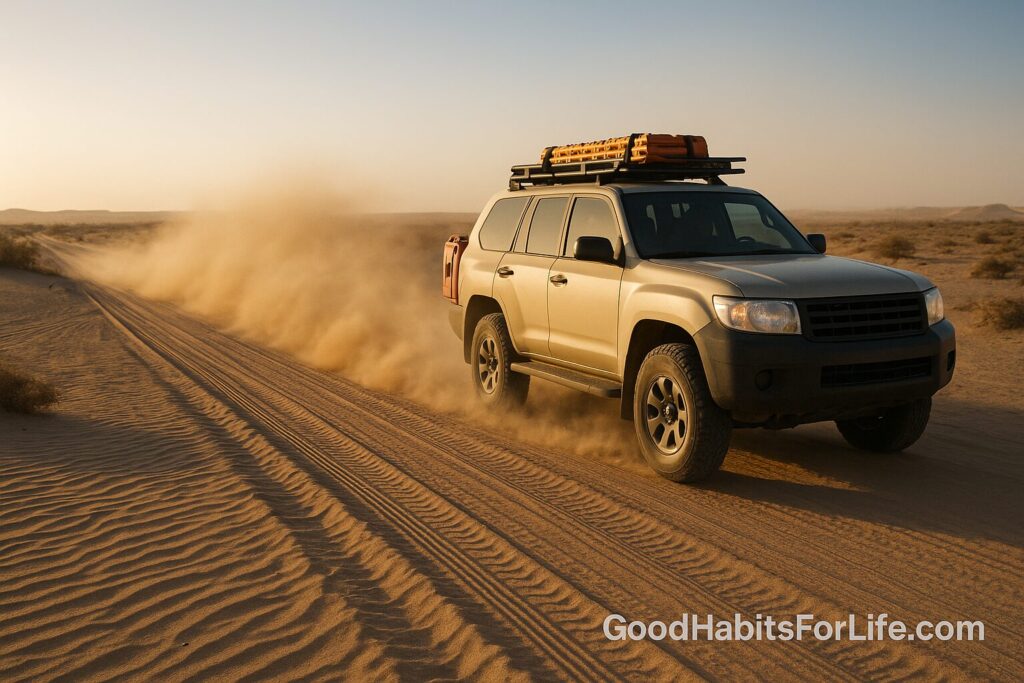
Dust & Desert: Filters, Range, and Recovery
Dust & Desert Driving: Filters, Range & Recovery
Table of Contents
🧭 What changes in the desert (and why it matters)
Desert driving combines three stressors: dust, heat and low-traction surfaces.
-
Dust compromises visibility and loads your engine air filter and cabin (HVAC) filter, which can reduce performance and air quality. In dusty conditions, reputable guidance recommends inspecting/replacing filters more frequently than “normal” schedules. AAA
-
Heat strains cooling systems and tires, and air-conditioning can significantly reduce fuel economy—by more than 25% in very hot conditions—so your range shrinks. fueleconomy.gov
-
Sand increases rolling resistance and demands different tire pressures and throttle control; airing down improves flotation and traction on oversand routes. National Park Service
✅ Vehicle prep: filters, cooling, tires & pressures
Engine air filter (intake):
-
Check at each fuel stop on dusty trips; replace sooner if restricted. AAA notes dusty rural conditions require more frequent replacement than clean-city intervals. AAA
-
Modern research confirms dust loading materially affects filter performance—plan spares. PMC
-
If your OEM manual has a severe service schedule, follow it (dust = severe). Example manufacturer guidance calls for more frequent air-cleaner service under “heavy dust.” Hyundai Owner’s Manual
Cabin (HVAC) filter:
-
Replace more often in dust to maintain defogging/AC airflow and reduce fine particles in the cabin. (Many vehicles specify inspection or change every 12–24 months; go shorter in dust.) Hyundai Owner’s Manual
Cooling system & fluids:
-
Verify coolant level/mixture, belt condition, and that fans engage normally. Hot weather magnifies any marginal issues (and AC adds load). cluballiance.aaa.com
Tires & pressures:
-
Check tread and pressure when tires are cold and use the door-placard specification—not the sidewall max. NHTSA+1
-
For oversand tracks, official park guidance typically recommends ~15–20 psi (103–138 kPa); some beaches specify ≤11–15 psi. Re-inflate before pavement. National Park Service+1
-
Choose tire types that match terrain (all-terrain vs. all-season), and avoid worn/overloaded tires in heat. NHTSA
🛠️ Quick Start: do-this-today checklist
-
Update maintenance: oil/coolant OK; new engine & cabin filters if borderline. AAA
-
Tires: inspect, set door-placard cold pressures; pack gauge & portable inflator. NHTSA
-
Dust storm plan: review “Pull Aside, Stay Alive.” Save the steps to your phone. National Weather Service
-
Water & heat: stock ≥3.8 L (1 gal) per person/day in vehicle; add electrolyte tabs; wide-brim hats. National Park Service
-
Recovery basics: shovel, traction boards or planks, tow strap/soft shackles, rated recovery points. (Some parks explicitly require boards.) National Park Service
-
Airing-down kit: tire deflators + compressor; target 15–20 psi off-road; reinflate after. National Park Service
-
Navigation & alerts: offline maps, paper map, weather app, Wireless Emergency Alerts enabled for dust/alerts. National Weather Service
⛽ Range planning in heat & sand
Why range drops:
-
AC is the biggest single hot-weather hit (can exceed 25% in extreme heat). fueleconomy.gov
-
Soft sand and low-speed off-road travel raise rolling resistance (tires + surface), increasing energy use. (Low-rolling-resistance research shows RR strongly influences fuel use even on-road.) Combustion Engines
Simple planner:
-
Start with your typical mixed driving range.
-
Subtract 25–30% for hot-AC conditions.
-
Subtract another 10–20% if significant sand driving is expected.
-
Add a 30% reserve (turn-back point at half the planned distance).
-
Carry a jerry can only if allowed and safely mounted; never inside passenger space.
On trip:
-
Keep speeds steady; avoid wheelspin; maintain momentum in sand. Manufacturer guidance emphasizes steady throttle and flotation over power. BFGoodrich Tires
📅 30–60–90 Habit Plan
Days 1–30 (Baseline & kit):
-
Service filters, tires, coolant; assemble water/heat kit; practice airing down & reinflation on a safe sand lot.
Days 31–60 (Proficiency): -
Learn recovery: shovel technique, traction boards, safe tow points, soft-shackle use; practice gentle throttle starts.
Days 61–90 (Advanced & rituals): -
Pre-drive ritual (below) becomes automatic; plan one supervised trail day; set seasonal reminder to inspect filters after each dusty weekend.
Pre-drive ritual (5 min): ABCDS
-
Air: set pressures; pack gauge/deflators/compressor. National Park Service
-
Belts/fluids: quick hood check. cluballiance.aaa.com
-
Cooling/AC: confirm fans; know AC’s range impact. fueleconomy.gov
-
Dust: check filters/spares. AAA
-
Safety: water, sun, comms, recovery points pinned. National Park Service
🧠 Techniques & frameworks (dust, sand, recovery)
Dust storm: PULL-ASIDE protocol
-
See dust wall? Do not enter. Safely exit travel lanes, lights off, brake set, stay buckled, wait. National Weather Service
Sand driving: A.I.R.
-
Air down to ~15–20 psi (103–138 kPa) on oversand routes; lower if regulations require. National Park Service+1
-
Inertia: steady momentum; no sharp steering; gentle throttle to avoid digging. BFGoodrich Tires
-
Re-inflate before pavement; heat + low psi = risk on asphalt. NHTSA
Stuck recovery: S.A.N.D.
-
Stop wheelspin (prevents burying).
-
Assess: choose a cleared path; reduce load (passengers out, lighten).
-
Nudge: dig leading/trailing ramps; place boards/traction devices; start in 2nd (manual) or sand mode. National Park Service
-
Deflate a bit more if needed; inch out smoothly; re-air once free. National Park Service
Heat & hydration (for drivers doing strenuous recovery):
-
Use Water-Rest-Shade; drink ~240 ml every 20 minutes when working in heat; add electrolytes for >2 hours of exertion. osha.gov
👥 Audience variations
-
Families: extra water/food; wide-brim hats; cabin filter spares for allergy/asthma-prone passengers. Hyundai Owner’s Manual
-
Solo travelers: satellite messenger, conservative range buffer (≥40%), leave route plan with a contact.
-
Professionals (field staff): standardize truck kits; daily ABCDS checks; OSHA hydration rules for crews. osha.gov
-
Renters/tourists: verify rental policy on airing down & off-pavement; carry boards only where permitted; follow local park tire-pressure rules. National Park Service
⚠️ Mistakes & myths to avoid
-
Myth: “Driving with hazards on helps in dust.” → Wrong. Pull far off roadway and turn all lights off to avoid being rear-ended by drivers who follow your lights. National Weather Service
-
Mistake: Entering a dust wall to “get through quickly.” Don’t. Zero-visibility pileups happen fast. National Weather Service
-
Mistake: Spinning wheels when stuck. It digs you in; stop, air down, dig ramps, use boards. National Park Service
-
Myth: “Sidewall-max pressure is the right setting.” Use the door placard and check when cold. NHTSA
🗣️ Real-life examples & scripts
Radio call (simple):
“Convoy, this is Car 3. Soft sand ahead. Airing down to 18 psi. Holding 30 km/h. Over.”
Passenger briefing (30 sec):
“If we hit dust, I’ll pull off and shut everything down. If we bog, stay seated until I ask for help to dig and place boards.”
Stuck micro-playbook:
-
Stop. Note where the chassis is touching.
-
Dig a 1–2 m ramp in the intended direction.
-
Place boards directly under tread; select low gear or sand mode; ease out 1–2 m.
-
Repeat if needed; re-air to road pressure before tarmac. National Park Service+1
🧰 Tools, apps & resources (quick picks)
-
Tire deflators + compressor: precise, repeatable airing down; reinflate before pavement. (Pros: traction; Cons: time.) National Park Service
-
Traction boards / planks: fast, low-risk recovery; many parks recommend/require them. (Pros: no snatch loads; Cons: bulky.) National Park Service
-
Shovel & work gloves: essential for creating ramps in soft sand.
-
Tow strap + rated soft shackles + recovery points: for assisted pulls; avoid hitch balls.
-
Sun & heat kit: shade tarp, hats, electrolyte tabs; follow Water-Rest-Shade. osha.gov
-
Weather & alert apps: enable Wireless Emergency Alerts for dust events. National Weather Service
📌 Key takeaways
-
Desert trips compress margins: filters clog sooner, fuel range shrinks, recovery matters.
-
Air down on sand (per local rules), keep momentum smooth, and re-inflate before pavement. National Park Service
-
Never drive into a dust storm. Pull aside, lights off, wait. National Weather Service
-
Plan water and rest like critical gear; dehydration ruins judgment and recovery. osha.gov
❓ FAQs
1) How often should I change my engine air filter if I drive in dust?
More often than “normal” intervals—inspect frequently and replace early in dusty use. Many owners see 10–15k km intervals off-road, but follow your severe-service guidance. AAAHyundai Owner’s Manual
2) What tire pressure should I use on soft sand?
Official park guidance typically suggests ~15–20 psi (103–138 kPa), sometimes down to ≈11–15 psi on specific beaches. Always re-inflate before pavement. National Park Service+1
3) Does AC really hurt range that much?
Yes—in very hot conditions, AC use can reduce fuel economy by >25%. Plan extra fuel. fueleconomy.gov
4) Which tires are best for desert trips?
Quality all-terrain tires balance on-road manners with off-road grip; ensure load rating is adequate and tread is healthy. NHTSA
5) What should I do if I meet a dust storm on the highway?
Do not drive into it. Safely exit lanes, turn lights off, set the brake, stay buckled, and wait for clearing. National Weather Service
6) How much water should I carry?
Parks commonly recommend ~3.8 L (1 gal) per person per day minimum in vehicles; carry more for hiking or remote routes. National Park Service
7) Are traction boards worth it?
Yes—fast, low-risk self-recovery in sand and recommended/required in some oversand areas. National Park Service
8) Can I just follow the tire’s sidewall pressure?
No. Use the door-placard cold pressure; sidewall shows maximum rating. NHTSA
📚 References
-
Arizona DOT / NWS. “Pull Aside, Stay Alive” dust-storm safety (PDF). National Weather Service
-
Arizona DOT. “When dust storms hit: Pull Aside, Stay Alive.” azdot.gov
-
NHTSA. Summer Driving Tips—check tire pressure cold; use door placard. NHTSA
-
Fueleconomy.gov (DOE). “Fuel Economy in Hot Weather” (AC impact >25%). fueleconomy.gov
-
NPS (Cape Lookout). “Over-Sand Vehicle (OSV) Use”—lower to 15–20 psi and reinflate after. National Park Service
-
NPS (Assateague). OSV tips—carry boards; operational guidance. National Park Service
-
NPS (Mojave). Safety—≥3.8 L (1 gal) water per person/day. National Park Service
-
OSHA. “Heat—Water. Rest. Shade.” Hydration frequency for work in heat. osha.gov
-
AAA. “Changing Your Car’s Engine Air Filter”—dusty conditions = more frequent changes. AAA
-
Dziubak T. Experimental Dust Absorption Study in Automotive Engine Air Filters (2024). PMC
-
NHTSA TireWise—tire types overview for conditions. NHTSA
-
BFGoodrich Off-Road Driving Tips—momentum & spin control in sand. BFGoodrich Tires
⚖️ Disclaimer
This guide is educational; follow local laws, your vehicle manual, and park regulations. Seek professional assistance for recovery or mechanical issues.