
Cold, Frost & Black Ice: Traction Basics
Cold, Frost & Black Ice: Traction Basics
Table of Contents
🧭 What is black ice—and why traction vanishes
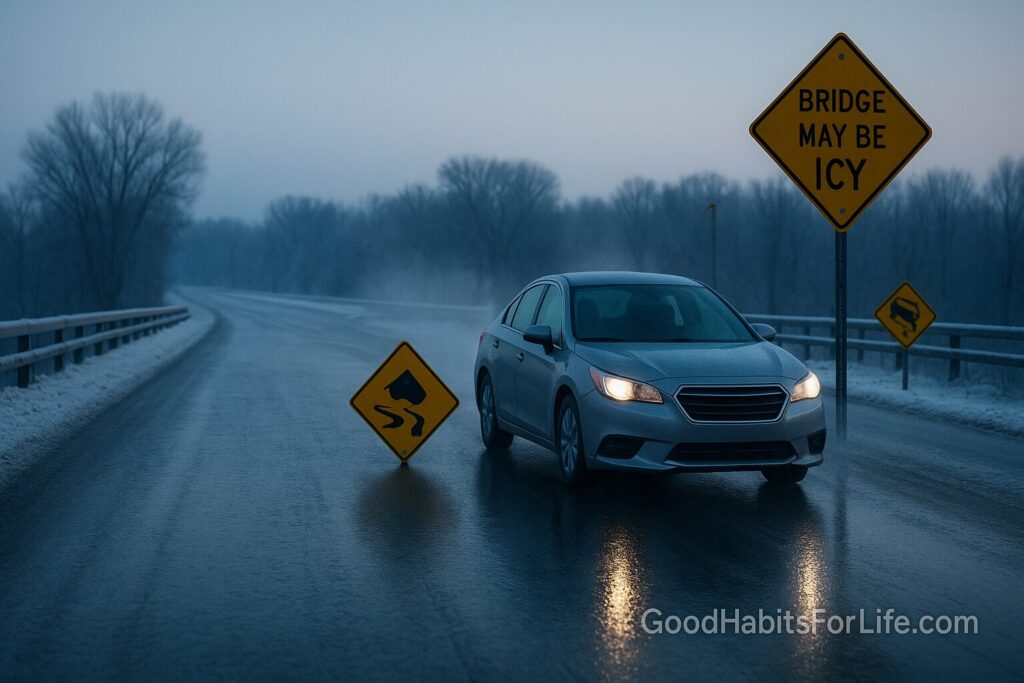
Black ice is a patchy, transparent glaze that blends with asphalt, making it hard to see. It often forms when wet roads refreeze near the freezing point or during freezing drizzle. Expect it at night and early mornings, especially on bridges, overpasses, and shaded stretches. forecast.weather.govNational Weather Service
Why traction disappears: ice drastically lowers tire-road friction, so any abrupt input (throttle, brake, steering) can exceed available grip and trigger a skid. That’s why stopping distances on ice can multiply—authorities advise margins up to ten times greater than in dry conditions. RAC
Modern safety tech helps, but physics still wins. Electronic Stability Control (ESC) and ABS can reduce certain crash types and help you steer while braking, yet they don’t make you stop like it’s summer. CrashStatsNHTSA
✅ Quick Start: Do-this-today checklist
-
Slow all inputs. Drive gently, brake earlier, and leave long gaps (aim 5–10+ seconds). AAA Exchange
-
No cruise control on snow/ice. You need instant, precise control. Illinois Department of Transportation
-
Know your ABS. With ABS, apply firm, steady pressure—don’t pump; without ABS, use gentle cadence braking. NHTSA
-
Check tires & pressure. Cold weather reduces tire pressure about 1 psi per 10 °F; verify “cold” pressures and top up. NHTSA
-
Prep your vehicle. Clear sensors/lights, stock a winter kit (scraper, blanket, gloves, shovel, traction mats, flashlight). NHTSA
-
Plan routes. Prefer treated roads; avoid bridge-heavy routes during refreeze windows. National Weather Service
🛠️ Habit Plan: 7-Day Winter-Driving Upgrade
Day 1 – Inspect & Inflate. Check tread depth, set “cold” tire pressures to the door-placard spec. Tire Rack
Day 2 – Learn your tech. Review your manual for ABS/ESC behavior; practice gentle stops in an empty, icy lot if safe. NHTSA
Day 3 – Pack the kit. Add scraper/brush, headlamp, gloves, chemical hand-warmers, reflective triangle, blanket, small shovel, traction aids, phone battery. NHTSA
Day 4 – Route & Weather routine. Check forecasts and advisories daily; build a “bridge awareness” habit. National Weather Service
Day 5 – Following-distance drill. Drive with a 5–10+ second gap; feel the reduced stress. AAA Exchange
Day 6 – Tires decision. If winters are common where you live, fit winter tires (below 7 °C they outperform all-seasons). Consumer Reports
Day 7 – Emergency simulation. Rehearse skid scripts (below) aloud; make it muscle memory. NHTSA
🧠 Techniques & Frameworks that keep grip
S.L.O.W. method
-
Smooth: feather throttle and brakes.
-
Look ahead: scan 12–15 s down the road for shiny patches and bridges.
-
Open space: keep big buffers and escape lanes.
-
Weight transfer: brake in a straight line; release before turning.
A.B.C. cues
-
Air temp near 0 °C? Assume refreeze risk.
-
Bridges/overpasses freeze first—slow before them, coast across. National Weather Service
-
Color & sheen: “wet-looking” asphalt in freezing weather can be black ice. ccohs.ca
Distance rules of thumb
-
Wet: double distance. Ice/snow: up to 10× longer to stop—leave huge margins. RAC
🛟 What to do if you hit black ice (ABS / non-ABS)
-
Stay calm; hold a steady wheel. Sudden moves break traction.
-
Ease off the accelerator. Let speed decay; don’t slam the brakes.
-
Steer where you want to go (your “escape path”). Look there; your hands follow your eyes. AAA Hoosier Motor Club
If you have ABS: press and hold the brake firmly; you’ll feel pedal pulsation—this is normal. Keep steering toward safety. NHTSA
If you don’t have ABS: use gentle cadence braking (press-release rhythm) while you steer; avoid locking wheels. NHTSA
Special case—bridges/overpasses: slow before the structure, coast across with minimal inputs; expect patchy grip. icyroadsafety.com
🛞 Tires, chains & pressure: getting traction right
-
Winter tires vs. all-season: In cold conditions (≤7 °C), winter tires use softer compounds and biting sipes to grip better and shorten stopping distances compared with all-seasons. Several government and testing sources recommend them for regular winter driving. ontario.caConsumer Reports
-
Measured differences: Controlled tests show meaningful stopping-distance reductions with winter tires on snow/ice (e.g., ~30 ft shorter at 48 km/h on packed snow in one Tire Rack test). Tire Rack
-
Chains/traction devices: Where legal and conditions demand, chains add bite on glare ice; follow local regulations and speed limits. (Check your state/provincial DOT before use.)
-
Tire pressure in the cold: Expect about 1 psi drop for every 10 °F (≈6 °C) temperature fall—check pressures often; under-inflation hurts grip and can trigger TPMS warnings. NHTSA
👥 Audience variations
-
Students / newer drivers: Practice low-speed maneuvers in an empty lot; narrate “slow-look-open-weight” while you drive to build habits. NHTSA
-
Parents with kids: Secure loose items, pre-warm safely (never in a closed garage), and set expectations: “We’ll arrive when it’s safe, not fast.” NHTSA
-
Professionals with long commutes: Choose routes with consistent treatment/plowing; schedule buffer time so you never feel rushed. FHWA Operations
-
Seniors: Consider winter tires even for light snow belts; the predictable grip reduces fatigue and sudden corrections. Consumer Reports
-
EV drivers: Pre-condition battery/cabin while plugged in and set regen to a milder mode on slick days to avoid abrupt weight transfer (vehicle-manual specific).
⚠️ Mistakes & myths to avoid
-
“AWD means I can go normal speed.” AWD helps you go, not stop—stopping distance still balloons on ice. RAC
-
“Pump ABS brakes.” Don’t. With ABS, press and hold—the system pulses for you. NHTSA
-
“Cruise control is fine if I’m careful.” Any slip can cause the system to accelerate or brake unexpectedly—leave it off on slick roads. Illinois Department of Transportation
-
“All-seasons are enough in real winter.” Below 7 °C, winter tires remain pliable and bite better, improving control and stopping. Consumer Reports
🎯 Real-life examples & copy-paste scripts
Bridge strategy (before freezing dawn):
“Temp is 0–2 °C, I see ‘wet’ shine ahead and a bridge sign. I’m easing to 30–40 km/h, widening my gap, and I’ll coast across with zero pedal inputs.”
Skid script (rear steps out):
“Eyes on my escape path. Off-throttle. Smooth counter-steer to line up. ABS? Hold brake and steer. No ABS? Gentle cadence braking.” NHTSA
Following distance mantra:
“Five… six… seven… seconds.” (Count between the lead car and a fixed roadside object.) AAA Exchange
🧰 Tools, apps & resources
-
Weather & alerts: National Weather Service web/app & local DOT road-condition pages for advisories, freezing drizzle, and flash-freeze risks. National Weather Service
-
Vehicle tech: Confirm ABS/ESC status and practice feel in safe areas; review owner’s manual sections on winter driving. NHTSA
-
Garage & kit: Digital tire gauge, portable inflator, de-icer, microfiber, compact shovel, traction mats or kitty litter, reflective triangle. NHTSA
📌 Key takeaways
-
Black ice is hard to spot—treat “wet-looking” roads near freezing as icy, especially on bridges and shaded areas. National Weather Serviceccohs.ca
-
Build time and space: bigger gaps and slower inputs prevent most winter incidents. AAA Exchange
-
Learn your ABS/ESC and practice; tech helps you steer, not defy physics. NHTSA
-
Winter tires plus correct pressure = the simplest traction upgrade in real winter. Consumer ReportsNHTSA
❓ FAQs
1) How can I tell black ice is ahead?
Look for a glassy “wet” sheen when air temps are near 0 °C, especially on bridges/overpasses, untreated side roads, and shaded sections. If in doubt, assume ice. National Weather Serviceccohs.ca
2) What following distance should I use on slick roads?
As a baseline, extend to at least 5–6 seconds—and more when it’s truly icy or downhill. AAA Exchange
3) Should I use cruise control on icy roads?
No. Maintain manual control so you can instantly adjust to changing grip. Illinois Department of Transportation
4) What do I do if my wheels lock and I don’t have ABS?
Release pressure slightly to let the wheels roll, then re-apply gently (cadence), steering toward your escape path. NHTSA
5) Do winter tires really make a difference on ice?
Yes. In cold conditions they’re designed to stay pliable and add biting edges; testing and official guidance show shorter stopping distances and better control than all-seasons. Consumer ReportsTire Rack
6) Why does my TPMS light come on during cold snaps?
Air contracts in the cold; tire pressure drops around 1 psi per 10 °F, which can trigger warnings. Top up to placard pressure when tires are “cold.” NHTSA
7) Does AWD help on ice?
AWD helps you launch and climb, but it doesn’t shorten stopping distance. Drive as if you’re on summer tires with rear-wheel drive—slow and smooth. RAC
8) Is ABS always better for stopping on ice?
ABS maintains steering control and often helps on low-grip surfaces, but stopping distance can still be long—plan for it and keep huge space. NHTSA
📚 References
-
National Highway Traffic Safety Administration (NHTSA). Winter Weather Driving Tips. NHTSA
-
NHTSA. Winter Driving Tips (2023–24 PDF). NHTSA
-
Federal Highway Administration (FHWA). Snow & Ice — Road Weather Management. FHWA Operations
-
NOAA / National Weather Service. Ice & Frost safety; black ice formation. National Weather Service
-
NOAA / NWS Glossary. Black Ice (definition). forecast.weather.gov
-
Canadian Centre for Occupational Health and Safety (CCOHS). Driving — Winter (PDF). ccohs.ca
-
Government of Ontario. Winter driving—winter tires improve traction/shorten braking distance. ontario.ca
-
Consumer Reports. Winter/Snow Tires vs. All-Season Tires: Comparison. Consumer Reports
-
Tire Rack. All-Season vs. Winter Tires Test Results; temperature & tire pressure guidance. Tire Rack+1
-
NHTSA. Electronic Stability Control effectiveness & ABS research. CrashStatsNHTSA
-
Illinois DOT. Winter Driving Tips (no cruise control; general safety). Illinois Department of Transportation
-
AAA. Winter Driving Tips—following distance guidance. AAA Exchange