
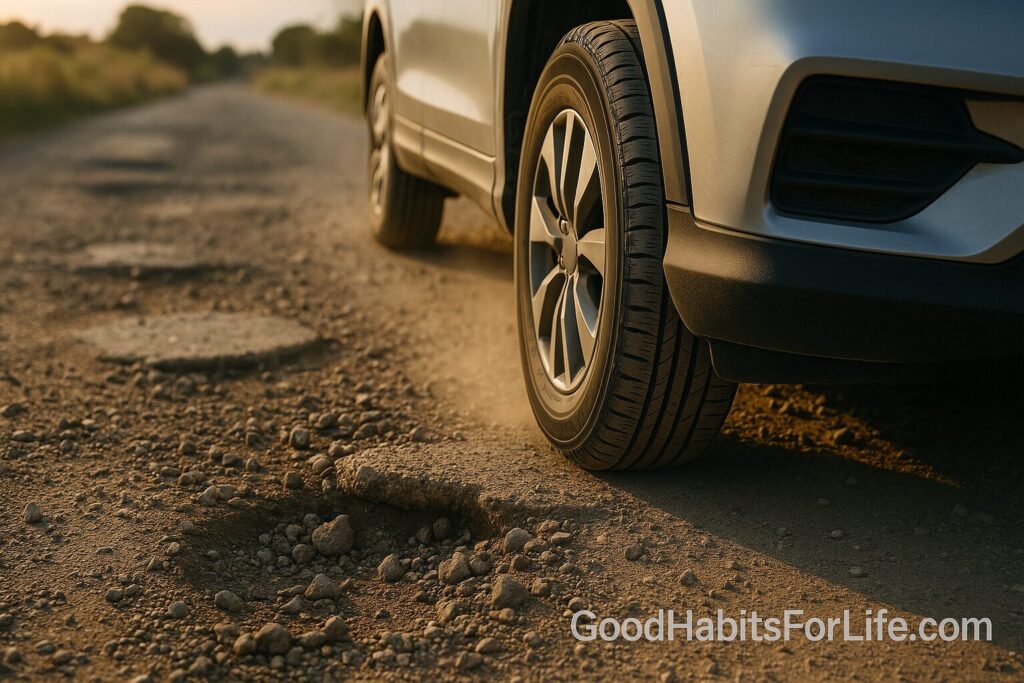
Gravel & Bad Roads: Tyre Pressure and Pace
Gravel & Bad Roads: Tyre Pressure & Pace
Table of Contents
🧭 What & Why: Gravel, pressure, and pace
Gravel and broken roads cut grip, extend stopping distances, and batter tyres and suspension. Two levers matter most:
-
Tyre pressure: Influences contact patch, heat, impact resistance, and puncture risk.
-
Pace: Governs stability, braking room, and the severity of hits from rocks and potholes.
You’ll drive safer and spend less on tyres/suspension if you keep pressures appropriate for load and speed—and match pace to sight lines and surface quality.
✅ Quick Start: Do this today
-
Read the placard on your door jamb or owner’s manual (cold pressure in kPa/psi for front/rear and for “normal” vs “full load”).
-
Start at placard for most gravel. If the surface is very rough/corrugated and you’ll stay below ~60 km/h (37 mph), consider a small, temporary reduction (≈10–15%) for comfort and grip.
-
Re-inflate to placard before sustained speeds ≥80 km/h (50 mph).
-
Drive smoothly: gentle throttle, earlier braking, no sharp steering.
-
Scan and choose lines that avoid loose marbles, sharp edges, and pothole clusters.
-
Extend space: at least 4–6 seconds following distance on gravel; more in dust.
-
Check tyres cold at the next stop; look for cuts, bulges, embedded stones.
🛠️ Tyre Pressure Fundamentals (with example settings)
Placard (cold) pressure is engineered for your vehicle’s mass, tyre size, and intended speeds. On gravel and broken tarmac:
-
Default: Use placard for most conditions.
-
Very rough/slippery at low speeds: A modest air-down (≈10–15%) can smooth impacts and improve compliance.
-
Heavier loads & higher speeds: Stay at or above placard to control heat and protect sidewalls.
-
Low-profile tyres (≤50 aspect), run-flats, or full load: Do not air down; reduce speed instead.
Example (illustrative only):
Placard: 240 kPa (35 psi) loaded.
• Corrugated gravel at ≤60 km/h: ~210–215 kPa (30–31 psi), then re-inflate before >80 km/h.
• Broken urban tarmac with potholes at low speed: keep near placard; slow down to avoid rim strikes.
Why modest only? Too low raises heat and sidewall flex, risks de-beading, rim damage, and TPMS alerts. The safest “gravel comfort” comes from small reductions paired with lower speeds.
🚦 Safe Pace, Lines & Braking on Loose Surfaces
-
Speed rule: If you can’t stop within what you can see, you’re too fast. Gravel braking distances can be 2× tarmac.
-
Smooth inputs: Feed throttle/steering/brake gently; sudden moves shear grip.
-
Cornering: Enter slower than you think; avoid mid-corner brakes; keep lines wide and tidy.
-
ABS/ESC: Leave on; expect longer stops and some pedal vibration.
-
Following distance: Minimum 4–6 s; dust can fully hide hazards—back off further.
-
Line choice: Avoid deep marbles, sharp rock edges, and standing water; cross ruts straight and slow.
-
Downhills: Use low gears/regen to reduce brake heat; brake early and lightly.
⚠️ When Not to Air Down (and what to do instead)
Skip airing down and slow right down when you have:
-
Low-profile or run-flat tyres, full load, or tow weight near limits.
-
High sustained speeds (≥80 km/h) ahead.
-
Unknown sharp-rock sections where sidewall cuts are likely.
-
No compressor to re-inflate.
Instead: Hold placard, drop pace to where impacts feel gentle, and pick cleaner lines.
🧪 Techniques & Mini-Frameworks
-
S-M-O-O-T-H
-
Sight lines first • Minimal steering • Observe marbles/ruts • Open distance • Throttle gently • Hold placard unless truly rough/slow.
-
-
Check-Set-Scan: Check placard → Set pressure (or small, temporary reduction) → Scan surface continuously and adjust pace first.
-
Stop-Inspect-Adapt: After rough segments, stop, feel for heat, inspect tread/sidewalls/valves, adapt pressure/pace.
👥 Variations: Small cars, SUVs, EVs, fully loaded trips
-
Small cars / city tyres: Sidewalls are short and rims vulnerable; keep near placard and go slow over holes.
-
SUVs with higher sidewalls: A small air-down at low speeds can help on corrugations; re-inflate for sealed roads.
-
EVs (heavier curb weight): Heat builds faster; stick closer to placard, lean more on regen for downhills, and monitor TPMS.
-
Fully loaded / roof-racks / towing: Use the loaded placard value; pace is your primary lever.
🚫 Mistakes & Myths to Avoid
-
Myth: “Lower is always better on gravel.” Too low overheats and damages tyres.
-
Mistake: Airing down without a compressor. You’ll be stuck low for highways.
-
Myth: TPMS will always warn in time. Many sensors trigger late; don’t rely on them alone.
-
Mistake: Hitting potholes fast at low pressure. That’s how rims bend and sidewalls pinch.
-
Myth: ABS means normal stopping. Expect longer distances on loose surfaces.
💬 Real-Life Examples & Scripts
-
Family hatch on rough county road
“Placard says 240 kPa (35 psi). The road is corrugated and I’m staying under 60 km/h. I’ll drop to ~210 kPa (30–31 psi) for comfort, keep speeds gentle, and air back to 240 kPa at the service station before I rejoin the highway.” -
Loaded SUV on rocky patch
“I’m at the loaded placard. Rocks are sharp and we’re heavy. I’ll keep pressure as is, crawl at 20–30 km/h, and choose clean lines to protect sidewalls.” -
EV on long gravel descent
“Hold placard, select strong regen, brake early and lightly, maintain big gaps in dust, and stop halfway to check temperatures.”
📅 7-Day Habit Plan for Safer Rough-Road Driving
Day 1: Find the placard and note pressures for normal vs loaded.
Day 2: Buy a digital gauge and learn to check tyres cold.
Day 3: Add a portable compressor, plug kit, and gloves to the boot.
Day 4: Practice the S-M-O-O-T-H framework on a quiet gravel lane.
Day 5: Set a pre-trip checklist (pressure, tools, space, pace).
Day 6: Learn TPMS reset/alerts in your manual.
Day 7: Create a “re-inflate before highway” reminder card on your phone.
🧰 Tools, Apps & Resources
-
Digital tyre gauge (accurate to ±1 psi / ±7 kPa).
-
12 V compressor (duty cycle ≥30% for repeated inflations).
-
Tyre plug kit and gloves.
-
Torque wrench for wheel nuts after puncture repair.
-
Navigation apps with offline maps and terrain (e.g., OSM-based).
-
Dash camera (helps in dust/incident review).
Pros/cons: Gauges and compressors add weight/cost but pay for themselves in saved tyres and time.
🔑 Key Takeaways
-
Start with placard pressure; on very rough roads at low speed, consider a small temporary reduction and re-inflate before higher speeds.
-
Pace and smoothness prevent most incidents—more than pressure alone.
-
Choose clean lines, extend following distance, and inspect tyres regularly.
-
Avoid airing down with heavy loads, high speeds, low-profile/run-flat tyres, or no compressor.
❓ FAQs
1) What’s the “right” gravel pressure?
There’s no single number. Use placard as home base; only reduce slightly for very rough surfaces at low speeds—and re-inflate before fast travel.
2) Will lowering pressure always improve grip?
Not always. On sharp rock or with low-profile tyres, lower pressure raises damage risk. Grip gains are modest; speed control matters more.
3) How often should I check pressure on a long gravel trip?
Check cold each morning and after any hard hit or long rough section. Inspect tread and sidewalls for cuts.
4) Do I need a compressor?
If you ever air down, yes. It lets you return to placard before highways and adjust for changing conditions.
5) Does ABS/ESC work on gravel?
Yes, but stopping distances are longer and ABS may feel “chattery.” Drive with more space and brake earlier.
6) Can I use the same approach for sand or mud?
No—those often require much larger pressure changes and specific recovery gear. This guide focuses on gravel and bad tarmac, not deep sand/mud.
7) What about EVs?
They’re heavier; stick close to placard, rely on regen on descents, and watch heat buildup.
8) How do I know I went too low?
Signs include TPMS warnings, squirmy handling, rim hits, or heat smell. Stop, re-inflate, and slow down.
📚 References
-
National Highway Traffic Safety Administration (NHTSA). Tires – Safety, Maintenance & TPMS. https://www.nhtsa.gov/equipment/tires
-
U.S. Tire Manufacturers Association. Tire Maintenance & Safety Basics. https://www.ustires.org/tires-101/maintenance-safety
-
Transport for NSW (Australia). Driving on unsealed roads — drive to conditions. https://www.nsw.gov.au/driving-boating-and-transport/road-safety/driving-safely/unsealed-roads
-
Waka Kotahi NZ Transport Agency. Unsealed roads: driving safely. https://www.nzta.govt.nz/safety/driving-safely/unsealed-roads/
-
RACV (Australia). How to drive on unsealed roads. https://www.racv.com.au/royalauto/lifestyle-cars/car-advice/how-to-drive-on-unsealed-roads.html
-
Michelin. When and how to check tire pressure. https://www.michelinman.com/auto/tires/learn/when-to-check-tire-pressure
-
AAA. Tire Pressure & TPMS Essentials. https://exchange.aaa.com/safety/automotive/
-
Government of Western Australia — Road Safety Commission. Unsealed roads safety. https://www.rsc.wa.gov.au