
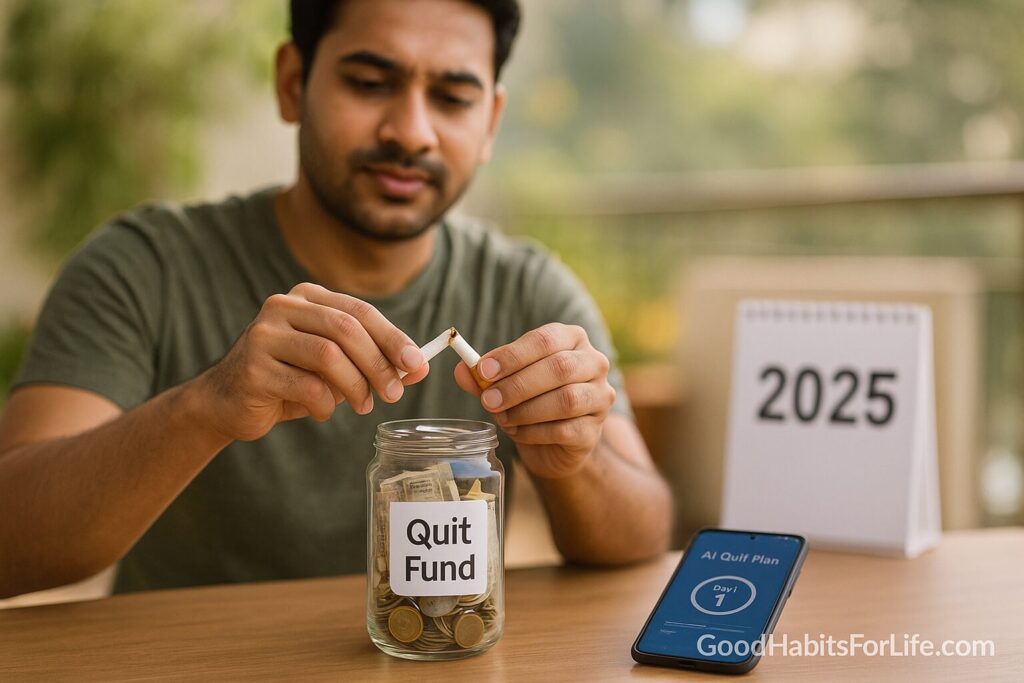
Your Why to Quit: Health, Money, Family: AI workflows (2025)
Why Quit Smoking (2025): Health, Money, Family + AI
Table of Contents
🧭 What & Why: The case for quitting now
Health: Cigarette smoke damages nearly every organ. Quitting lowers heart rate and blood pressure within 20 minutes; carbon monoxide levels normalize in ~24 hours; heart attack risk drops substantially within weeks, and stroke risk approaches that of a never-smoker in 5–15 years. Cancer risks fall over time; the earlier you quit, the bigger the gain. Authoritative bodies (WHO, CDC, NCI) all document these timelines and risk reductions.
Money: Pack prices vary globally, but the math is simple: (packs per day × price per pack × 365). Even 0.5 pack/day at ₹300 (≈US$3.6) costs ~₹54,750 (US$660) yearly. Many readers will save 1–3 months of rent or a meaningful chunk of tuition.
Family: Secondhand smoke raises risks of SIDS, lower respiratory infections, ear disease, and asthma attacks in children; it increases heart disease and lung cancer risk for adults. A smoke-free home and car are protective.
Hope: Most smokers try multiple times before success. Evidence-based aids (combination NRT, varenicline, bupropion, counseling, quitlines, digital programs) double to triple quit rates compared with willpower alone.
✅ Quick Start: Do this today
-
Pick a quit date (within 7–14 days). Put it in your calendar; tell one supportive person.
-
Start pre-quit medication (if appropriate):
-
Varenicline: typically begin 1 week before quit day.
-
NRT: start a patch daily; add gum/lozenge for cravings.
-
Bupropion SR: usually start 1–2 weeks before.
(Talk to your clinician/pharmacist to check safety and choose.)
-
-
Make your home/car 100% smoke-free today.
-
List top 3 reasons (“Whys”): health, money, family—write them on your phone lock screen.
-
Set a money goal: open a separate “Quit Jar” savings (UPI/autosave).
-
Text ‘QUIT’ to your national quitline (or call) and install a quit-app (see tools).
-
Prepare replacements: sugar-free gum, water bottle, toothpicks, 5-minute walk playlist.
-
Plan your toughest moments (after meals, tea/coffee, commute, stress): pair each with a replacement action.
-
Snapshot your baseline: morning cough, stairs test, pulse rate, daily spend—so progress is visible.
🛠️ 30-60-90 Habit Plan
Days 0–30: Stabilize
-
Medication: Daily patch + short-acting NRT when cravings hit (or varenicline/bupropion per plan).
-
Craving rule (4Ds): Delay 10 minutes, Deep breathe 4–7–8, Drink water, Do something else.
-
Routine anchors:
-
Wake: 60-second stretch + glass of water.
-
After meals: mint gum + 5-minute walk.
-
Commute: podcast + fidget tool.
-
-
Triggers log: Each craving → note When/Where/Feeling/Action.
-
Savings: Auto-transfer daily “cigarette budget” to the Quit Jar.
-
Shield your environment: Remove lighters/ashtrays; launder smoke-scented items.
-
Support: 1 human check-in per day (friend/partner/quitline coach).
Checkpoint (Day 30): Smoke-free streak, fewer coughs, better taste/smell, resting HR down, ₹/US$ saved.
Days 31–60: Strengthen
-
Taper short-acting NRT; keep a few for emergencies.
-
Fitness nudge: Add 2×/week brisk 20-minute walk or light strength routine (improves mood and weight control).
-
Stress tools: brief mindfulness (3 minutes), progressive muscle relaxation.
-
Identity work: “I’m a non-smoker.” Replace social patterns (tea break = fruit + chat).
-
Relapse rehearsal: If you slipped, reset the next hour—not “next Monday.”
Checkpoint (Day 60): CO levels normal, stamina up, noticeable savings; review your “Why” list.
Days 61–90: Sustain
-
Medication: Taper patch per label or clinician advice.
-
New rewards: Use Quit Jar to buy something symbolic (shoes/air purifier/mini trip).
-
Guardrails: Keep smoke-free rules for home/car; decline “just one.”
-
Give back: Share your story; accountability helps you too.
Checkpoint (Day 90): You’ve banked 12+ weeks—relapse risk persists, but your systems are strong.
🧠 Techniques & Frameworks that work
-
Medication + Behavioral Support (gold standard): Strong evidence that combining pharmacotherapy (NRT, varenicline, bupropion) with counseling/quitlines/apps improves outcomes over either alone.
-
Implementation Intentions: “If it’s 4 pm and I crave, then I will walk the stairs for 3 minutes.”
-
Urge Surfing: Notice the craving as a wave; breathe and watch it pass in ~5–10 minutes.
-
Temptation Bundling: Reserve a favorite podcast/series for walks during craving windows.
-
Environment Design: Keep cigarettes inaccessible; place water/gum in easy reach.
-
Identity-Based Habits: Act as the kind of person you want to be (“non-smoker who protects family”).
-
Financial Reframing: Convert each avoided pack to a visible micro-reward.
🤖 AI Workflows: Your pocket quit-coach
Use any safe AI assistant/app to automate small decisions. Copy-paste and adapt these:
1) Daily Morning Prime (90 seconds)
-
Prompt: “Create a 3-line pep talk using my 3 Whys: [health], [money goal], [family]. Include one breathing cue and one tiny action for the first craving window.”
-
Output target: lock-screen note.
2) Trigger Mapper
-
Prompt after each craving: “Log this craving in a table with columns: time, location, feeling, trigger, action taken, urge 1–10. Suggest a better action next time.”
-
Weekly: ask the AI to summarize top triggers and best counter-moves.
3) Relapse Reboot Script
-
Prompt: “I slipped and had a cigarette. Write a 60-second compassionate reset, 3 lessons learned, and a 24-hour plan. Keep it non-judgmental.”
4) Money Motivator
-
Prompt: “I saved ₹/US$X this week by not smoking. Suggest a reward ladder for 1, 4, 12 weeks aligned to [goal].”
5) Social Shield
-
Prompt: “Write three polite lines to decline a cigarette in a social setting, matching a friendly tone in [country/culture].”
6) Medication Adherence
-
Prompt: “Build a reminders schedule for [patch/varenicline/bupropion] with common side-effects and when to call a doctor. Format as checklist.”
Tip: Keep these as pinned notes or Shortcuts; schedule them on your calendar for the first 30 days.
👥 Variations: Students, parents, professionals, seniors, teens
-
Students: Campus triggers = late-night study + social events. Pair caffeine with water; keep gum and 5-minute movement breaks.
-
Parents/Caregivers: Emphasize smoke-free home/car; involve children in rewards (“family picnic fund”).
-
Professionals: Replace smoke breaks with walking one-on-ones; use calendar nudges.
-
Seniors: Check medication interactions, use lower-intensity exercise; discuss lung screening eligibility with clinician.
-
Teens: Focus on identity, sports performance, and money savings; get family/coach support; address nicotine vapes too.
⚠️ Mistakes & Myths to avoid
-
“I’ll just go cold turkey without support.” Possible, but success rates are lower than with evidence-based aids.
-
“One cigarette won’t matter.” It restarts neural patterns; treat it as an urgent-care moment.
-
“Weight gain is inevitable and huge.” Average gain is modest; activity and mindful eating can minimize it.
-
“NRT is just replacing one addiction.” Used correctly, NRT is safer than smoking and helps you quit.
-
Skipping meals or sleep. These amplify cravings; prioritize basics.
-
Hiding the quit. Telling one or two allies boosts accountability.
💬 Real-Life Examples & Scripts
-
At a party: “I’m off cigarettes—saving for a trip. I’ll grab a soda instead.”
-
After dinner craving: “Timer for 5 minutes; I’ll walk the block and chew gum.”
-
Stress at work: “Two box breaths, then 20 wall push-ups.”
-
Offered a cigarette by a friend: “Thanks, I’m smoke-free now. Hold me to it!”
-
Slip happened: “I’m resetting now. Patch on, water, short walk, text my buddy.”
🧰 Tools, Apps & Resources (brief pros/cons)
-
National Quitlines (phone/text/web): Free counseling, tailored plans; time-limited but high-value.
-
SmokefreeTXT / Smokefree apps (US & global variants): Daily tips, cravings logging; notifications help adherence.
-
Kwit, Smoke Free, EasyQuit: Gamified streaks, health/savings dashboards; premium features may cost.
-
Medication:
-
NRT (patch + gum/lozenge): Flexible dosing; minor skin irritation/jaw fatigue possible.
-
Varenicline: Strong efficacy; possible nausea/vivid dreams—take with food and discuss side-effects.
-
Bupropion SR: Helps with cravings and mood; check contraindications.
-
-
Carbon-Monoxide (CO) monitors: Immediate feedback; optional but motivating.
-
Air purifiers: Help de-smoke environments post-quit; cost consideration.
🔑 Key Takeaways
-
The best time to quit is now; benefits start within minutes and keep compounding.
-
Combine medication + counseling/quitlines/apps for the highest success odds.
-
Design your environment and identity to match “non-smoker.”
-
Use AI micro-workflows for planning, logging, and compassionate resets.
-
Follow the 30-60-90 plan and protect your home/car as smoke-free zones.
-
Convert each craving overcome into visible savings toward a meaningful goal.
❓ FAQs
1) How long do cravings last?
Most peak in the first week and last 5–10 minutes. Frequency and intensity decline markedly over 2–4 weeks.
2) What if I slip?
It’s a data point, not a failure. Re-apply your plan immediately, review the trigger, and contact support that day.
3) Which medication is best?
Varenicline and combination NRT are among the most effective; choice depends on health history, access, and preference—ask your clinician/pharmacist.
4) Will I gain weight?
Some do, on average a few kilograms. Planning snacks, movement, and sleep reduces this. Health gains from quitting far outweigh modest weight changes.
5) Is vaping a good way to quit?
Evidence varies by product and regulation; some adults switch successfully, but dual use is common. Many guidelines still recommend first-line approved meds and counseling; discuss with your clinician.
6) How do I calculate my savings?
(Packs/day × price × 365). Move that amount daily to a separate savings account to “see” progress.
7) When should I consider lung cancer screening?
If you’re in a high-risk group (e.g., certain age and pack-year history), a clinician can assess your eligibility for low-dose CT screening.
8) How do I protect my family right now?
Make your home/car 100% smoke- and vape-free; never smoke near kids or indoors. Ventilation alone doesn’t eliminate risk.
9) What if stress makes me want to smoke?
Use urge surfing, brief breathing, short walks, and social micro-support. Pair with short-acting NRT if prescribed.
10) How long until my risk drops?
Cardiovascular risk starts dropping within weeks and keeps improving; cancer risks decline over years—the earlier you quit, the greater the reduction.
📚 References
-
World Health Organization. Tobacco: health effects and benefits of quitting. https://www.who.int/news-room/fact-sheets/detail/tobacco
-
Centers for Disease Control and Prevention. Health Benefits of Quitting Smoking Over Time. https://www.cdc.gov/tobacco/quit_smoking/how_to_quit/benefits/index.htm
-
National Cancer Institute. Harms of Cigarette Smoking and Health Benefits of Quitting. https://www.cancer.gov/about-cancer/causes-prevention/risk/tobacco/cessation-fact-sheet
-
U.S. Public Health Service / Agency for Healthcare Research and Quality. Treating Tobacco Use and Dependence: 2008 Update (still widely cited for combined therapy efficacy). https://www.ahrq.gov/prevention/guidelines/tobacco/index.html
-
Cochrane Tobacco Addiction Group. Combination pharmacotherapy and behavioural support for smoking cessation (systematic reviews). https://www.cochranelibrary.com/topic/Smoking%20and%20tobacco
-
CDC. Secondhand Smoke: Health Effects. https://www.cdc.gov/tobacco/data_statistics/fact_sheets/secondhand_smoke/health_effects/index.htm
-
U.S. Preventive Services Task Force. Lung Cancer Screening Recommendation (for high-risk adults). https://www.uspreventiveservicestaskforce.org/
-
National Health Service (UK). Stop smoking treatments. https://www.nhs.uk/live-well/quit-smoking/nhs-stop-smoking-services-and-treatments/
Disclaimer: This article is for education only and is not a substitute for personalized medical advice; consult a qualified health professional before starting or changing any medication or treatment.