
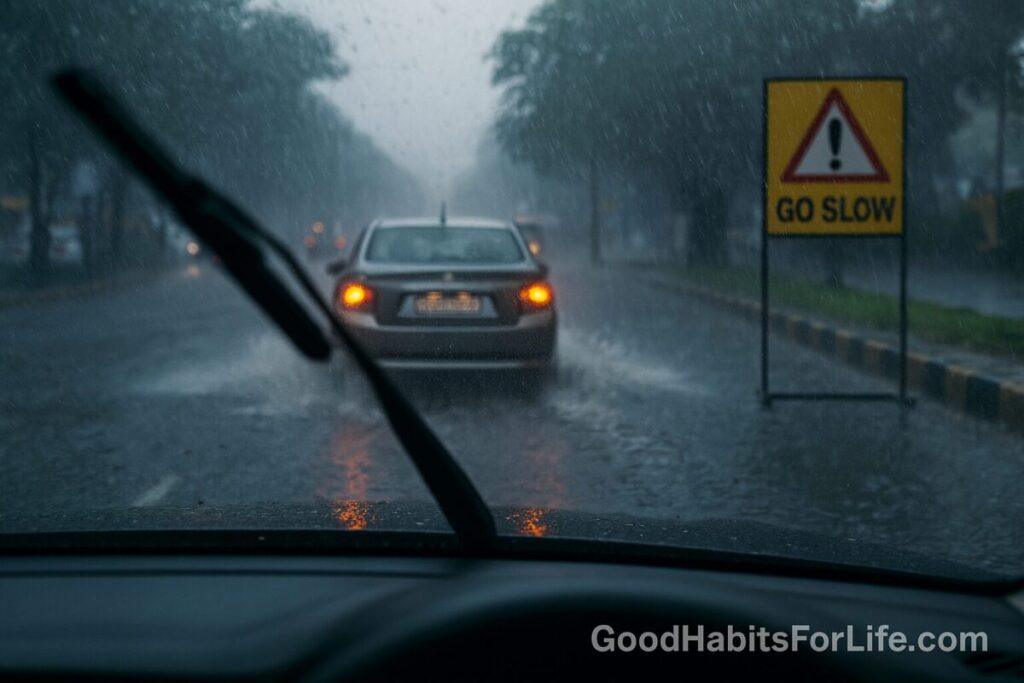
Monsoon Driving: Wipers, Wake, and Water Depth
Monsoon Driving: Wipers, Wake & Water Depth
Table of Contents
🧭 What this guide covers & why
Monsoon rain changes driving physics: visibility drops, braking distances grow, tires can ride up on water (aquaplaning), and even shallow flooding can disable or sweep a vehicle. This guide translates best-practice road-safety advice into practical habits you can apply today: how to set up your wipers and glass for clear sight, how slow to go, how to judge water depth/flow, what to do if you aquaplane, and how to drive through shallow water only when it’s genuinely safe.
Key benefits
-
Fewer close calls in downpours.
-
Better visibility and reaction time.
-
Reduced risk of engine hydrolock or electrical failure from water.
-
Confident, step-wise actions under pressure.
✅ Quick safety setup: wipers, glass & defogging
1) Wipers & washer
-
Replace blades every 6–12 months or at first signs of streaking/judder.
-
Fill washer reservoir with proper washer fluid (not plain water) so it cuts road film.
-
Use the correct wiper speed: intermittent for drizzle; continuous low for steady rain; high only when needed (it can chatter and wear faster).
2) Windshield & windows
-
Clean outside with a quality glass cleaner (remove road film/oil).
-
Clean inside (haze forms from plastics off-gassing).
-
Consider a hydrophobic coating on the exterior glass; it helps bead water at speed, improving visibility.
3) Fast defog routine (copy/paste)
-
A/C on (yes, even if it’s cool—A/C dries air).
-
Temp to warm-neutral, not hot blast.
-
Airflow to windshield + feet, fresh-air intake (not recirculate).
-
Rear defogger on; wipe side mirrors if safe to stop.
4) Tires & tread
-
Aim for ≥3–4 mm tread depth for wet grip (legal minimums are often lower but give poor wet performance).
-
Check pressure monthly; underinflation increases aquaplaning risk.
🛠️ Speed, spacing & lights in heavy rain
Slow is smart. Wet stopping distances can double. In heavy rain:
-
Drop 10–20 km/h (6–12 mph) below the posted limit—or more if visibility/standing water is bad.
-
Maintain a 5–6 second following gap; longer at night or in spray.
-
Low beams in rain, day or night. High beams reflect from raindrops and reduce contrast.
-
Use fog lights only if your local rules allow and visibility is severely reduced.
-
No hazard lights while moving (unless your jurisdiction explicitly instructs otherwise). Use them when stopped or as a road hazard, not as “I can’t see.”
Lane choice
-
Middle lanes are often less flooded than outer lanes.
-
Avoid ruts that channel water; they increase aquaplaning risk.
Control inputs
-
Smooth throttle, braking, and steering; avoid cruise control in heavy rain.
🌊 Reading water depth (and flow) safely
Golden rule: If you can avoid driving through floodwater, do so. Turn back or choose another route.
Quick checks
-
Watch other vehicles: their wheel height vs. water line gives a rough estimate.
-
Look for ripples/wakes against curbs—it can indicate depth and flow.
-
Water that is moving is far more dangerous than still water.
Conservative thresholds
-
~10–15 cm (4–6 in) of moving water can cause a loss of control or stall a small car.
-
~30 cm (12 in) can float many cars.
-
~60 cm (24 in) can carry away most vehicles.
If you’re not certain of depth or road integrity (open manholes, washed-out sections), do not enter.
🌬️ Aquaplaning (hydroplaning): prevention & recovery
What it is: Tires ride up on a thin water film, losing contact with the road. Steering goes light; you may feel the engine rev freely.
Prevention
-
Keep speeds moderate, especially where water is pooling.
-
Good tread depth (≥3–4 mm) and correct pressure.
-
Avoid hard steering or braking in standing water.
If you aquaplane
-
Stay calm; gently ease off the throttle.
-
Keep steering straight; don’t yank the wheel.
-
Do not brake hard. When grip returns, steer and brake gently.
-
If you have a manual, depress the clutch to let the tires re-engage without engine torque.
🚘 The “wake” (bow wave) technique—when and how
Only consider this for short, shallow sections you must cross (e.g., curb-to-curb puddling) when you’ve judged depth and there’s no safer option.
Set-up
-
Engage 1st/low gear (or low manual mode in automatics).
-
Creep at 3–5 km/h (2–3 mph)—just enough to form a small bow wave ahead of the bumper.
-
Keep steady revs; do not stop mid-water.
-
Avoid oncoming splash/wakes from large vehicles—wait and time your entry.
-
After exiting: gently brake to dry the pads; check that steering and engine feel normal.
Never attempt if water is above the mid-wheel height, flowing strongly, or you can’t see the road edge/drain covers.
🗓️ 7-Day Monsoon-Ready Habit Plan
Goal: One week to hard-wire safer routines.
Day 1 – Inspect & replace
-
Fit new wiper blades; top up washer fluid.
-
Check tire tread and pressure.
Day 2 – Glass & vision
-
Deep-clean inside/outside glass; apply hydrophobic coating to windshield.
Day 3 – Defog drill
-
Practice the A/C + fresh-air defog sequence until it’s automatic.
Day 4 – Route & alerts
-
Save 2–3 alternate routes in your maps app.
-
Subscribe to local weather and traffic alerts.
Day 5 – Spacing & speed
-
On your next rainy drive, consciously hold a 6-second gap; note the calmer feel.
Day 6 – Aquaplane rehearsal (dry run)
-
Mentally rehearse: “Ease off throttle, steer straight, no hard brake.” Say it out loud.
Day 7 – Water-hazard policy
-
Write your rule: “Unknown depth? I turn around.” Share it with family/colleagues who ride with you.
👥 Variations for students, parents, professionals & seniors
-
Students & new drivers: Practice the defog drill and 6-second gap with an experienced driver in low-risk conditions first.
-
Parents with kids onboard: Pre-pack towels, a small umbrella, and a flashlight. Kids can fog up glass—use fresh-air intake early.
-
Professionals with long commutes: Keep a micro-kit: phone mount, charging cable, glass cloth, and a compact rain jacket to reduce rush-out stress.
-
Seniors: Ensure anti-glare prescriptions are current; consider additional rest stops in heavy rain to reduce fatigue.
⚠️ Mistakes & myths to avoid
-
Myth: “High beams help you see more in rain.”
Fact: They can reduce contrast via back-glare. -
Myth: “Cruise control is fine in the wet.”
Fact: It can maintain throttle when you need to lift off. -
Mistake: Entering water because “that car made it.”
Vehicle height, intake position, and weight differ—don’t copy blindly. -
Mistake: Braking hard during aquaplaning—this locks tires and prolongs the slide.
-
Mistake: Using recirculate when glass fogs—this traps humidity.
💬 Real-life examples & scripts
At a shallow curb-to-curb puddle
-
Decision: “Depth looks <10 cm, no flow, solid road edges visible.”
-
Action script: “Low gear, 3–5 km/h, steady revs… out… test brakes.”
When aquaplaning starts
-
Self-talk: “Lift. Straight hands. Wait for grip.”
-
Passenger talk: “Hang on—coasting through water, it’ll bite again.”
At an unknown-depth underpass
-
Rule: “Turn Around, Don’t Drown.”
-
Action: Indicate, pull into a safe bay, check map for alternate route.
📱 Tools, apps & resources
-
Weather apps/alerts: National meteorological service app, rain radar, and push warnings.
-
Navigation: Map apps with real-time reports; save offline maps for low-signal areas.
-
Car kit: Microfibre glass cloth, squeegee, torch, tyre gauge, poncho, and tow strap.
-
In-car tech: Use voice commands; keep the phone in a mount to avoid fumbling.
Pros & cons (quick)
-
Weather radar: Great for timing your departure; needs data connection.
-
Hydrophobic coatings: Better vision above ~60 km/h; reapply every few months.
-
Fog lights: Useful in very poor visibility; can glare others if misused.
🧾 Key takeaways
-
Prepare your wipers, glass, and defog routine before the rains hit.
-
In heavy rain: slow down, 5–6 s gap, low beams.
-
Never enter water of unknown depth or strong flow.
-
If you aquaplane: lift off, steer straight, wait for grip.
-
For shallow, safe crossings only: low gear, tiny bow wave, test brakes after.
❓ FAQs
1) What’s the safest following distance in heavy rain?
Aim for 5–6 seconds; add more at night or in spray.
2) Should I use hazard lights while moving in heavy rain?
Generally no; use low beams and fog lights (if legal). Reserve hazards for when stopped or an immediate hazard.
3) How often should I change wiper blades?
Every 6–12 months or at the first sign of streaking, noise, or missed patches.
4) Can a small car handle 15 cm (6 in) of water?
It might—but risk rises quickly, especially if the water is moving. Avoid if possible; turn around if unsure.
5) What do I do after driving through water?
Drive slowly and gently brake to dry the pads. If the steering pulls, brakes feel weak, or engine runs rough, stop somewhere safe and seek assistance.
6) Do hydrophobic coatings replace good wipers?
No. They complement good blades and clean glass; they’re not a substitute.
7) Is cruise control safe in rain?
Avoid it in heavy rain or standing water; you need immediate throttle control.
8) Which lane is usually safer in rain?
Often the middle lane, which tends to collect less water than the outer lanes—still adjust to actual conditions.
📚 References
-
National Weather Service (NOAA). Turn Around, Don’t Drown®: flood depth & flow cautions. https://www.weather.gov/safety/flood
-
AAA. Wet-Weather Driving Tips (visibility, spacing, cruise control). https://exchange.aaa.com/safety/driving-advice/wet-weather-driving-tips/
-
NHTSA. Tire Safety: Everything Rides on It (tread depth & pressure). https://www.nhtsa.gov/equipment/tires
-
The AA (UK). Driving through floods (bow wave, depth guidance). https://www.theaa.com/driving-advice/seasonal/driving-through-floods
-
RoSPA. Driving in Adverse Weather—Rain & Floods. https://www.rospa.com/road-safety/advice/drivers/adverse-weather
-
Met Office (UK). Driving in heavy rain (visibility & speed). https://www.metoffice.gov.uk/weather/warnings-and-advice/seasonal-advice/travel/driving-in-heavy-rain
-
Ready.gov (FEMA). Flood Safety (vehicle flotation/depth risks). https://www.ready.gov/floods
-
Queensland Government. Wet weather driving (hydroplaning & braking). https://www.qld.gov.au/transport/safety/road-safety/driving-safely/wet-weather
-
National Highways (UK). Driving in rain & floods (speed, spacing). https://nationalhighways.co.uk/road-safety/driving-in-rain
-
India Meteorological Department. MAUSAM—Forecasts & Warnings. https://mausam.imd.gov.in/