
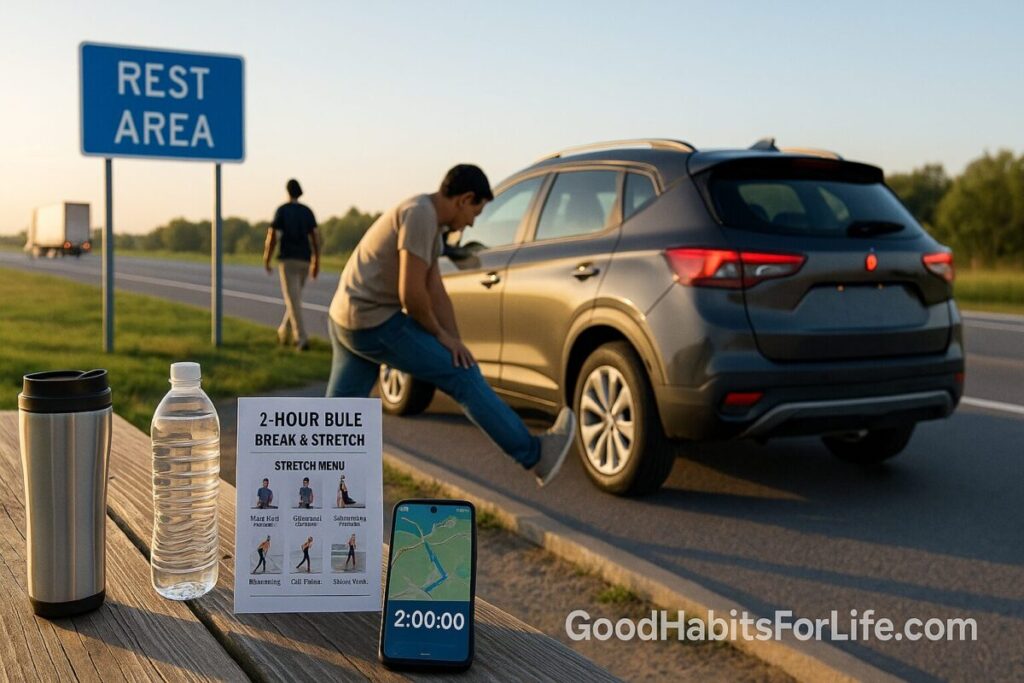
Break Planning: 2Hour Rule & Stretch Menu
2-Hour Rule for Driving: Break Planning & Stretch Menu
Table of Contents
🧭 What is the 2-Hour Rule & Why It Works
Definition: The 2-hour rule means building a stop into your itinerary at least every ~2 hours (or ~150–200 km), for ~15 minutes, to reset alertness and mobility.
Why it matters
-
Alertness: Even when you “feel fine,” sustained attention declines with continuous driving, especially on monotone highways.
-
Reaction time: Fatigue slows hazard perception and braking—critical for high-speed merging and overtaking.
-
Circulation & mobility: Long sitting stiffens hips/hamstrings and can cause neck/shoulder tension; short walks and stretches restore range of motion for safer mirror checks and head turns.
-
Safety culture: Countries and road-safety bodies consistently recommend regular breaks on long trips; planning them ahead prevents “just one more hour” decisions.
When to stop sooner than 2 hours
-
Night driving, heavy meals, warm cabins, solo driving, post-work trips, new medications, or any yawning/lane wandering—treat these as early-stop triggers.
✅ Quick Start: Plan Today’s Trip in 5 Steps
-
Map your legs: In Google/Apple Maps, place pins for rest areas, fuel stations, and reliable cafés every ~150–200 km.
-
Set alerts: Add calendar alarms or phone timers for 1:55 after you start each leg.
-
Pack a break kit: Water, light snacks (nuts/fruit), sunglasses, wet wipes, small towel, resistance band, and a trash bag.
-
Cabin prep: Correct seat height (hips ≈ knees), lumbar support, mirrors adjusted (to minimize neck strain), cabin temp ~20–22 °C (68–72 °F).
-
Commit to the pause: Park fully off the roadway at a designated area. Lock the car. Walk 2–3 minutes. Do the Stretch Menu. Reset, then roll.
🛠️ The 5-Minute Driver Stretch Menu (Rest-Stop Safe)
Do these off the road, in a safe parking area. No stretching on the shoulder.
Minute 0–1: Walk & shake-out
-
Brisk walk around the car, shoulder rolls, gentle neck turns (look left/right/up/down).
Minute 1–2: Hips & hamstrings
-
Figure-4 lean (hold 20s/side): ankle over opposite knee, hinge at hips while holding a bench/boot lip.
-
Hamstring door-frame (20s/side): heel on a low step/kerb, soft knee, hinge until you feel a gentle back-thigh stretch.
Minute 2–3: Calves & ankles
-
Wall calf stretch (20s/side): back heel flat, knee straight; then bend back knee slightly to hit the soleus.
-
Ankle circles (10 each way/side).
Minute 3–4: Chest & shoulders
-
Doorway/boot stretch (20s): forearms on the A-pillar/door frame, lean forward to open chest.
-
Band pull-apart (10–15 reps) or clasped-hands “open book” arcs.
Minute 4–5: Eyes & breathing
-
20-20-20 rule: look 20 m (65 ft) away for 20 s.
-
Box breathing 4-4-4-4: inhale, hold, exhale, hold (4s each) × 3–4 cycles.
Optional add-ons (another 2–3 min): gentle hip flexor lunge, seated piriformis stretch on a bench, forearm/wrist flossing if you grip the wheel tightly.
🧠 30-60-90 Roadmap: Make Breaks an Unbreakable Habit
Days 0–30 (Install the habit)
-
Pre-save 3–5 favorite, safe stop points per regular route.
-
Use a “Breaks First” template in your map app: drop pins before adding cafés/fuel.
-
After every break, log a one-liner in Notes: “Stop @ 11:10, 6/10 alertness → better mirrors.”
Days 31–60 (Optimize)
-
Track alertness before vs. after (1–10). Adjust timing: some drivers need 90-minute intervals at night.
-
Standardize your 5-minute menu + 2-minute add-ons if hips are your weak link.
-
Add windshield reset (wipe bugs/film), cabin declutter, and seat micro-tweak (1–2 cm) each stop.
Days 61–90 (Automate & scale)
-
Create a driving checklist on your phone’s home screen.
-
Share your route with co-drivers; agree break points in advance.
-
Add contingency stops for heat, storms, or heavy traffic.
📚 Techniques & Frameworks for Low-Fatigue Driving
-
2-Hour Rule + 15-Minute Reset: The core. If drowsy, stop earlier.
-
Hydration cadence: 2–3 sips every 20–30 minutes; avoid massive chugs that force urgent stops.
-
Caffeine timing: If you use it, keep to 100–200 mg early in the drive; avoid within 6–8 hours of bedtime.
-
Light & ventilation: Daylight and cooler cabins help vigilance; crack windows for fresh air bursts.
-
Task variation: Rotate micro-tasks at each break—walk, stretch, clean lenses, quick snack, bathroom.
-
Risk spikes: Night, post-lunch dip (13:00–15:00), monotonous highways, and solo drives—shorten intervals.
-
Overtaking discipline: If you’re even slightly foggy, don’t overtake. Fatigue lengthens decision time and misjudgment of oncoming speed.
🧩 Variations: Families, Professionals, Seniors, Motorcyclists
Families with kids
-
Plan play-park stops; bring a ball or skipping rope. Stagger snacks to avoid sugar crashes.
-
Add 5 extra minutes for car-seat checks and cabin tidy.
Professional/commuter drivers
-
Strictly schedule stops within legal/organisational policies; batch admin (receipts, logs) into break time so you never skip the physical reset.
Seniors or joint-sensitive drivers
-
Prioritise gentle hip flexor/hamstring work and short, frequent walks (every 60–90 minutes may feel better).
Motorcyclists
-
Break more often. Emphasise neck/shoulder mobility, hip flexor opening, and hydration (camelbak). Heat/cold stress compounds fatigue fast.
⚠️ Mistakes & Myths to Avoid
-
“I’m fine” bias: Feeling okay ≠ optimal reaction time. Planned breaks beat gut feel.
-
Energy drinks as a substitute: Caffeine temporarily masks drowsiness; it isn’t recovery.
-
Stretching on the shoulder: Dangerous. Only in safe, designated areas.
-
Skipping food or over-eating: Both can make you sleepy. Aim for light, protein-forward snacks.
-
All breaks at fuel stops: Mix in parks and rest areas for fresh air and walking.
🗣️ Real-Life Scripts & Checklists
Script to agree breaks with co-driver
-
“We’ll stop every 1h55. I’ve pinned three options per leg. If anyone yawns, we pull in sooner—no questions.”
Waze/Maps annotation
-
“Pinned Rest Area Eastbound km 188 + Café Leaf + Fuel Max. Alert set for 1:55 after departure.”
Glovebox checklist (laminated)
-
□ Seat & mirrors set
-
□ Timer started (1:55)
-
□ Water accessible
-
□ Sunglasses clean
-
□ Next 2 stops pinned
-
□ Cabin temp 20–22 °C
At each stop (15 min)
-
Park safe, walk loop (2–3 min)
-
5-Minute Stretch Menu
-
Water + light snack
-
Windshield & mirrors quick clean
-
Reset timer; micro-tweak seat
🧰 Tools, Apps & Gear
-
Apps: Google Maps / Apple Maps / Waze (multi-stop planning, live traffic); Roadtrippers (route points of interest); Apple Shortcuts/Android Routines (auto-start timer on CarPlay/Android Auto connection).
-
Timers: Phone timer or a small vibration timer watch.
-
Comfort gear: Lumbar roll, seat wedge (for long femurs), blue-light-filter glasses if night driving, resistance band for chest/shoulder work.
-
Cleaning: Microfibre cloth + spray for windshields; vision clarity reduces eye strain.
Pros/Cons snapshot
-
Maps (free, ubiquitous): +Easy planning, +live traffic; −Manual pin management.
-
Roadtrippers: +Discovery; −Subscription for full features.
-
Shortcuts/Routines: +Automation; −Setup time.
-
Lumbar roll/wedge: +Posture; −Trial-and-error fit.
🧾 Key Takeaways
-
Plan breaks first, route second.
-
Use the 2-hour rule as your default; stop earlier if any drowsiness signs appear.
-
A quick 5-minute stretch menu restores mobility and sharpens attention.
-
Night, heat, big meals, and solo driving all shorten safe intervals.
-
Never stretch or loiter on the shoulder—choose safe, designated areas only.
❓ FAQs
1) Is the 2-hour rule mandatory?
No; it’s a widely recommended safety practice. Some professional driving regulations specify maximum continuous driving times—always follow local laws and company policy.
2) What if I can’t find a rest area exactly at 2 hours?
Aim for 1.5–2.5 hours. Pre-pin multiple options so you’re never forced to push on while drowsy.
3) How long should the break be?
About 15 minutes works for most drivers: short walk, stretches, hydration, bathroom. If still drowsy, extend or power-nap (10–20 minutes) in a safe, approved location.
4) Does coffee replace breaks?
No. Caffeine can help alertness briefly, but you still need a stop to move, hydrate, and reset eyes/posture.
5) Are micro-stops (fuel-only) enough?
Not really. Build in movement and mobility—walk, stretch, breathe—so the break actually restores function.
6) Is this different for night driving?
Yes. Reduce intervals (e.g., every 90 minutes) and avoid heavy meals. If you’re fighting sleep, stop and rest; don’t rely on windows or loud music.
7) What about overtaking on highways?
Only overtake when fully alert with a long, clear view. Fatigue slows judgment of speed/distance—if unsure, don’t go.
8) Can I stretch inside the car at signals?
Some gentle neck/shoulder rolls are fine when stopped and safe, but do the full menu at a proper rest stop.
9) How do I keep kids happy with frequent stops?
Make it a game: step counter challenges, playground stops, or quick scavenger lists. Everyone travels better after a move break.
10) How do I know my personal interval?
Track alertness and comfort scores. If you dip below 7/10 before 2 hours, shorten your default interval.
References
-
UK Highway Code, Rule 91: Driving when tired (gov.uk) — guidance on planning breaks and avoiding fatigue.
-
U.S. National Highway Traffic Safety Administration (NHTSA): Drowsy Driving resource hub (nhtsa.gov).
-
Centers for Disease Control and Prevention (CDC): Drowsy Driving—Asleep at the Wheel (cdc.gov).
-
AAA Foundation for Traffic Safety: Research on drowsy driving risks and prevalence (aaafoundation.org).
-
National Safety Council (NSC): Fatigue & Transportation Safety (nsc.org).
-
Transport for NSW (Australia): Driver Fatigue guidance (nsw.gov.au).
-
VicRoads (Australia): Managing fatigue on long trips (vicroads.vic.gov.au).
-
Royal Society for the Prevention of Accidents (RoSPA): Driver Fatigue (rospa.com).
Disclaimer: This article offers general safety and mobility guidance and is not a substitute for medical advice or professional driving regulations; always follow local laws and your health professional’s advice.