
Convoy & Group Drives: Roles, Radios, Rules
Convoy & Group Drives: Roles, Radios, Rules
Table of Contents
🧭 What “Convoy Driving” Means & Why It Helps
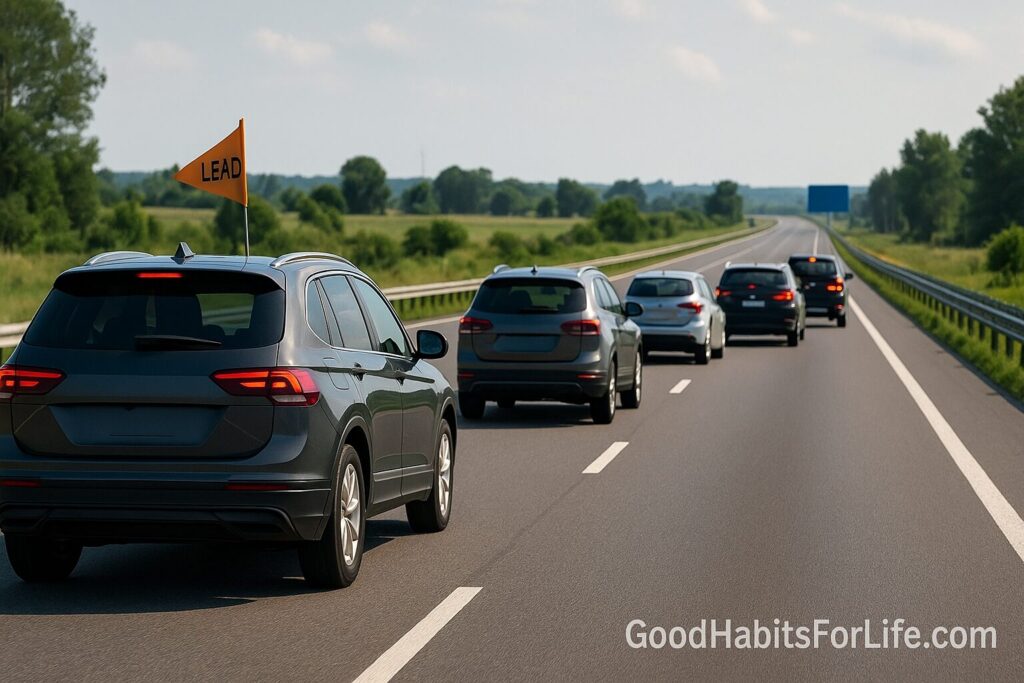
Convoy driving is a planned group journey with agreed roles, communications, and spacing so several vehicles can travel smoothly and safely as one unit. Done well, convoys reduce wrong turns, shorten regrouping after tolls or lights, and keep everyone calmer on long distances.
Core benefits
-
Fewer missed exits and U-turns thanks to a clear Lead and Sweep role.
-
Faster decisions at forks, fuel, food, and restroom stops because plans are shared up front.
-
Safer lane changes and overtakes when spacing and etiquette are standardised (e.g., give cyclists ≥1.5 m at lower speeds and more at higher speeds). GOV.UK
-
Lower crash risk when drivers maintain time-based following gaps (≥3–4 seconds, more in bad conditions). NHTSA
✅ Quick-Start Checklist (Do This Today)
-
Assign roles
-
Lead (Navigator): Sets pace, monitors traffic, announces exits/lanes, schedules breaks.
-
Sweep (Tail-end): Keeps last position, confirms everyone made the turn/exit, alerts issues. (Known in many clubs as “tail-end Charlie.”) act4wdclub.org.au
-
-
Agree comms
-
Choose a radio service that’s legal where you drive (see “Radios & Legal Options” below).
-
Confirm a primary channel, a backup, and a plain-English call sign (“Car 1 Lead”, “Car 7 Sweep”).
-
Do a radio check before departure. Just 4x4s
-
-
Brief the route
-
Share turn-by-turn destinations, planned stops (≈ every 2 hours/160 km), and refuelling points. AAA Driver Training Store
-
Nominate rendezvous points if separated (e.g., next rest area).
-
-
Set spacing & lane etiquette
-
Traffic lights & merges
-
Do not block intersections. If the group splits, the Lead slows at the next safe point so the Sweep can close the gap; never rush yellows. ITS Tactical
-
-
Contingencies
-
If someone pulls over, Sweep stops with them and notifies Lead. Group regroups at a safe lay-by. EVO India
-
🧠 30-60-90 Habit Plan for Group Drives
Goal: Turn safe convoy behaviours into muscle memory.
Days 1–30 (Foundations)
-
Standardise roles, radio channel, and pre-drive checklist.
-
Practice time-gap awareness using a roadside marker (count “one-thousand-one…”). Use more time at higher speeds or poor weather. UK Government Publishing
-
Do two short practice drives (45–60 min) to test light/indicator signals and radio scripts.
Days 31–60 (Consistency)
-
Add night or rain drills (bigger gaps, calmer pace).
-
Integrate overtake etiquette on multi-lane roads (announce “overtake left/right,” re-form in lane only when all vehicles are clear). GOV.UK
-
Run one longer run (3–4 hours) with planned breaks every ~2 hours/160 km. AAA Driver Training Store
Days 61–90 (Mastery)
-
Rotate Lead/Sweep to build bench strength.
-
Add a no-cell-data scenario: rely on radios, printed directions, and preset rendezvous points.
-
Conduct a post-drive debrief (5 minutes): what to keep, fix, drop.
Checkpoints
-
30 days: Everyone uses the same radio script; no missed turns.
-
60 days: Convoy can split/rejoin without stress.
-
90 days: Any driver can serve as Lead/Sweep; spacing and comms are automatic.
🛠️ Techniques & Frameworks
PACE — Plan, Assign, Communicate, Execute
-
Plan: Route, stops, fuel windows, contingencies.
-
Assign: Lead, Sweep, and positions for novices near the front.
-
Communicate: Radios tested; plain language; hand/indicator reinforcement.
-
Execute: Calm pace, time gaps, lawful overtakes.
L-S-R — Lead–Sweep–Relay
-
Lead calls hazards/exits; mid-pack relays if someone has weak reception; Sweep confirms everyone is through. act4wdclub.org.au
Time-based gaps
-
Use the 3-second rule minimum; increase to 4–6+ seconds with rain, darkness, heavy vehicles, or towing. NHTSA
Overtaking etiquette
-
Overtake only when legal with clear visibility.
-
Give cyclists ≥1.5 m at ≤30 mph (more at higher speeds); slow and give more space to horses. GOV.UK
📻 Radios & Legal Options by Region
Choose radios that are legal in your country and suit your terrain and group size.
United States
-
FRS (Family Radio Service): License-free, handhelds, short range; governed by 47 CFR Part 95 Subpart B. Good for small convoys. eCFR
-
GMRS (General Mobile Radio Service): License required for the holder; better range and repeaters; family covered by one license. fcc.goveCFR
-
CB (Citizens Band): License-free; vehicle-mounted antennas improve range; 40 channels. fcc.gov
-
Ham (Amateur Radio): Best capability but requires a license (start with Technician). Great for long/remote expeditions. arrl.org+1
UK/EU
-
PMR446: License-free UHF handsets; FRS/GMRS radios aren’t licence-exempt in the UK; use PMR446-approved sets only. www.ofcom.org.uk
-
CB (CEPT): Generally licence-exempt with certified equipment (check local rules).
Rules of thumb
-
Mount external antennas where legal for better range (CB/GMRS).
-
Keep radio chatter short and relevant; call signs first (“Lead to Sweep…”). act4wdclub.org.au
🧑🤝🧑 Audience Variations
Families: Put the calmest navigator in Lead; schedule more frequent restroom/food stops; carry spare water/snacks.
Students/road-trip groups: Share the route in a group chat; rotate Leads to reduce fatigue; practice radio brevity.
Professionals (fleets/events): Document SOPs (this page), pre-trip vehicle checks, and duty-of-care policies.
Seniors: Daylight departures, extra time gaps, simpler routes, more rest stops; avoid peak sleepiness windows. NHTSA
⚠️ Mistakes & Myths to Avoid
-
Myth: “Tight bumper-to-bumper keeps us together.” Reality: It’s dangerous. Use time gaps, not meters. NHTSA
-
Rushing yellows or blocking intersections. Safer to regroup ahead. ITS Tactical
-
Using the wrong radios. FRS/GMRS isn’t licence-free everywhere; PMR446 required in UK, and GMRS needs a license in the U.S. fcc.govwww.ofcom.org.uk
-
Skipping breaks. Plan proper rest; fatigue quietly degrades judgement. AAA Driver Training Store
🗣️ Real-Life Scripts (Copy-Paste)
Pre-drive WhatsApp/Signal message
Convoy plan
Route: NH48 → Exit 27 → Fuel at 180 km.
Roles: Lead=Car 1, Sweep=Car 7.
Radio: Primary FRS Ch 3 (US) / PMR446 Ch 3 (UK). Backup: Ch 8.
Stops: 11:00 & 13:00. If separated, meet at Shivpuri Rest Area. Drive safe, 3–4 sec gaps.
Radio check (before departure)
“Lead to all cars: radio check and convoy numbers please.”
“Car 2 good.” … “Car 7 Sweep good.”
Lane change
“Lead: prepare lane left in 300 m.”
(Mid-pack relays if needed.)
“Sweep: all through, lane left complete.”
Overtake
“Lead: safe overtake in 500 m after bus—single file.”
“Sweep: last car clear; reform in lane.”
Pull-over
“Car 4 to Sweep: mechanical issue, pulling over.”
“Sweep to Lead: stopping with Car 4; please slow to 70 and hold at next lay-by.”
📚 Tools, Apps & Resources
-
Radios:
-
FRS (US, licence-free; short range), GMRS (US, licensed; better range), CB (licence-free), PMR446 (UK/EU, licence-free), Ham (licensed; advanced capability). eCFRfcc.gov+1www.ofcom.org.ukarrl.org
-
-
Navigation: Offline maps (download areas in Google Maps), paper backup, printed waypoints.
-
Coordination apps: Shared notes (Drive/Docs), group chats for route sheets, fuel/food lists.
-
Safety kit: First-aid, triangle, hi-vis, torch, tyre inflator, jump leads; follow your local Highway Code/road rules. GOV.UK
🔑 Key Takeaways
-
Plan & brief the route, roles, channels, stops.
-
Use legal radios for your region; license where required.
-
Keep time-based spacing; increase in poor conditions.
-
Respect lane and overtaking etiquette; regroup safely if split.
-
Practice the scripts until the convoy runs itself.
❓ FAQs
1) What’s the safest following distance in a convoy?
Use a time gap: at least 3 seconds in ideal conditions; more with rain, night, heavy loads, or towing. NHTSA
2) How do we handle traffic lights without losing cars?
Don’t force yellows. If split, Lead slows at the next safe area and Sweep escorts stragglers to regroup. ITS Tactical
3) Which radios work without a license in the U.S.?
FRS and CB do; GMRS needs a license (one license covers your family). eCFRfcc.gov+1
4) I’m in the UK—can I use FRS/GMRS?
No. Use PMR446 equipment that is type-approved; FRS/GMRS handsets aren’t licence-exempt in the UK. www.ofcom.org.uk
5) Do we really need a Sweep car?
Yes. The Sweep confirms everyone makes turns, assists with issues, and coordinates with Lead. act4wdclub.org.au
6) How often should we stop?
Plan a break roughly every 2 hours/160 km on long drives to reduce fatigue. AAA Driver Training Store
7) What clearance should we give cyclists when overtaking?
As per the Highway Code guidance: ≥1.5 m at ≤30 mph, more at higher speeds. GOV.UK
8) Can we use amateur (ham) radios for better range?
Yes, but you must be licensed (start with the Technician license in the U.S.). arrl.org
9) What if a car needs to pull over?
The Sweep stops with them and informs the Lead; the rest continue to the next safe regroup point. EVO India
10) Is it OK to run bumper-to-bumper to stay together?
No—dangerous and illegal in many contexts. Maintain safe time gaps and regroup ahead if split. NHTSA
📚 References
-
UK Highway Code — General rules & techniques (rules 103–158). GOV.UK
-
UK Highway Code — Using the road (overtaking guidance; 159–203). GOV.UK
-
UK Highway Code — Stopping distances (illustrated PDF). UK Government Publishing
-
NHTSA — Drowsy driving (risks and countermeasures). NHTSA
-
NHTSA — Safe following (3–4 seconds guidance; long-trip breaks). NHTSA
-
AAA — Breaks every ~2 hours/100 miles guidance. AAA Driver Training Store
-
FCC eCFR — Family Radio Service rules (Part 95 Subpart B). eCFR
-
FCC — Personal Radio Services consumer guide (GMRS license required). fcc.gov
-
FCC — Citizens Band Radio Service overview. fcc.gov
-
Ofcom — PMR446 licence-exempt guidance (UK; FRS not permitted). www.ofcom.org.uk
-
ARRL — Getting your Technician (ham) license (U.S.). arrl.org
-
ACT 4WD Club — Convoy procedure (roles, comms, etiquette). act4wdclub.org.au
⚖️ Disclaimer
This guide is educational; always follow your local traffic laws, radio regulations, and vehicle manufacturer guidance.