
CruiseReady Check: Tyres, Fluids, Tools
CruiseReady Check: Tyres, Fluids, Tools
Table of Contents
🧭 What is a CruiseReady Check?
A CruiseReady Check is a fast, pre-trip car inspection designed to prevent common roadside failures before highway or long-distance drives. It focuses on three high-impact areas—tyres, fluids, and tools—plus a quick look at lights, wipers, and battery.
Why it matters
-
Under-inflated or damaged tyres, low oil/coolant, and missing tools account for a big share of avoidable breakdowns on long trips.
-
A 10–15 minute routine improves safety, comfort, and fuel economy and reduces the chance you’ll be stranded without the basics.
What you’ll need
-
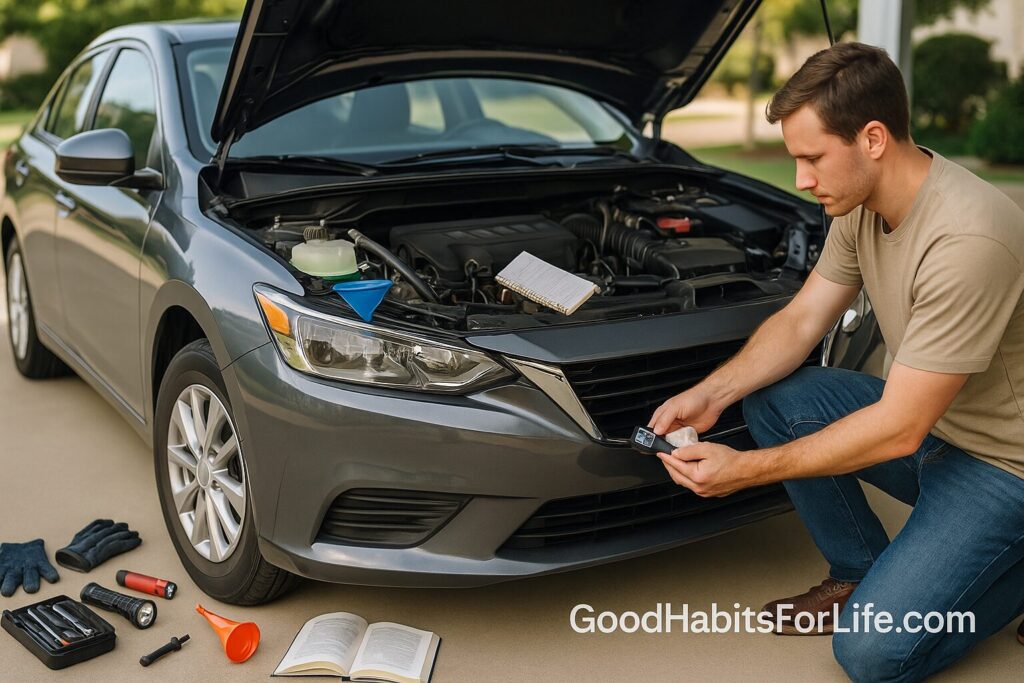
Digital tyre gauge, tread-depth gauge (or coin test), paper towel, funnel, torch/flashlight, gloves, and your vehicle handbook (for specs).
✅ Quick Start: 15-Minute Drive-Off Routine
Do this with the car cold and parked on level ground.
1) Tyres (5 minutes)
-
Pressures: Use the door-jamb placard or handbook. Typical highway range is 220–250 kPa (32–36 psi)—use the spec for your vehicle and load. Check all four + spare.
-
Tread: Aim for ≥3 mm (4/32″) if rain is likely. Replace if close to the legal minimum in your region (often 1.6 mm / 2/32″). Look for uneven wear and sidewall bulges/cuts.
-
Valves & caps: Ensure caps are fitted and stems not cracked.
2) Fluids (7 minutes)
-
Engine oil: On level ground, dipstick wipe-check-wipe-read. Top up with the specified grade only. If it’s near or below MIN, investigate for leaks/consumption.
-
Coolant: Check the expansion tank against COLD mark. Only open radiator cap when fully cold. Top up with the correct premix if needed.
-
Brake fluid: Should sit between MIN–MAX. Low can indicate pad wear or leaks—don’t ignore.
-
Windscreen washer: Fill for bug splatter and dust.
-
(If applicable) Power steering/transmission per handbook.
3) Lights, Wipers, Battery, Cabin (3 minutes)
-
Lights: Headlights (low/high), indicators, hazards, brake and reverse lights. Ask a helper or use reflections.
-
Wipers & screen: No streaking, no cracks; carry spare washer fluid.
-
Battery: Terminals clean, tight; no acid crusting.
-
Cabin: Set mirrors/seat; clear the dash and parcel shelf; secure cargo.
4) Tools & Safety Gear (up to 2 minutes)
-
Spare tyre or repair kit (and sealant in date), jack, wheel brace/lug wrench, locking-nut key, warning triangle, hi-vis, first-aid kit, torch, jumper cables or booster pack, gloves, tow rope, basic fuses, tyre inflator.
🗓️ 7-Day “Big Trip” Plan
A simple ramp-up if you’re leaving this weekend.
Day −7 (Booking & Baseline)
-
Book maintenance if due (oil, pads, alignment).
-
Order missing tools/consumables (triangle, inflator, bulbs).
Day −5 (Deep Check)
-
Tyres: Inspect tread across the full width; rotate if due.
-
Wheel alignment & balance if you feel pull or vibration.
-
Battery test at a service centre if >3 years old or cranks slowly.
Day −3 (Load & Spares)
-
Build a small spares bag: bulbs, fuses, washer tablets, nitrile gloves, roll of duct tape, cable ties, paper towels.
-
Download offline maps and store insurer/roadside numbers.
Day −2 (Fluids & Clean)
-
Top up all fluids; clean windscreen inside/out; treat wiper rubbers.
-
Deodorise cabin; remove heavy clutter to improve fuel economy.
Day −1 (Final Pack)
-
Test-fit luggage to avoid rear-window blockage.
-
Check tyre pressures again cold (overnight temperature drop can lower pressure).
Trip Morning
-
Run the 15-minute routine above; set a calm departure window.
🛠️ Techniques & Frameworks: The 3-Zone Walk-Around
Use this every time—Outside → Under-bonnet → Inside.
Zone 1: Outside (Tyres, Lights, Body)
-
Clockwise walk: front-left → front → front-right → rear-right → rear → rear-left.
-
Touch each tyre: pressure, tread, valve cap, wheel-nut visually seated.
-
Tap each light lens; quick function test; check for leaks under car.
Zone 2: Under-Bonnet (Fluids & Belts)
-
Identify the 5 common reservoirs: oil dipstick/filler, coolant, brake fluid, washer fluid, power steering (if hydraulic).
-
Belts: no cracks/glazing; no squeal on start.
Zone 3: Inside (Controls & Safety)
-
Gauges illuminate; no persistent warning lights.
-
Mirrors clean; seat/steering adjusted; horn, wipers, washers work.
-
Seatbelts retract smoothly; child seats correctly latched.
👥 Audience Variations
Parents & Families
-
Pack child meds and snacks within reach; schedule fuel/loo breaks every 2–3 hours. Keep the rear shelf clear for visibility.
Students & First-Time Drivers
-
Save pressures and service items in a notes app. Practice the jack + wheel change at home once with supervision.
Professionals/Rideshare
-
Keep inflator + plug kit to minimise downtime. Maintain a spare wiper blade and bulb kit.
Seniors
-
Ask the workshop to set pressures at the upper recommended highway load if carrying passengers/bags. Use larger-print checklist cards.
Hot Climate / Mountain Routes
-
Heat stresses cooling systems and tyres. Verify coolant concentration, ensure UV-hardened wipers; check brakes before long descents.
⚠️ Mistakes & Myths to Avoid
-
Myth: “Tyres look fine, so they’re fine.”
Reality: Pressure can be 10–20% low and look normal—always use a gauge. -
Mistake: Mixing random coolants/oils.
Use only specified types; mixing can cause sludge or corrosion. -
Mistake: Ignoring brake fluid.
Hygroscopic fluid absorbs moisture over time; low level = inspection needed. -
Myth: “TPMS means I don’t need a gauge.”
TPMS warns when too low, not when slightly under-inflated or the spare is flat. -
Mistake: Overloading roof racks.
Check dynamic roof-load limit; high loads raise centre of gravity and braking distance.
💬 Real-Life Scripts & Examples
Partner/Family Departure Script (30 seconds)
“Quick CruiseReady: I’ll do tyres and fluids; can you test lights and load the triangle/first-aid? We leave at 7:30—seatbelts on, bags low, water bottles filled.”
Calling a Workshop
“Hi, I’m doing a highway trip this weekend. Please check alignment, tyre tread depth, battery health, and coolant strength. Car: 2019 hatchback, 65,000 km.”
Roadside Contingency (Tyre Puncture)
-
Pull well clear, hazards on, triangle at 45–75 m (50–80 yd).
-
Handbrake, first gear/PARK, chock opposite wheel.
-
Swap to spare or use repair kit; drive slowly to nearest tyre shop.
🧰 Tools, Apps & Resources
Essentials to carry
-
Digital tyre gauge & compact inflator
-
Tread-depth gauge (or coin), gloves, torch
-
Triangle, hi-vis vest, first-aid kit
-
Jack, wheel brace, locking-nut key
-
Jumper cables/booster pack
-
Bulb & fuse kit, basic tape/cable ties
Helpful apps (examples)
-
Maintenance trackers (store service dates/tyre sizes)
-
Offline maps with traffic & fuel-station layers
-
Your insurer/roadside provider app
Pros/Cons
-
Digital gauge: fast, accurate; needs battery.
-
Inflator: fixes small pressure losses on the go; louder/noisier.
-
Booster pack: independent jump-start; keep charged monthly.
📌 Key Takeaways
-
Tyres first: pressure, tread, and spare decide comfort, control, and fuel use.
-
Fluids save engines & brakes: oil and coolant levels are non-negotiable.
-
Be self-sufficient: carry jack, brace, triangle, first-aid, inflator, jump pack.
-
Repeatable routine = fewer surprises: the 3-Zone Walk-Around makes it easy.
-
Do a deeper check a few days before long trips; verify battery and alignment.
❓ FAQs
1) What tyre pressure should I use for highway driving?
Use the vehicle placard or handbook (door-jamb/glovebox). For loaded trips, some makers recommend the higher of the listed ranges—never exceed the wheel/tyre rating.
2) How much tread is “safe” for rain?
Aim for ≥3 mm (4/32″) for wet grip. Many regions set the legal minimum around 1.6 mm (2/32″), but more tread gives better aquaplaning resistance—replace earlier for long trips.
3) Can I mix different coolant colours?
No. Colours don’t reliably indicate chemistry. Use the specified formula (e.g., HOAT/OAT) to avoid gelling or corrosion.
4) My TPMS light turns on and off—what does it mean?
You’re hovering near the threshold. Pressures drop with overnight temperature; set them cold to spec and recheck after 24 hours.
5) Do I really need a spare tyre if I have a repair kit?
Repair kits handle small tread punctures only; sidewall cuts or large holes require a spare or recovery. For remote routes, a spare is strongly recommended.
6) Which fluids are “critical” for a short trip?
Engine oil, coolant, and brake fluid—plus washer fluid for visibility. Power steering/transmission depend on your vehicle type.
7) How often should I test the battery?
Have it tested annually after year three, sooner if cranking slows or accessories dim at idle.
8) Should I increase tyre pressure for heavy luggage?
Follow the maker’s loaded pressure guidance (often on the placard). Do not exceed the tyre’s maximum cold pressure printed on the sidewall.
9) What emergency numbers should I save?
Insurer/roadside assistance, local highway emergency number, and a trusted workshop. Add them to your phone and print a glovebox card.
10) Is a “once-over” at the fuel station enough?
Good start, but a proper cold-tyre check at home is more accurate and gives time to fix issues before you’re on a deadline.
📚 References
-
National Highway Traffic Safety Administration (NHTSA). Tires: Safety, Maintenance, and TPMS. https://www.nhtsa.gov/equipment/tires
-
NHTSA. Tire Pressure Monitoring System (TPMS). https://www.nhtsa.gov/equipment/tires/tire-pressure-monitoring-system
-
AAA (American Automobile Association). Road Trip Vehicle Checklist & Pre-Trip Inspection Tips. https://exchange.aaa.com/safety/roadway-safety/road-trip-vehicle-checklist
-
RAC (UK). Car Checks Before a Long Journey. https://www.rac.co.uk/drive/advice/car-maintenance/checks-before-long-journey/
-
Transport for NSW (Australia). Check Your Car Before You Drive. https://www.nsw.gov.au/driving-boating-and-transport/roads-safety-hub/check-your-car
-
Consumer Reports. How to Check Your Car’s Oil & Other Fluids. https://www.consumerreports.org/cars/car-maintenance/fluids-to-check-in-your-car/
-
U.S. Department of Energy. Keeping Your Car in Shape (Fuel Economy Guide). https://www.fueleconomy.gov/feg/maintain.jsp
-
TyreSafe (UK charity). Tyre Tread Depth & Safety. https://www.tyresafe.org/tyre-safety/tyre-tread-depth/