
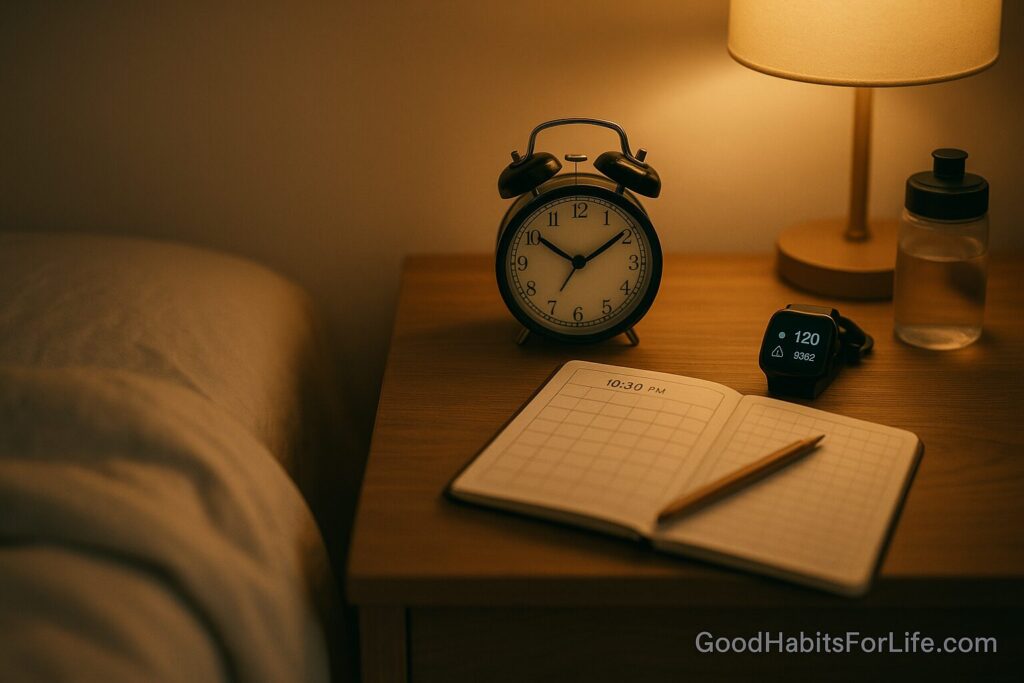
The 90-Minute Rule: Plan Bedtime Backwards: Zone 2 + NEAT (2025)
90-Minute Rule: Plan Bedtime Backwards + Zone 2 & NEAT
Table of Contents
🧭 What Is the 90-Minute Sleep Rule (and Why It Works)
The 90-minute rule is a practical way to plan sleep around your brain’s natural sleep cycles, which typically run ~90 minutes (often 80–110). A full night’s rest contains multiple cycles that progress through light, deep (NREM), and REM sleep. Waking at the end of a cycle makes you feel more refreshed than waking mid-cycle. Aligning bedtime backwards from your target wake time aims to land your alarm near a cycle boundary. Evidence also shows that regular physical activity improves sleep quality and reduces sleep latency; pairing the rule with daytime Zone-2 aerobic work and NEAT (non-exercise movement) strengthens circadian timing and sleep pressure. cite in References
Targets
-
Most adults: 7.5–9 hours (5–6 cycles).
-
Sleep-onset buffer (time to fall asleep): ~15 minutes (10–20 normal).
-
Consistency: same wake time 7 days/week is the strongest anchor.
✅ Quick Start: Plan Tonight, Sleep Better by Tomorrow
-
Pick a fixed wake time (e.g., 06:00). Keep it even on weekends.
-
Choose cycles: start with 5 cycles (7.5 h); adjust later.
-
Add buffer: 15 minutes to fall asleep.
-
Count backward from wake time to get bedtime.
-
Set anchors:
-
Morning light in the first hour after waking (5–20 min outdoors).
-
Zone-2 cardio 30–45 min most days, ending ≥3 h before bed.
-
NEAT: 5–10 min light movement each hour you’re awake.
-
-
Evening wind-down (45–60 min): low light, no heavy food/alcohol, screens dim or off, calm activity.
-
Bedroom: cool (about 18 °C / 65 °F), dark, quiet.
-
Caffeine cut-off: 6–8 hours before bedtime.
🛠️ The “Backward Bedtime” Formula + Examples
Formula
Bedtime = Wake Time − (Cycles × 90 min) − Sleep-Onset Buffer (≈15 min)
If 06:00 wake and 5 cycles: 6:00 − (5 × 90 = 450 min) − 15 = 22:15 (10:15 PM).
Prefer 6 cycles (9 h)? 6:00 − 540 − 15 = 20:45 (8:45 PM).
Need a shorter night: 4 cycles (6 h) occasionally—6:00 − 360 − 15 = 23:45 (11:45 PM) (not ideal long-term).
Cheat Table (15-min buffer assumed)
| Wake | 4 cycles (6 h) | 5 cycles (7.5 h) | 6 cycles (9 h) |
|---|---|---|---|
| 05:30 | 23:15 | 21:45 | 20:15 |
| 06:00 | 23:45 | 22:15 | 20:45 |
| 06:30 | 00:15 | 22:45 | 21:15 |
| 07:00 | 00:45 | 23:15 | 21:45 |
Tip: If you still feel groggy after a week, keep your wake time fixed and shift in full-cycle steps (±90 minutes) rather than micro-tweaks.
📅 30-60-90 Day Habit Roadmap
Days 1–30 (Stabilize)
-
Fix wake time and use 5 cycles.
-
Establish morning light, Zone-2 30–45 min (or split into 2×20), and hourly NEAT breaks.
-
Create a 60-min wind-down and bedroom checklist (cool, dark, quiet).
-
Track: time in bed, time asleep, energy on waking (1–5), caffeine timing.
Days 31–60 (Optimize)
-
If waking before alarm, try 6 cycles twice a week.
-
Fine-tune caffeine, alcohol, and screen cut-offs; move dinner earlier.
-
Add strength work 2–3×/week (not within 3 h of bed).
-
Troubleshoot with a 10-minute worry list at 18:00 to off-load rumination.
Days 61–90 (Automate)
-
Keep wake time constant; allow 1 strategic 90-min deviation for social events.
-
Layer power naps 10–20 min before 15:00 if needed.
-
Quarterly review of your schedule, goals, and sleep quality.
🧠 Techniques & Frameworks That Make This Stick
-
Two Anchors + One Lever: Morning wake + light are fixed; bedtime is the lever you set via cycles.
-
The Talk Test for Zone-2: You can talk in sentences but not sing; heart rate roughly moderate intensity.
-
Caffeine Curfew: Your last coffee/tea ≥6–8 h before bedtime.
-
Dim-Down Rule: Reduce blue/bright light 2–3 h pre-bed; use warm lamps, “night shift” modes, or blue-light-limiting glasses.
-
Thermal Cueing: Warm shower 60–90 min pre-bed (helps body cool afterwards); keep bedroom around 18 °C (65 °F).
-
If-Then Plans: “If I miss Zone-2, then I’ll add 3×10-min brisk walks after meals.”
-
Sunday Setup: Pre-enter wake time and chosen cycles in your calendar; block your wind-down.
🏃 Zone-2 Cardio & NEAT: Daytime Habits That Supercharge Sleep
Why it helps
-
Moderate-intensity aerobic exercise improves sleep quality, reduces sleep latency, and increases deep sleep in many people.
-
NEAT—all the light activity that isn’t formal exercise (walking while on calls, taking stairs, tidying, gardening)—combats sedentariness that’s linked with poorer sleep and daytime sleepiness.
How to do it
-
Zone-2 menu (choose 1): 30–45 min brisk walk, easy cycling, light jog, swimming, elliptical—finish ≥3 hours before bed.
-
NEAT targets:
-
1–2 min movement every 30–60 min of sitting (set a timer).
-
Post-meal 10-minute walks (bonus: blunts glucose spikes).
-
Phone-call pacing, stairs over lifts, park farther, carry groceries.
-
Weekly minimums (adults)
-
150–300 min moderate aerobic activity + 2× strength sessions; more is okay if recovery is solid.
👥 Variations by Audience
Students
-
Fix wake time around classes; stack Zone-2 between lectures; shift heavy study earlier; library glasses/filters at night.
Parents (esp. with infants)
-
Protect the wake anchor for the caregiving adult who drives in the morning; use tag-team naps (10–20 min) before 15:00; keep wind-down compact (20–30 min).
Professionals
-
Treat NEAT as meetings: calendar blocks for walk-and-talks; hard caffeine cutoff on your calendar; dim office lights after 18:00.
Seniors
-
Prioritize morning light and daytime movement; avoid long late naps; talk to a clinician about meds that disrupt sleep.
Teens
-
Circadian phase is naturally later: keep wake time realistic; morning outdoor light and after-school Zone-2; avoid energy drinks.
⚠️ Mistakes & Myths to Avoid
-
Myth: Everyone’s cycle is exactly 90 minutes. Reality: it ranges; use 90 as a starting heuristic, then adjust.
-
Oversleeping weekends: drifts your body clock; keep wake time fixed.
-
Late, heavy exercise: vigorous sessions within 3 hours of bed can backfire for some (though exercise overall is beneficial).
-
Blue-light blast: bright screens late keep you wired.
-
“I’ll make it up with one long sleep.” Debt repayment is not 1-for-1; consistency wins.
-
Caffeine stealth: tea, soda, chocolate, and pre-workouts count.
-
Hot stuffy bedrooms: aim for cool, dark, quiet.
🗣️ Real-Life Examples & Copy-Paste Scripts
Bedtime math (Weekday schedule)
-
Target wake: 06:00; choose 5 cycles + 15-min buffer ⇒ Bed 22:15.
-
Calendar entry: “22:15 lights out; 21:15 wind-down begins.”
If-Then scripts
-
If I’m still awake after 20 min, then I’ll do a calm reset in low light (book, breathing) and return when sleepy.
-
If I work late, then I’ll keep wake at 06:00 and add a 10–20 min nap before 15:00.
-
If rain cancels my walk, then I’ll do 3×10-min indoor cycling spaced out.
-
If I crave late coffee, then I’ll switch to decaf/herbal.
Wind-Down (45–60 min)
-
0–15 min: dim lights, quick tidy, lay out clothes.
-
15–30 min: warm shower; bedroom cooling.
-
30–45 min: light stretch, journaling/worry list.
-
45–60 min: read paper pages; lights out.
🧰 Tools, Apps & Resources
-
Timers & alarms for hourly NEAT breaks.
-
Light meter/Weather app to catch morning daylight windows.
-
Fitness trackers (optional) for heart rate in Zone-2; avoid obsessing over “sleep scores.”
-
Blue-light filters on devices; warm-spectrum bulbs at home.
-
White-noise machines or apps if your area is noisy.
📌 Key Takeaways
-
Plan sleep backwards from a fixed wake time using ~90-minute cycles plus a small sleep-onset buffer.
-
Lock morning light and daily movement to sync your clock.
-
Stack Zone-2 cardio and NEAT for deeper sleep and smoother energy.
-
Keep the bedroom cool, dim, and quiet; curb caffeine and screens late.
-
Adjust in 90-minute steps if you still feel groggy after a week.
❓ FAQs
1) Is the 90-minute rule scientifically exact?
No—cycles vary ~80–110 minutes and change across the night and with age. Use 90 minutes as a planning tool, then tune by feel over a week.
2) How many cycles should I aim for?
Most adults do best with 5–6 cycles (7.5–9 h). If you’re short on time, avoid going below 4 cycles regularly.
3) When should I exercise for best sleep?
Anytime works for health; for sleep, many people prefer morning to late afternoon. Keep vigorous sessions ≥3 hours before bed.
4) What if I can’t fall asleep at my planned bedtime?
Get out of bed after ~20 minutes; do a calm, low-light activity; return when sleepy. Keep wake time fixed.
5) Do naps hurt nighttime sleep?
Short 10–20 min naps before 15:00 are usually fine. Longer/late naps can reduce sleep pressure.
6) What’s Zone-2 and how do I find it without a lab?
It’s moderate intensity—breathing faster but can speak in sentences. Heart rate often aligns with the moderate zone; “talk test” works well.
7) How late is too late for caffeine?
For most, stop 6–8 hours before bed. If sensitive, cut earlier.
8) Does alcohol help sleep?
It may speed sleep onset but fragments sleep and suppresses REM—avoid within 3–4 hours of bedtime.
9) What bedroom temperature is best?
Around 18 °C (65 °F) works for many; keep it cool, dark, and quiet.
10) Should my sleep window change on weekends?
Keep wake time the same; shift bedtime only in full-cycle steps if needed.
📚 References
-
National Heart, Lung, and Blood Institute. How Sleep Works. https://www.nhlbi.nih.gov/health/sleep/how-sleep-works
-
NIGMS, NIH. Circadian Rhythms – Fact Sheet. https://www.nigms.nih.gov/education/fact-sheets/Pages/circadian-rhythms.aspx
-
Centers for Disease Control and Prevention (CDC). Sleep and Sleep Hygiene Tips. https://www.cdc.gov/sleep/about_sleep/sleep_hygiene.html
-
CDC. How Much Sleep Do I Need? https://www.cdc.gov/sleep/about_sleep/how_much_sleep.html
-
American Academy of Sleep Medicine (AASM). Exercise and Sleep – Position statements/resources. https://aasm.org/advocacy/position-statements/exercise-and-sleep/
-
CDC. Measuring Physical Activity Intensity (Talk Test; HR ranges). https://www.cdc.gov/physicalactivity/basics/measuring-physical-activity-intensity.htm
-
CDC. Physical Activity and Health. https://www.cdc.gov/physicalactivity/basics/pa-health/
-
Johns Hopkins Medicine. Exercising for Better Sleep. https://www.hopkinsmedicine.org/health/wellness-and-prevention/exercising-for-better-sleep
-
Harvard Medical School. Blue light has a dark side. https://www.health.harvard.edu/staying-healthy/blue-light-has-a-dark-side
-
Sleep Foundation (nonprofit). Best Temperature for Sleep. https://www.sleepfoundation.org/bedroom-environment/best-temperature-for-sleep
-
National Institute on Aging. A Good Night’s Sleep. https://www.nia.nih.gov/health/good-nights-sleep
-
Mayo Clinic. Sitting risks: Why you should get up and move more. https://www.mayoclinic.org/healthy-lifestyle/adult-health/expert-answers/sitting/faq-20058005
⚖️ Disclaimer
This article is for general education and does not replace personalized medical advice. If you have persistent sleep problems, talk to a qualified health professional.