
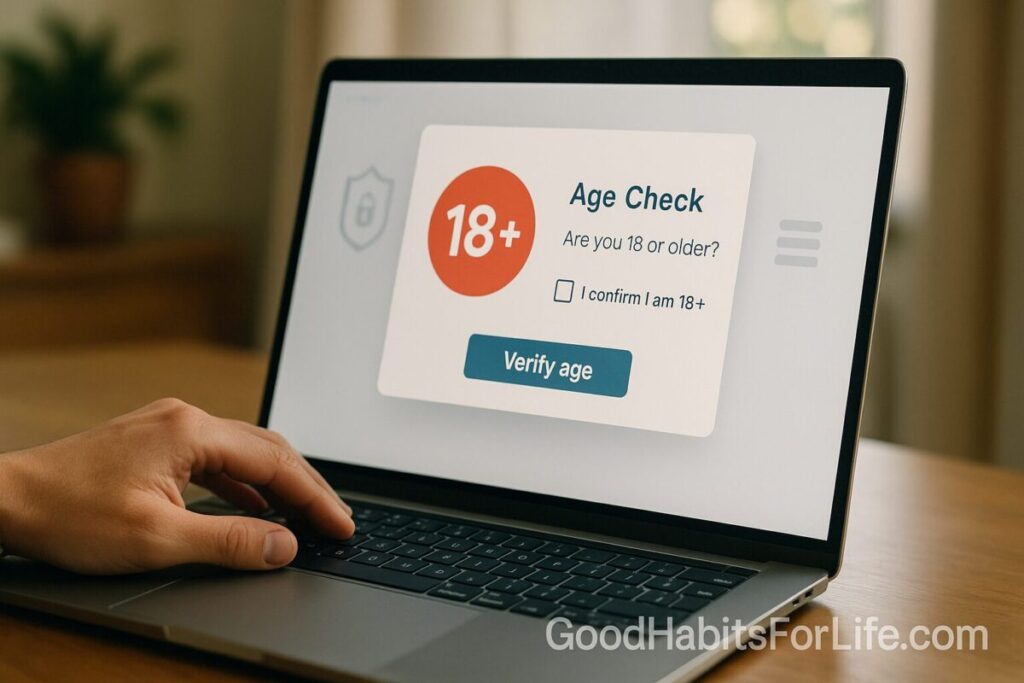
Age-Restricted Purchases Online: Verify Without Oversharing
Age-Restricted Purchases Online: Verify Without Oversharing
Table of Contents
🧭 What This Covers & Why Privacy Matters
Age-restricted purchases (e.g., alcohol, vaping products, knives, mature games) require sellers to verify a buyer’s age. The challenge: confirm “Is this person at least X years old?” without collecting more personal data than necessary. The principle here is data minimization—only what’s adequate, relevant, and limited to your purpose. In practice that means proving over-18 (or local threshold) without storing a full identity dossier. ico.org.ukgdpr-info.eu
If you collect less, you expose less in the event of a breach and reduce compliance risk under regulations that embed data minimization (e.g., GDPR). EUR-Lex
✅ Legal & Compliance Basics (Fast Scan)
-
Data minimization & purpose limitation. Decide exactly what you need to prove (e.g., “≥18”) and avoid unrelated data (e.g., exact birth date, address) unless strictly necessary. Document this logic. EUR-Lex
-
Security & retention. Keep only a pass/fail flag, a transaction reference, and retention period; purge on schedule. Follow recognized security guidance. Federal Trade Commission
-
Payments ≠ age proof. A payment card is not a reliable proxy for age, but if used in the flow, remember PCI DSS rules: never store sensitive authentication data (e.g., CVV) after authorization—even if encrypted. Middlebury
-
Identity assurance proportionality. Match the rigor of the age check to the risk of the product in line with digital identity assurance guidance (see NIST SP 800-63A-4). nvlpubs.nist.gov
This article gives practical guidance, not legal advice. Always check your local laws and platform policies.
🛠️ Quick Start: Do-This-Today Setup
-
Classify your products by risk.
-
Low: age-limited content, inexpensive items.
-
Medium: moderate risk items (e.g., 16+ games).
-
High: alcohol/vapes/knives.
Pick the minimum viable method per tier (see comparison below). nvlpubs.nist.gov
-
-
Add an explicit age gate + policy link.
-
Short notice: what you check, what you store (pass/fail only), retention window.
-
Collect consent where required. ico.org.uk
-
-
Implement a verification step.
-
Start with a low-intrusion method (e.g., third-party database/credit-reference age check or a privacy-preserving credential).
-
Fall back to document + liveness only for high-risk items or if the light method fails. BSI Knowledgenvlpubs.nist.gov
-
-
Data discipline.
-
Store only pass/fail + date/time + verifier ID; set retention (e.g., 30–60 days) and auto-purge.
-
If payments are present, don’t store CVV or mag-stripe data—ever. Middlebury
-
-
Test 10 real orders.
-
Confirm false-fail/false-pass rates and usability (completion <60 seconds).
-
Record results in your risk log and adjust.
-
🧪 Methods Compared: From “Light Touch” to High Assurance
Below are common approaches, with a privacy lens:
1) Self-declaration (“I am 18+”)
-
Use when: very low risk, content gating.
-
Pros: frictionless. Cons: weak assurance; keep it paired with other signals.
2) Payment signal (small authorization) + address check
-
Use when: low-to-medium risk; not sufficient alone.
-
Pros: low friction. Cons: card ≠ age; still follow PCI rules (never store CVV). Middlebury
3) Third-party database/credit reference check
-
Use when: medium risk; buyer inputs name/DOB; service returns pass/fail.
-
Pros: quick, no document images; Cons: coverage varies by country. Align with minimization. BSI Knowledge
4) Document scan + liveness (remote)
-
Use when: high risk or required by law; aligns with NIST proofing practices.
-
Pros: strong assurance; Cons: higher data exposure. Strictly limit storage to results. nvlpubs.nist.gov
5) Facial age estimation (no ID)
-
Use when: quick screening with consent; use ethically and offer alternatives.
-
Pros: no ID stored; Cons: accuracy varies; keep as optional.
6) Verifiable Credentials (VCs) / Selective Disclosure (“Over-18” only)
-
Use when: you want proof of age without disclosing DOB/name.
-
How it works: An issuer (e.g., government/ID provider) gives a digital credential; the customer proves “≥18” using VC Data Model 2.0 and SD-JWT style selective disclosure. You receive a cryptographically verifiable “over-X” claim—nothing more. W3C+1IETF Datatracker
7) In-person courier check (on delivery)
-
Use when: shipping high-risk goods; verify at doorstep; store pass/fail only.
Industry code of practice: BSI PAS 1296:2018 outlines good practice for online age checks. BSI Knowledgeimg.antpedia.com
🧠 Map Risk → Assurance: A Simple Model
Use a two-column worksheet:
-
Risk tier (Low/Med/High) per product.
-
Assurance needed mapped to NIST identity proofing levels and method choice:
| Risk Tier | Recommended Method | Notes |
|---|---|---|
| Low | Self-declaration + frictionless signals | For content gating; log consent. |
| Medium | Database check or VC “Over-18” | Minimal data retained. |
| High | Doc scan + liveness or VC w/ strong issuer | Keep only pass/fail artifacts; purge. |
Calibrate these choices with NIST SP 800-63A-4 (match the identity assurance to the harm if mis-sale occurs). nvlpubs.nist.gov
🛡️ Data Minimization: What to Collect, Store & Purge
Collect (inputs): only what your chosen method needs (e.g., DOB for a one-time check or a VC proof that contains just “Over-18”). ico.org.uk
Store (outputs):
-
Pass/Fail flag
-
Non-identifying transaction ID
-
Method/issuer used
-
Timestamp + retention deadline
Do not store: full ID images, MRZ, face images, raw biometrics, CVV or mag-stripe data. Middlebury
Retention: define short periods (e.g., 30–60 days) and auto-purge. Logging should be purpose-limited and minimized. EUR-Lex
Security controls: apply FTC’s practical checklist (restrict access, encrypt in transit/at rest, segment networks). Federal Trade Commission
🗣️ Real-Life Scripts & Notices (Copy-Paste)
Checkout microcopy (banner):
“We verify age for safety & compliance. We only store a pass/fail outcome and order reference (no ID images). See Privacy & Retention Policy.”
Privacy & retention snippet:
“Purpose: Confirm you are at least [X] years old to purchase restricted items.
Data we store: pass/fail result, order ID, method, timestamp.
Retention: [30/60] days then automatic deletion.
Your options: alternate verification method available on request.”
Support reply (failed check):
“We couldn’t confirm age using the light-touch method. You can retry with a different method (e.g., VC over-18 credential or document + liveness). We’ll store only the result—never your CVV or full ID image.”
👥 Variations: Merchants vs. Shoppers
For merchants (site owners):
-
Publish your age-check policy page (method, data stored, retention).
-
Offer at least two methods (e.g., database check and VC).
-
Provide a manual fallback for accessibility (in-person pickup, secure video check).
For shoppers (protect your privacy):
-
Prefer merchants that use selective disclosure credentials or clearly state “pass/fail only.” W3CIETF Datatracker
-
Avoid emailing ID photos; use the secure flow only.
-
If you used a payment method, know that merchants should never store your CVV. Middlebury
⚠️ Mistakes & Myths to Avoid
-
“Credit card = 18+.” Not reliable; treat as a weak signal only.
-
Collecting full DOB when not needed. If “≥18” suffices, don’t keep exact DOB. ico.org.uk
-
Keeping ID images ‘just in case’. Raises breach and compliance risk; store results only. Federal Trade Commission
-
Saving CVV or PIN blocks. Explicitly prohibited after authorization. Middlebury
-
One-size-fits-all checks. Match assurance to risk per NIST guidance. nvlpubs.nist.gov
🗺️ 7-Day Rollout Plan (Audit-Ready)
Day 1 – Scope & Risk
List products → assign risk tier → pick target assurance per tier (table above). nvlpubs.nist.gov
Day 2 – Method choice
Select primary (e.g., VC or database pass/fail) + fallback (document + liveness for high risk). W3CBSI Knowledge
Day 3 – Data model
Define fields to collect vs store; write retention policy (30–60 days). ico.org.uk
Day 4 – Build & integrate
Add age gate, verification step, and privacy notice; ensure payment flows never store CVV. Middlebury
Day 5 – Security hardening
Encrypt in transit/at rest; restrict access; log admin actions; test rate-limits. Federal Trade Commission
Day 6 – Usability & failover
Run 10 test orders; measure time-to-verify; refine fallback and support scripts.
Day 7 – Go live + monitor
Publish policy; enable auto-purge; set weekly reviews of false-fails and appeals.
🧰 Tools, Apps & Resources
-
Standards to anchor your design
-
NIST SP 800-63A-4 (identity proofing & assurance mapping). nvlpubs.nist.gov
-
W3C Verifiable Credentials v2.0 (holder-controlled credentials). W3C+1
-
IETF SD-JWT (selective disclosure of claims). IETF Datatracker
-
BSI PAS 1296:2018 (online age-checking code of practice). BSI Knowledge
-
-
Security hygiene (vendor-neutral)
-
Follow FTC security lessons learned for handling PII. Federal Trade Commission
-
Follow PCI DSS where payments are in scope (never store CVV). Middlebury
-
🔑 Key Takeaways
-
Prove age, not identity: store pass/fail, not full ID. ico.org.uk
-
Pick the least intrusive method that meets risk and law. nvlpubs.nist.gov
-
Prefer VCs/SD-JWT for “Over-18” proofs with selective disclosure. W3CIETF Datatracker
-
Apply PCI/FTC basics to minimize breach impact and liability. MiddleburyFederal Trade Commission
❓ FAQs
1) Is a credit card enough to prove age?
Not reliably. Treat it as a weak signal and pair with a proper age check where risk is higher. Never store CVV. Middlebury
2) What’s the most privacy-friendly way to verify age?
Use verifiable credentials or selective-disclosure tokens to confirm “Over-18/21” without revealing your DOB or name. W3CIETF Datatracker
3) Do I have to keep copies of IDs?
Generally no—store the result (pass/fail) and purge quickly unless a specific law requires otherwise. Follow data minimization and retention principles. ico.org.uk
4) What if the light-touch method fails for a legitimate adult?
Offer an accessible fallback (e.g., doc scan + liveness or in-person courier check) and a quick appeals process. nvlpubs.nist.gov
5) How do I decide which method to use?
Map product risk to assurance level using NIST guidance; pick the least intrusive method that meets that level. nvlpubs.nist.gov
6) Are face-based age estimates allowed?
Often yes with consent and alternatives, but treat as optional and avoid storing face images; keep only pass/fail. Pair with a stronger method for high-risk items.
7) Does GDPR specifically require minimization here?
Yes—collect only what’s necessary for your purpose and keep it for no longer than needed. EUR-Lex
8) What security basics should I follow when handling any PII?
Control access, encrypt, segment networks, and retain only what you need—see FTC guidance. Federal Trade Commission
📚 References
-
European Union. GDPR – Official Journal (Art. 5 principles incl. data minimization). https://eur-lex.europa.eu/eli/reg/2016/679/oj/eng EUR-Lex
-
UK Information Commissioner’s Office. Principle (c): Data minimisation. https://ico.org.uk/…/data-minimisation/ ico.org.uk
-
European Data Protection Supervisor. Data minimization (definition & scope). https://www.edps.europa.eu/…/d_en European Data Protection Supervisor
-
NIST. SP 800-63A-4: Digital Identity Guidelines — Identity Proofing & Enrollment (2025). https://nvlpubs.nist.gov/nistpubs/SpecialPublications/NIST.SP.800-63A-4.pdf nvlpubs.nist.gov
-
NIST. Digital Identity Guidelines (landing & suite overview). https://pages.nist.gov/800-63-3/ pages.nist.gov
-
W3C. Verifiable Credentials Data Model v2.0 (Recommendation, 2025). https://www.w3.org/TR/vc-data-model-2.0/ W3C+1
-
IETF OAuth WG. Selective Disclosure for JWTs (SD-JWT) — Internet-Draft. https://datatracker.ietf.org/doc/html/draft-ietf-oauth-selective-disclosure-jwt IETF Datatracker
-
BSI. PAS 1296:2018 — Online age checking: Code of Practice. https://knowledge.bsigroup.com/products/online-age-checking-provision-and-use-of-online-age-check-services-code-of-practice BSI Knowledge
-
PCI Security Standards Council. PCI DSS v4.0.1 (Requirement: Do not store sensitive authentication data after authorization). https://www.middlebury.edu/sites/default/files/2025-01/PCI-DSS-v4_0_1.pdf Middlebury
-
U.S. Federal Trade Commission. Start with Security: A Guide for Business (lessons from FTC cases). https://www.ftc.gov/system/files/ftc_gov/pdf/920a_start_with_security_en_aug2023_508_final.pdf Federal Trade Commission
Disclaimer: This guide is educational and not legal advice; check your local laws and platform rules before implementing age-verification.