
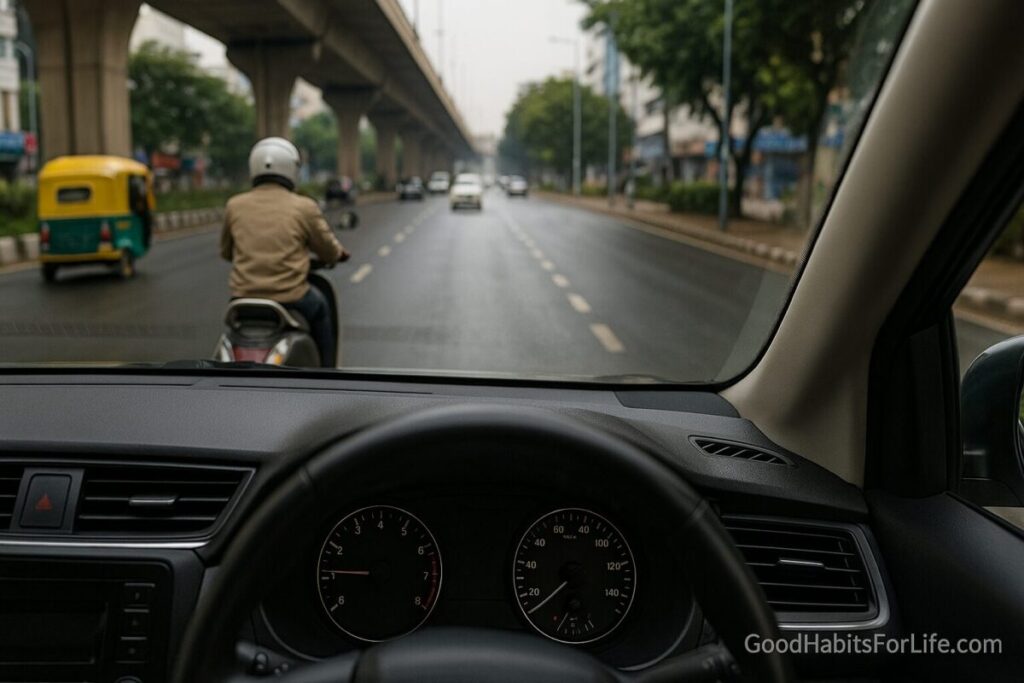
TwoWheelers Around You: Predict, Protect, Pass
Two-Wheelers Around You: Predict, Protect, Pass
Table of Contents
🧭 Predict, Protect, Pass — What & Why
Motorcycles and scooters are small, fast-accelerating, and vulnerable. Globally, road deaths remain staggering (≈ 1.19 million annually), with vulnerable road users—including motorcyclists and riders of two-/three-wheelers—making up a large share. Lower- and middle-income countries carry the heaviest burden. World Health OrganizationIrisVital Strategies
In India specifically, official data show 1,72,890 fatalities in 2023, with two-wheeler riders a major share of victims—reminding drivers that protecting them protects families. Ministry of Road Transport and Highways
Risk is not just frequency—it’s severity. Per mile traveled in the U.S., motorcyclist fatality rates are vastly higher than for car occupants (≈28× in 2023), underscoring why cars must create space and time around bikes. Crash Stats
**The GoodHabits framework—Predict → Protect → Pass—**turns that reality into repeatable driving habits that lower crash risk in busy city traffic.
🔎 Predict: See Two-Wheelers Early
Why bikes get missed: They present a slim profile, appear farther than they are, and can be masked by pillars/mirrors. At junctions and lane changes, do a deliberate second scan for motorcycles and scooters.
Habits that work
-
Junction double-take. Before moving off or turning, check mirrors, signal, shoulder-check, and specifically look for bikes filtering through traffic. GOV.UK
-
Mirror discipline. Re-scan side mirrors every 5–8 seconds in congestion; scooters can appear quickly from behind.
-
Indicator skepticism. Motorcycle indicators often don’t self-cancel; treat a steady blinker as maybe still going straight until motion proves otherwise. Department of Transportation
-
Low-speed hotspots. Bus stops, construction zones, and pothole-ridden stretches trigger sudden line changes by two-wheelers—anticipate them. NHTSA
Micro-drill (30 seconds): Say out loud—“Mirrors, signal, shoulder”—before every lateral move for the next week. (Repetition wires the reflex.)
🛡️ Protect: Build a Safety Bubble
Two-wheelers need room to maneuver around hazards that barely affect cars (gravel, manholes, joints, potholes). Your job is to buffer.
Space & speed rules
-
Following distance: Leave 3–4 seconds behind motorcycles; double in rain or at night. Department of Transportation
-
Full-lane respect: A motorcycle is entitled to a full lane—don’t crowd or “share” the lane. Department of Transportation
-
Don’t door. When parked, check mirrors and glance back before opening—two-wheelers can be alongside.
-
Gentle speed variance. If a scooter is wobbling over rough tarmac, ease off to expand their escape route.
-
Signals that stick. If a bike’s indicator stays on, wait for body language (head/shoulder turn, lane position) before assuming the turn. Department of Transportation
Protective positioning
-
Keep your car centred in lane to avoid creating a tempting squeeze-through gap.
-
In queuing traffic, stagger slightly within your lane to maximize sightlines at mirrors and reduce blind spots.
🛣️ Pass: Overtake Without Risk
Passing a two-wheeler safely is simple if you do it deliberately.
Clean overtake recipe
-
Decide only when you can give a full lane’s width—never “same-lane” pass. Department of Transportation
-
Signal early and shoulder-check for filtering riders. GOV.UK
-
Commit with a modest speed differential; don’t linger alongside.
-
Return only when you see both bike and rider fully in your mirror—then add a beat.
-
In crosswinds, rain, or at night, increase clearance and pass more slowly. UK guidance: give at least as much room as you would a car when overtaking vulnerable riders. THE HIGHWAY CODEGOV.UK
⚡ Quick Start: Do This Today (10 Minutes)
-
Mirror reset (2 min): Adjust side mirrors outward to just erase your car’s flanks—shrinks blind spots.
-
Blind-spot drill (3 min): Park, buckle in, and practice left/right shoulder-checks with hands at 9-and-3.
-
Following-time test (2 min): On your next stretch, pick a fixed point; ensure 3–4 seconds behind any motorcycle. Department of Transportation
-
Junction mantra (3 min): For every turn today: mirrors → signal → shoulder-check → pause → steer.
🗓️ 7-Day Starter Plan
-
Day 1: Learn the Predict–Protect–Pass loop; apply it once on every commute segment.
-
Day 2: Practice double-take at 10 junctions (count them). GOV.UK
-
Day 3: Keep a 3–4s buffer behind at least five motorbikes today (log them). Department of Transportation
-
Day 4: Do five perfect overtakes: full signal, shoulder-check, decisive pass, delayed return. Department of Transportation
-
Day 5: Rain/night rehearsal: drive a short route and double your gaps; note longer stopping distance.
-
Day 6: Parking awareness: add a door-check and slow roll-off when pulling out.
-
Day 7: Review: What felt risky? Where did Predict or Protect save you? Set two habits to keep.
🧠 Techniques & Frameworks
-
P-P-P Loop (per minute): Predict (scan mirrors + shoulder), Protect (set gap), Pass (only if full lane, clean return).
-
2×2 Attention Grid: High risk/low speed (markets, school zones) = eyes wide, hands light; High risk/high speed (arterials) = space first, speed later.
-
“Indicator skepticism” rule: Don’t trust a single blinker—wait for commitment cues (wheel, head, lane position). Department of Transportation
👥 Audience Variations
-
Students / New drivers: Hard-wire MSM + shoulder-checks on every lateral move; do commentary driving (“Bike left, holding gap”). GOV.UK
-
Parents: Kids in the car raise workload—slow your approach to intersections and narrate your checks to teach safe habits.
-
Professionals (taxis, deliveries, ride-hail): Expect lane filtering at stops; leave half-a-car length to see/ be seen; signal early to avoid “pinch points.”
-
Seniors: Boost mirror size (clip-ons) and consider blind-spot monitoring; increase following distance to 4–5s for extra reaction time.
-
Teens: Practice five clean overtakes with an experienced driver, focusing on not lingering alongside.
⚠️ Mistakes & Myths to Avoid
-
Myth: “They’re small, so I can share the lane.” → Never. Motorcycles deserve a full lane. Department of Transportation
-
Mistake: Squeezing past a scooter at a speed bump. → Wait; bumps cause big balance shifts.
-
Myth: If a bike is fast, they must avoid me. → The higher injury risk is theirs; you must build the buffer. Crash Stats
-
Mistake: Relying only on mirrors. → Shoulder-checks catch what mirrors miss. GOV.UK
-
Myth: Their indicator means they’re definitely turning. → Treat it as a maybe until movement confirms. Department of Transportation
🗣️ Real-Life Examples & Scripts
-
Lane change script (right): “Mirror-mirror—signal—right shoulder—gap 4s—glide across.”
-
Junction script: “Stop line—bike check left/right—commit.” GOV.UK
-
Overtake script: “Signal—shoulder—pass fully—mirror sees rider—one-Mississippi—return.” Department of Transportation
-
Congestion script: “Expect filterers; keep lane center; widen gap by a car length.”
🧰 Tools, Apps & Resources
-
Blind-spot mirrors / BS monitors: Wider view; doesn’t replace shoulder-checks.
-
Dashcams: Evidence after close passes; mind storage and privacy rules.
-
Navigation apps (Android Auto/CarPlay): Hands-free voice prompts keep eyes up.
-
ADAS (where fitted): Blind-spot warning helps, but you remain responsible.
📌 Key Takeaways
-
Two-wheelers are common and vulnerable—your space cushion protects them. Ministry of Road Transport and HighwaysCrash Stats
-
Run the Predict → Protect → Pass loop on repeat.
-
3–4s behind, full lane to themselves, shoulder-checks before any lateral move. Department of TransportationGOV.UK
-
In poor conditions, double your margins and slow your overtake. THE HIGHWAY CODE
❓ FAQs
How much space should I give when passing a motorcycle or scooter?
Give them a full lane—never attempt to pass within the same lane. In poor conditions, increase clearance and pass more slowly. Department of TransportationTHE HIGHWAY CODE
What following distance is safest behind a motorcycle?
Keep 3–4 seconds; extend to 4–6 seconds in rain/night. Department of Transportation
Why do motorcycles weave or ride to one side of the lane?
They’re positioning for visibility and to avoid hazards like potholes, paint lines, or debris—give them room to adjust. NHTSA
Do I trust a bike’s indicator?
Treat motorcycle indicators with caution; many don’t self-cancel. Confirm with movement before proceeding. Department of Transportation
What’s the single biggest mistake drivers make at junctions?
“Looking but not seeing.” Do a deliberate second scan for bikes before you turn or pull out. GOV.UK
Is lane filtering legal? Should I block it?
Laws vary by country/state. Regardless, don’t squeeze riders; keep your line, signal early, and check mirrors/shoulders before lateral moves. (Consult local rules for specifics.) GOV.UK
References
-
World Health Organization. Global Status Report on Road Safety 2023. (summary & full report). https://www.who.int; PDF: 13 Dec 2023. World Health OrganizationIris
-
Ministry of Road Transport & Highways (MoRTH), Government of India. Road Accidents in India 2023 (official report, PDF). Ministry of Road Transport and Highways
-
National Highway Traffic Safety Administration (NHTSA). Traffic Safety Facts 2023: Motorcycles (fatality rates). Crash Stats
-
U.S. Department of Transportation. Consumer Advisory: Safely “Share the Road” with Motorcyclists (full-lane and 3–4s following guidance). Department of Transportation
-
UK Government. The Highway Code — Road users requiring extra care (Rules 204–225; esp. 211–212). GOV.UK
-
Highway Code UK (consolidated guidance on overtaking space for vulnerable road users). THE HIGHWAY CODE
-
Insurance Institute for Highway Safety (IIHS). Motorcycles — facts & fatality statistics. IIHS Crash Test+1
-
OECD/International Transport Forum. Road Safety Annual Report 2023 (global trends). itf-oecd.org