
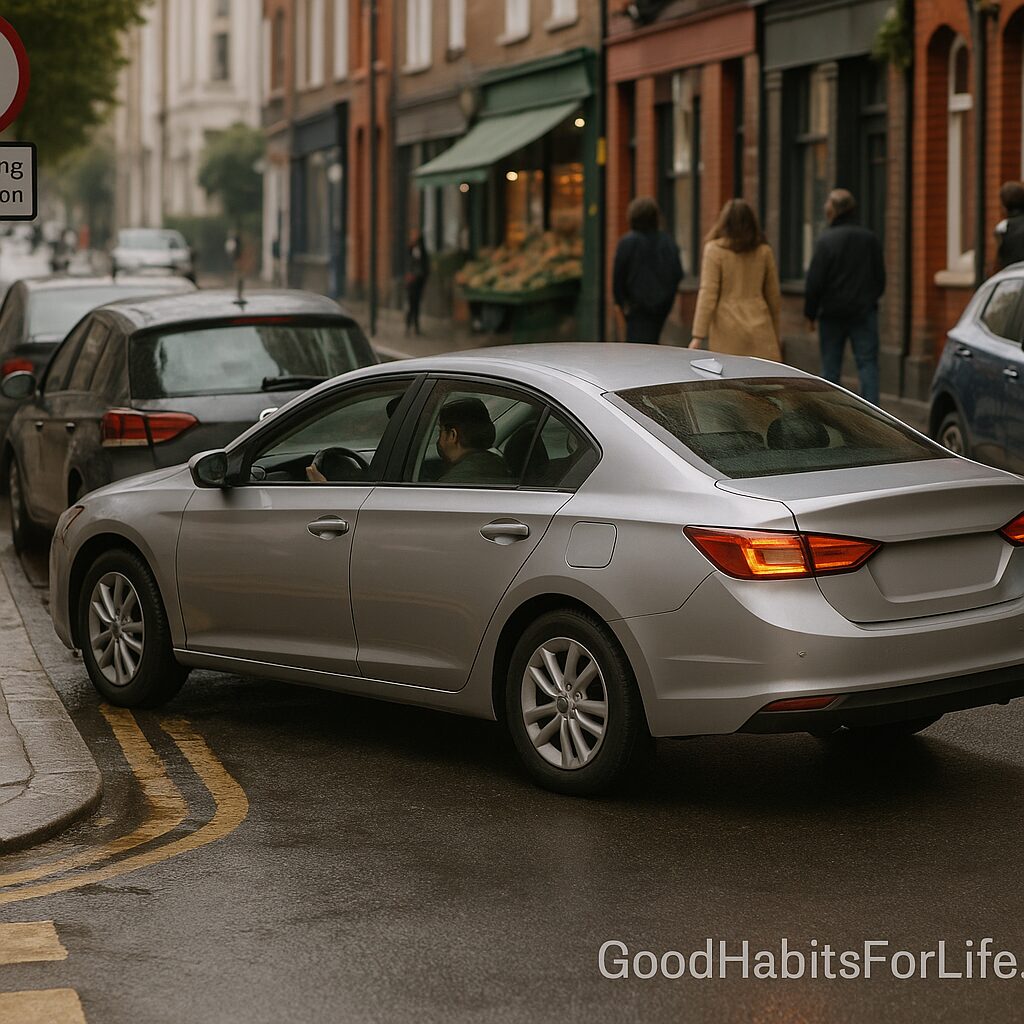
Parking in Tight Streets: Spots, Signals, Safety
Parking in Tight Streets: Spots, Signals, Safety
Table of Contents
🧭 What & Why: Parking Smart in Narrow Streets
Parking in tight streets means placing your vehicle safely where space is limited—dense urban blocks, older neighborhoods, market lanes—without obstructing traffic, endangering pedestrians, or risking damage.
Why it matters
-
Safety: Clean line-of-sight reduces dooring and pedestrian conflicts.
-
Flow: Fewer hold-ups for buses, cyclists, and emergency vehicles.
-
Cost: Avoid fines, towing, scrapes, tyre rash, and mirror knocks.
-
Confidence: A calm, repeatable method cuts stress and decision fatigue.
Evidence-backed benefits: Defensive driving habits (systematic scanning, signaling, and low-speed control) correlate with fewer collisions and conflicts; official road codes emphasize clear indication, road-edge positioning, and hazard awareness.
⚙️ The Core System: SMOG + 360° Checks
Use this every time you begin any parking maneuver:
SMOG
-
Signal: Turn on the indicator well before you brake.
-
Mirror: Check rear-view and side mirrors.
-
Over-shoulder: Blind-spot glance toward cyclists, scooters, pedestrians.
-
Go: Commit slowly; feet gentle; be ready to pause.
360° Bubble
-
Front corners, mirrors, rear corners, kerb/wheel, door-zone.
-
Talk yourself through: “Signal on… mirrors… shoulder… creep.”
-
Speed rule: If someone could walk beside you, you’re slow enough (≈3–5 km/h; 2–3 mph).
🚦 Quick Start: Do-This-Today Checklist
-
Before you stop
-
Read parking signs, curb markings, driveways, hydrants, ramps.
-
Pick a spot with a clear exit line and enough room (car length + 1–1.5 m / 3–5 ft for parallel).
-
Signal early; ease past the space to align your rear axle with the rear of the target spot (for parallel).
-
-
While maneuvering
-
Keep wheels straight until the turn-in point.
-
Enter at ~45° for parallel; reverse is king for precision.
-
One wheel-turn ≈ 2–2.5 m (6–8 ft) of rear swing—watch tail clearance.
-
Pause if traffic builds; let others pass; continue calmly.
-
-
Set & secure
-
Centre in the bay; kerb gap 20–30 cm (8–12 in).
-
Wheels straight, handbrake/park, engine off. Check for cyclists before door opening (“Dutch Reach”: use far hand).
-
🛠️ Techniques & Frameworks (Parallel, Reverse-in, Angle)
Parallel Parking (tight street essential)
-
Position: Pull up parallel beside the car ahead of the space, ~50–75 cm (20–30 in) away; rear axles roughly aligned.
-
Reverse straight until your back seat or C-pillar lines up with the other car’s rear bumper.
-
Steer full-lock toward kerb; creep until your front wheel clears the neighbor’s rear.
-
Counter-steer to straighten as your front enters; use small pauses to reassess mirrors and kerb gap (aim 20–30 cm / 8–12 in).
-
Centre between vehicles; leave ~1 m (3 ft) to exit if possible.
Micro-tips
-
Use a fixed body reference (e.g., “when my rear door handle reaches their rear light, begin full-lock”).
-
If you’ll block traffic for more than ~10–15 s, wave following drivers through first.
Reverse-in (bay or gap on narrow lanes)
-
Reverse-in gives better visibility when exiting.
-
Start wider than you think; hinge at the far corner; enter slowly with small steering bites.
-
If angle is tight, two-stage S-curve: half-lock in, straighten, then finish.
Angle Parking on Tight Blocks (legal where marked)
-
Approach wide; signal; aim for the bay midpoint.
-
Turn late; roll straight in; avoid clipping with over-steer.
-
When leaving, reverse straight until you can see past adjacent cars, then turn.
Hand Signals (backup when indicators fail or to reinforce intent)
-
Left turn/merge: Left arm straight out.
-
Right turn/merge: Left arm up at 90° (forearm vertical).
-
Stop/slow: Left arm down at 90° (palm back).
(Use only where legal and safe; maintain steering control.)
🗺️ Choosing Spots: Rules, Readability, Risk
Use the 3-R Filter:
-
Rules: Legal signage, curb paint, driveways, crossings, hydrants, bus stops, loading zones, disabled bays.
-
Readability: Lighting at night, sightlines from intersections, grade/slope, surface defects.
-
Risk: Door-zone to bike lane, truck turns, school zones, theft or flood risk, tree sap/falling debris.
Sightline math (simple): If you can’t see at least 50–70 m (160–230 ft) of oncoming flow in both directions on a narrow two-way, choose another spot.
📈 7-Day Starter Plan
Daily dose: 15–30 minutes. Two cones or bottles are enough.
-
Day 1 — Controls & Mirrors: Set your seat, mirrors (cover blind spots), slow-roll clutch/brake control; practice SMOG.
-
Day 2 — Reference Points: Parallel entries with cones; learn your turn-in marks.
-
Day 3 — Reverse-in Practice: Bay or improvised box; two-stage S-curves.
-
Day 4 — Tight Parallel: Shrink the space (car length + 1 m / 3 ft). Add a spectator to spot tail swing.
-
Day 5 — Busy Street Rehearsal: Add traffic flow; practice pausing and letting others pass without pressure.
-
Day 6 — Night & Rain: Repeat in low light/wet; note longer stopping distances and poorer depth cues.
-
Day 7 — Full Flow Drill: Choose three different streets; execute 6 clean parks (parallel, reverse-in, angle if legal) with zero cone touches.
Checkpoint: You should park cleanly in ≤2 pull-ups on a typical space and exit without corrections.
👥 Audience Variations
Students / New Drivers
-
Script yourself aloud: “Signal… mirror… shoulder… angle… straighten.”
-
Practice with a mentor; swap driver–spotter roles.
Professionals (time-pressed)
-
Pre-pick low-risk side streets near destinations; fewer interruptions.
-
If you’ll load equipment, choose wider exits over a closer spot.
Seniors
-
Prefer reverse-in for better exit vision; consider wide-angle mirror add-ons.
-
Take extra time; ignore honking—steady beats speedy.
Parents with Kids
-
Curb-side child exit only; use child locks.
-
Do a final 360° kid/cycle check before opening doors.
⚠️ Mistakes & Myths to Avoid
-
Myth: “Front-in is quicker.”
Reality: Reverse-in is usually safer and faster on exit. -
Mistake: Steering while stopped.
Fix: Roll slightly to reduce tyre scrub and strain. -
Mistake: Fixating on the kerb.
Fix: Scan mirrors and front corners—tail swing can clip. -
Myth: “Hazard lights make illegal stops OK.”
Reality: They don’t override rules; use only as permitted. -
Mistake: Rushing under pressure from traffic.
Fix: Let them pass; continue at safe creep speed.
💬 Real-Life Scripts & Micro-Routines
When a driver is close behind you:
Indicator on. Hand wave: “Please pass.” Maintain lane; pause until clear; begin reverse.
When a cyclist appears:
Cancel maneuver; hand up (stop), eye contact; let them pass; restart SMOG.
When you mis-angle the entry:
Stop. Full lock away; creep forward 30–60 cm (1–2 ft); reset the angle; reverse again.
Dutch Reach for doors:
Use the far hand to open; your torso turns; check mirror + shoulder for riders.
🔧 Tools, Apps & Low-cost Gear
-
Parking apps: Parkopedia, ParkMobile (availability, rules, digital payment).
-
Maps & street imagery: Google Maps/Street View to pre-scout curb rules.
-
Cameras & sensors: Factory or aftermarket reversing cameras; add parking sensor kits if your car lacks them.
-
Mirror aids: Clip-on blind-spot mirrors; interior wide-angle mirror.
-
Cones/Markers: Two collapsible cones for weekly practice.
-
Protectors: Flexible number-plate or bumper guards (check local legality).
Pros/Cons (quick)
-
Apps: +Rules clarity / –Coverage varies.
-
Sensors: +Confidence / –False alerts in rain.
-
Cameras: +Rear view / –Depth perception takes practice.
✅ Key Takeaways
-
Use SMOG + 360° every time.
-
Reverse-in or parallel with slow, early steering.
-
Choose spots with clear rules, visibility, and exit.
-
Practice 15–30 min/day for one week to cement skill.
-
Signals, eye contact, and patience prevent conflicts.
❓ FAQs
1) How much space do I need to parallel park?
Ideally, your car length + 1–1.5 m (3–5 ft). Skilled drivers can do it with less, but don’t force it if traffic is heavy.
2) Should I front-in or reverse-in to a tight bay?
Reverse-in is usually safer and gives better visibility when you leave—especially on narrow streets.
3) When should I use hazard lights while parking?
Only as allowed locally (e.g., to warn of a temporary obstruction). Hazard lights don’t legalize prohibited stopping.
4) What kerb distance is acceptable?
Aim for 20–30 cm (8–12 in) from the kerb. Touching or mounting kerbs may damage tyres and can be illegal.
5) Is it OK to hold up traffic while I park?
Briefly, yes—signal early, pause to let vehicles pass, then complete the maneuver at safe creep speed.
6) Hand signals still relevant?
Yes as a backup to indicators or to reinforce intent where legal: arm straight for left, up for right, down for stop/slow.
7) How do I avoid scraping alloys on the kerb?
Turn in later, keep a small approach angle, and glance at the kerb mirror; consider inexpensive rim protectors.
8) Any night-time adjustments?
Slow further, use clean mirrors/windows, and prioritize well-lit spots with clear sightlines.
9) Can I park opposite another parked car on a narrow two-way?
Only if fire trucks/buses and opposing traffic can still pass safely and local rules permit—when in doubt, pick another spot.
10) What’s the safest way to open doors into a bike lane?
Use the Dutch Reach: far hand, body turns, check mirror and shoulder, open slowly.
📚 References
-
UK Government. The Highway Code — Waiting and Parking (Rule 239 etc.) https://www.gov.uk/guidance/the-highway-code/waiting-and-parking
-
California DMV. Driver Handbook — Parking https://www.dmv.ca.gov/portal/handbook/california-driver-handbook/parking/
-
NHTSA. Safe Driving Tips & Defensive Driving https://www.nhtsa.gov/road-safety/safe-driving
-
AAA. How to Parallel Park (Step-by-Step Guide) https://www.ace.aaa.com/automotive/advocacy/how-to-parallel-park.html
-
FHWA. Manual on Uniform Traffic Control Devices (MUTCD) https://mutcd.fhwa.dot.gov/
-
Transport for London. Stopping and Parking Guidance https://tfl.gov.uk/modes/driving/parking
-
WHO. Road Safety — Key Facts https://www.who.int/news-room/fact-sheets/detail/road-traffic-injuries
-
IIHS. Driver Assistance and Crash Avoidance Basics https://www.iihs.org/topics/advanced-driver-assistance
⚖️ Disclaimer
This article offers general driving and parking guidance, not legal advice; always follow your vehicle manual and local traffic laws and signage.