
Stacking Savings: Coupons, Cashback, Gift CardsWithout Confusion: No-Spend Challenge (2025)
Stacking Savings: Coupons, Cashback & Gift Cards
🧭 What “Stacking Savings” Means & Why It Works
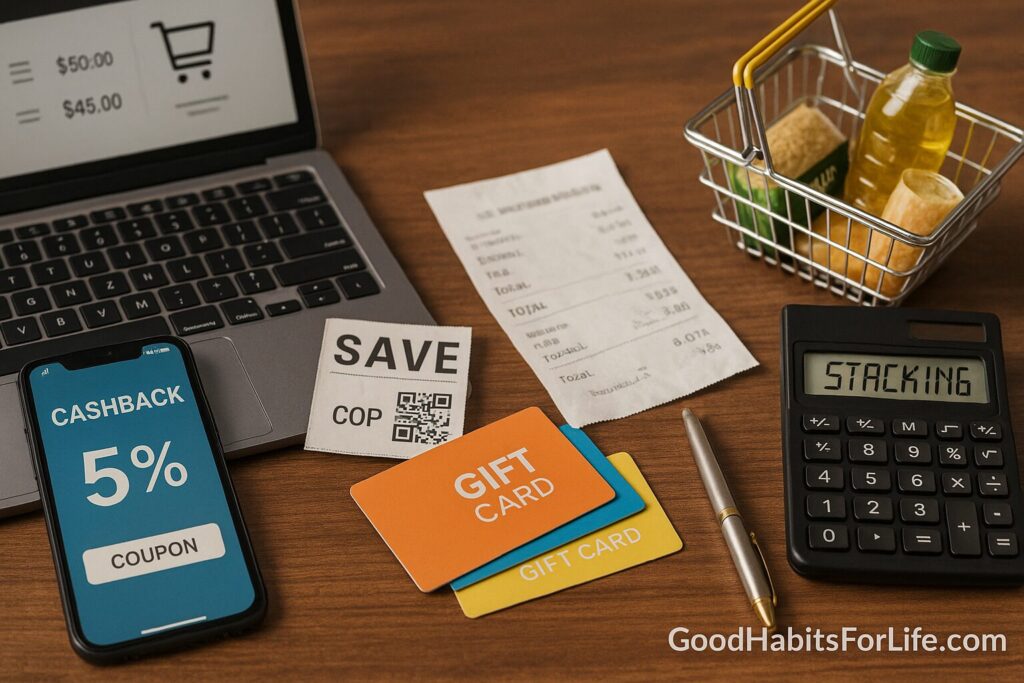
Stacking savings means combining multiple legitimate discounts on the same purchase—price comparison, store coupons or promo codes, discounted gift cards, cashback portals or apps, and your card’s own rewards—to reduce the final cost without breaking any rules.
Why it works
-
Stores run overlapping promotions; affiliate and rewards ecosystems let consumers share in commissions (cashback).
-
Careful stacking helps you beat inflation creep and “junk fees” by focusing on total price you’ll actually pay. Consumer regulators emphasize transparent, total pricing to help comparison shopping. Federal Trade Commission
-
Gift card and rewards programs are regulated (e.g., expiry/fees limits for most U.S. gift cards; regulators also watch card-rewards claims), which protects consumers who understand the terms. Consumer Financial Protection Bureau+1Consumer Financial Protection Bureau
Evidence-backed shopping basics
-
The FTC advises comparing prices, seeking coupon codes wisely, and being cautious with gift cards and sellers that demand payment via gift card (common scam red flag). Federal Trade CommissionConsumer Advice
-
Use unit pricing (price per 100 g, litre, etc.) to identify true value—official guidance exists to help consumers save using unit price labels. NIST Publicationsmyplate.gov
✅ Quick Start: The 5-Step Checkout Stack
-
Price Check (start here):
-
Compare across 2–3 retailers. Check unit prices; look for “junk” fees and shipping before deciding. NIST
-
-
Apply Store Coupon/Promo:
-
Add a single best code. If multiple codes are allowed, apply highest-value first (some carts allow code + loyalty).
-
-
Pay with a Discounted Gift Card (optional):
-
Use only trusted sources; inspect physical cards and avoid auction sites. Verify terms (most U.S. gift cards: ≥5-year expiry; some countries require ≥3 years). Consumer AdviceFDICACCC
-
-
Click Through a Cashback Portal/App:
-
Open a clean browser window, disable ad-blockers, accept cookies, then click through and buy in one session. MoneySavingExpert.comTopCashback
-
-
Finish with a Rewarding Card:
-
Use the card that pays the highest after any fees; know issuers must honor advertised rewards and regulators police devaluations or “bait-and-switch” tactics. Consumer Financial Protection BureauConsumer Financial Protection Bureau
-
🛠️ Techniques & Frameworks
The 3-Stack (fast everyday purchases)
-
Compare price → One best coupon → Card rewards.
-
Use unit price to confirm value; skip the rest if time-pressed. NIST Publications
The 5-Stack (big-ticket or planned buys)
-
Price check → Promo code → Discounted gift card → Cashback portal → Card rewards.
-
Keep screenshots of the offer and portal click-through for claims.
P.A.C.E. pre-flight
-
Policy: Does the store allow multiple codes/portal + code?
-
Account: Logged in, loyalty added, address saved.
-
Cookies: Ad-blocker off; other tabs closed. TopCashback
-
Expiry: Check gift card and promo code dates. FDIC
Reality check: is it a real deal?
-
Use unit pricing and total-price disclosure to spot pseudo-discounts. NIST PublicationsFederal Trade Commission
🧱 30-60-90 Habit Plan
Days 1–30 (Foundations)
-
Create a “Deal” bookmark folder: Price Compare, Coupons, Cashback, Gift Cards.
-
Set up one clean browser profile: no extensions; cookies allowed.
-
Pick one cashback portal and learn its rules. Save your top 10 stores. MoneySavingExpert.com
-
Practice the 3-Stack on groceries and household staples using unit pricing in-store or online. myplate.gov
Days 31–60 (Confident Stacker)
-
Add discounted gift cards—but only from reputable sellers. Inspect physical cards before purchase; avoid auction sites; keep receipts. Consumer Advice
-
Try the 5-Stack on a planned buy (appliance, insurance, travel booking).
Days 61–90 (Optimize & Automate)
-
Track wins in a single spreadsheet: item, store, RRP, final paid, stack sequence, % saved.
-
Add a second cashback portal for rate-shopping (but only one click-through per purchase). MoneySavingExpert.com
-
Review your rewards card strategy yearly; regulators monitor fairness but you should still verify value for your spend. Consumer Financial Protection Bureau
👥 Audience Variations
Students: Focus on groceries and transport; unit pricing + student discounts + one cashback portal is enough.
Parents: Bulk buys: compare price per 100 g and avoid brand-loyal traps.
Professionals: Big-ticket tech/workwear—use 5-Stack and calendar major sales (but verify pre-sale prices).
Seniors: Favor reliability and clear returns; keep the stack simple (price + coupon + card rewards).
⚠️ Mistakes & Myths to Avoid
-
Myth: “More codes = more savings.” Many carts accept only one code; test best value rather than stacking random coupons.
-
Mistake: Using ad-blockers during cashback checkout. It can prevent tracking and void rewards. TopCashback
-
Mistake: Buying gift cards from unknown sellers. Risk of tampering or stolen balances; inspect cards and keep proof. Consumer Advice
-
Myth: “Cashback is guaranteed.” It’s an affiliate commission share—track carefully; merchants can decline if terms aren’t met (returns, other cookies). MoneySavingExpert.com
💬 Real-Life Example Scripts
In-store price match + coupon
“Hi! I see your online price is ₹2,999 and a competitor has ₹2,749. Do you match it? If yes, can I still apply this store coupon?”
Gift card question
“I’d like to confirm: this gift card has a 5-year minimum expiry and no inactivity fees within the first year, correct?” FDIC
Cashback claim message
“Order #12345 on 12 Sept 2025 via your portal. Click-through screenshot attached. No returns or other coupons used. Please review tracking.”
🧰 Tools, Apps & Resources
-
Price comparison & history: multiple comparison sites; for Amazon-style stores, price-history trackers.
-
Coupons/promo: store newsletters & loyalty programs; one reputable coupon extension at a time to avoid conflicts.
-
Cashback portals/apps: pick 1–2 well-reviewed platforms; read their tracking help and cookie policies. TopCashback+1
-
Unit pricing aids: state/agency unit-price guides and labels. NIST PublicationsNIST
-
Security & returns: FTC shopping guidance and gift card safety. Federal Trade CommissionConsumer Advice
📌 Key Takeaways
-
Start with total price (fees included), not the headline discount. Federal Trade Commission
-
The safe, repeatable order is Compare → Promo → Gift Card → Cashback → Card Rewards.
-
Unit pricing keeps you honest about value; ad-blockers off keeps cashback tracking. NIST PublicationsTopCashback
-
Know the rules: gift card expiry/fees and reward program terms exist—read them. Consumer Financial Protection Bureau
❓ FAQs
1) Is coupon stacking legal?
Yes—provided you follow the store’s policy and the code’s terms. Some stores limit to one code; others allow code + loyalty. Always check the cart rules.
2) Do ad-blockers stop cashback from tracking?
Often yes; portals rely on cookies and click-through attribution. Use a clean browser or pause the blocker for the retailer and portal. MoneySavingExpert.comTopCashback
3) Are gift cards safe to use for stacking?
They can be—if you buy from trusted sources, inspect the card, and keep the receipt. Avoid auction sites and watch for tampering. Consumer Advice
4) What’s the minimum expiry on gift cards?
In the U.S., most gift cards cannot expire for at least five years; some countries set three-year minimums (e.g., Australia). Always check local law and the card’s terms. FDICACCC
5) Can portals + promo codes + gift cards all work together?
Sometimes. Many merchants allow a portal plus one promo code; some exclude gift card spend from cashback. Read the merchant’s portal page before buying.
6) What if my card issuer devalues rewards after I apply?
Regulators monitor rewards programs and deceptive practices; document offers and contact the issuer if benefits aren’t delivered. Consumer Financial Protection Bureau
7) How do I know a discount is real?
Compare unit prices, check prior price history, and look for total-price disclosure (with fees) before paying. NIST PublicationsFederal Trade Commission
8) Do I need multiple cashback portals?
One is fine to start; add a second only after you’ve mastered tracking and record-keeping. The “last-cookie-wins” rule means only one portal should be used per purchase. MoneySavingExpert.com
9) What records should I keep?
Save order confirmation, portal click-through screenshot, and promo details for claims—especially on big-ticket purchases.
10) Are there fees or gotchas with gift cards?
Some cards can charge inactivity fees after 12 months of no use (where disclosed), and terms vary—read the fine print. FDIC
📚 References
-
Federal Trade Commission — Online Shopping Tips and Coupon/Price Guidance. Federal Trade Commission
-
Federal Trade Commission — Online Shopping (Consumer Advice) and Avoiding & Reporting Gift Card Scams. Consumer Advice+1
-
Consumer Financial Protection Bureau — 12 CFR 1005.20: Gift Cards & Certificates; Credit Card Rewards Issue Spotlight; Circular on Rewards Programs. Consumer Financial Protection Bureau+1Consumer Financial Protection Bureau
-
FDIC — What You Should Know About Gift Cards (expiry and fees). FDIC
-
MoneySavingExpert — Cashback Websites Guide (cookie tracking basics). MoneySavingExpert.com
-
TopCashback — Ensuring Tracking Success & Ad-blockers and Tracking (operational mechanics). TopCashback+1
-
NIST — Unit Pricing Guide (SP 1181) and Unit Pricing Guidance (why unit pricing helps consumers). NIST PublicationsNIST
-
MyPlate (USDA) — Shop Smart: Unit Price. myplate.gov
-
ACCC / Consumer Affairs (AU) — Gift cards must be valid for at least 3 years. ACCCConsumer Affairs Victoria
Disclaimer: This guide is educational information, not financial advice; always check a retailer’s terms and local consumer laws before purchasing.