
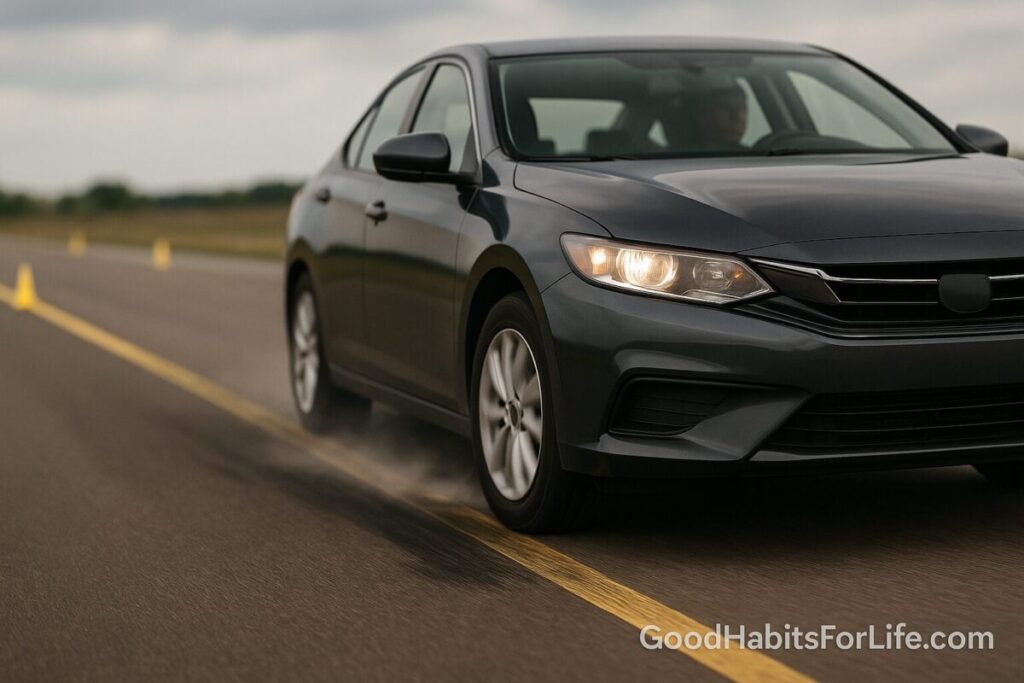
Braking Like a Pro: Threshold, ABS, and Mistakes
Braking Like a Pro: Threshold, ABS, and Mistakes
Table of Contents
🧭 What “Threshold Braking” Means & Why It Matters
Threshold braking is applying the brake pedal as hard as possible without locking the wheels—right at the “threshold” of grip. It delivers the shortest controlled stopping distance while preserving stability. Oregonris.dls.virginia.gov
Why care?
-
Shorter, straighter stops in emergencies. Oregon
-
Keeps steering authority when paired with ABS or skilled pedal control. NHTSA
-
Builds consistent habits you can call on under pressure.
🧠 ABS: What It Does—and How to Use It
Anti-lock Braking Systems (ABS) monitor wheel speed and rapidly modulate brake pressure to prevent lockup. That lets you brake hard and still steer around hazards. When ABS activates you’ll feel pulsing/vibration in the pedal—hold firm pressure and steer. Do not pump. My Car Does WhatRoSPAexchange.aaa.com
On many paved surfaces, ABS helps you stop faster and with more control; real-world crash reductions vary, but its steering benefit is clear. NHTSA
If your ABS light stays on, the system may be offline—get it checked and be prepared to use manual threshold braking. mn-ia.aaa.com
✅ Quick-Start: Safer Stops Today
-
Set space: Use the 2-second rule (double in wet; more on ice/gravel). RoSPA
-
Eyes up: Look far ahead; plan stops early.
-
Decisive brake: In an emergency, stomp-and-steer with ABS—press hard, keep pressing, steer to safety. My Car Does What
-
Without ABS: Use threshold braking—press firmly to the lockup point; if a wheel locks, ease slightly and re-apply to keep it rolling. Oregon
-
Grip check: In rain or cold, expect longer stops and slow down. GOV.UK
🛠️ 7-Day Practice Plan (Empty-Lot to Real-Road Readiness)
Where: An empty, legal practice area with cones or chalk marks.
Goal: Build the “feel” for threshold/ABS and lock it into muscle memory.
-
Day 1–2: Baseline feel (dry pavement)
-
25–30 km/h (15–20 mph) approach, hard stop at a cone.
-
With ABS: press hard to activation and hold; focus on steering stability.
-
Without ABS: increase pressure until a hint of lock; back off ~5% and hold. Oregon
-
-
Day 3: Progression
-
Repeat at 40–50 km/h (25–30 mph). Note weight transfer (nose dip) and keep the wheel straight while thresholding.
-
-
Day 4: Steering under ABS
-
Set a cone “gate” and practice braking and gentle steering around an obstacle while ABS pulses. My Car Does What
-
-
Day 5: Split-friction simulation
-
One wheel on dusty patch (if safe). Feel ABS modulate side-to-side; keep the wheel straight.
-
-
Day 6: Wet-grip adjustment
-
Lightly wet the practice area (where allowed) or practice after rain. Expect much longer distances; build in more space. GOV.UK
-
-
Day 7: Review & log
-
Measure cones-to-bumper distances; note improvements and settings (tyre pressure, load). Revisit monthly for 10 minutes.
-
🧩 Techniques & Frameworks
Friction circle (grip budget): Tyres have limited grip. If you use 100% for braking, you have 0% for turning; blend inputs smoothly to stay within the circle.
Weight transfer: Hard braking loads the front tyres (more grip) and unloads the rear—keep the car straight as the load comes forward.
With ABS (most cars):
-
Press-hold-steer. Expect pedal pulsing; that’s the system preventing lock. My Car Does What
Without ABS (older/classic cars or ABS fault):
-
Threshold braking: firm pressure to just-before-lock. If you feel/see lockup, ease a fraction, then hold. Oregon
-
Cadence braking (backup for some non-ABS vehicles): quick rhythm pumps to simulate ABS, but it’s harder to do well under stress—threshold is preferred if you can manage it. Driving Tests
AEB is a helper, not a habit: Newer cars may add Automatic Emergency Braking (AEB) to apply brakes if you don’t—great backup, but still build manual skill. NHTSAFederal Register
📊 Stopping-Distance Cheat Sheet (Highway Code figures)
Typical dry-road stopping distances (thinking + braking) from the UK Highway Code: GOV.UK
| Speed | Total stopping distance |
|---|---|
| 32 km/h (20 mph) | ~12 m |
| 48 km/h (30 mph) | ~23 m |
| 64 km/h (40 mph) | ~36 m |
| 80 km/h (50 mph) | ~53 m |
| 96 km/h (60 mph) | ~73 m |
| 112 km/h (70 mph) | ~96 m |
In wet conditions, expect at least double the distance; increase the following gap accordingly. RoSPA
🎯 Audience Variations
-
New drivers/students: Practice in short sets; narrate “press-hold-steer” out loud to build recall. Use cones and fixed speeds. My Car Does What
-
Parents with kids onboard: Secure cargo/child seats; extra mass lengthens stopping distances—drive earlier and softer. RoSPA
-
Daily commuters: Make the 2-second rule your default; scan 20–30 seconds ahead in traffic. RoSPA
-
Seniors: Prioritize smooth pressure and longer gaps; do a simple empty-lot drill monthly to keep the feel sharp.
-
Motorcyclists in the family: ABS is particularly protective on bikes; consider ABS-equipped models. IIHS Crash Testing+1
⚠️ Mistakes & Myths to Avoid
-
“Pump the brakes with ABS.” Wrong—hold firm pressure and steer. My Car Does Whatexchange.aaa.com
-
Looking down or at the bumper. Eyes up; aim where you want to go.
-
Too-late, too-soft braking. Decisive, straight-line pressure gets grip working faster.
-
Ignoring tyres. Low tread/pressure = longer stops; check regularly.
-
Assuming ABS always shortens distance. On some loose surfaces, its primary benefit is steering control; distance can vary. NHTSA
🗣️ Real-Life Scripts (Copy/Paste)
-
Emergency stop with ABS: “Brake hard—hold—look—steer to open space.” (Feel pulsing; keep holding.) My Car Does What
-
Without ABS: “Firm to just-before-lock… ease a hair if it skids… hold.” Oregon
-
Wet-day routine: “Double my gap, gentle inputs, early braking.” RoSPA
🧰 Tools, Apps & Resources
-
Tyre care: Digital pressure gauge & tread-depth tool—cheap, big safety return.
-
Driver-feature refresher: MyCarDoesWhat explainer pages & quick guides on ABS. My Car Does What+1
-
Training: Look for local skid-pan/advanced driving courses (check national road-safety orgs such as RoSPA for guidance). RoSPA
✅ Key Takeaways
-
Threshold braking gives the shortest controlled stop; ABS lets you brake hard and steer. OregonMy Car Does What
-
In an emergency with ABS: press-hold-steer; without ABS: press to threshold. My Car Does WhatOregon
-
Space and speed are your biggest safety multipliers—double gaps in wet. GOV.UKRoSPA
-
Practice monthly for 10 minutes to keep the feel fresh.
❓ FAQs
1) How can I tell if my ABS is working?
The ABS light should illuminate briefly at start-up and then go off. If it stays on, the system may be disabled—get it checked and be prepared to use threshold braking. mn-ia.aaa.com
2) Should I pump the brakes in the rain?
Not with ABS—hold firm pressure and steer. Without ABS, use threshold braking; cadence (pumping) is only a fallback and hard to execute precisely. exchange.aaa.comOregon
3) Why do my stops feel longer in wet or cold weather?
Lower tyre-road friction and longer reaction times increase stopping distance; double your following gap in the wet. GOV.UKRoSPA
4) Does ABS always reduce stopping distance?
Often on paved surfaces, yes—but ABS’s consistent advantage is steerability and stability under hard braking; distance can vary by surface. NHTSA
5) What if my car has AEB?
Great backup, but you still need the skill. AEB brakes automatically when a crash seems imminent or to support your braking; don’t rely on it exclusively. Federal Register
6) Manual transmission tip in emergencies?
Focus on straight-line heavy braking; depress the clutch near the end to avoid stalling if needed—priority is maximum, stable deceleration.
7) How often should I practice?
Do 5–10 hard-stop drills when you rotate tyres or once a month; it keeps your sense of grip and pedal pressure calibrated.
8) What following gap should I use on dry roads?
At least 2 seconds (more at higher speeds); double in wet. RoSPA
📚 References
-
UK Highway Code — Typical stopping distances (PDF). GOV.UK
-
RoSPA — Electronic Braking Systems factsheet (ABS tips & notes). RoSPA
-
NHTSA — Driver crash-avoidance behavior with ABS (research summary). NHTSA
-
MyCarDoesWhat (Univ. of Iowa & National Safety Council) — ABS: What you need to do. My Car Does What
-
AAA — Wet-weather driving: Get a Grip (ABS guidance & spacing). exchange.aaa.com
-
Oregon DMV — Basic Driving Skills (threshold braking definition). Oregon
-
Transport Canada — Driver assistance technologies: know your system. Transport Canada
-
UK Highway Code — Rule 126: Stopping distances (HTML). GOV.UK
-
IIHS — Motorcycle ABS reduces fatalities (context on ABS effectiveness). IIHS Crash Testing