
Road Signs Youll Actually See (With Simple Tests)
Road Signs You’ll Actually See (+ Simple Tests)
Table of Contents
🧭 What Counts as a “Road Sign” & Why It Matters
Road (traffic) signs are standardized symbols and words placed along roads to regulate (what you must/must not do), warn (what’s coming), and guide (where to go). Learning them isn’t just for the written test—sign literacy reduces crashes, wrong-way turns, and last-second braking, and helps you drive smoothly and confidently. Signs are designed to be understood at a glance, so you’ll learn them best by pattern (shape + color) and context (where you are when you see them).
✅ The 5 Sign Families You’ll See Most
-
Regulatory (rules you must follow)
-
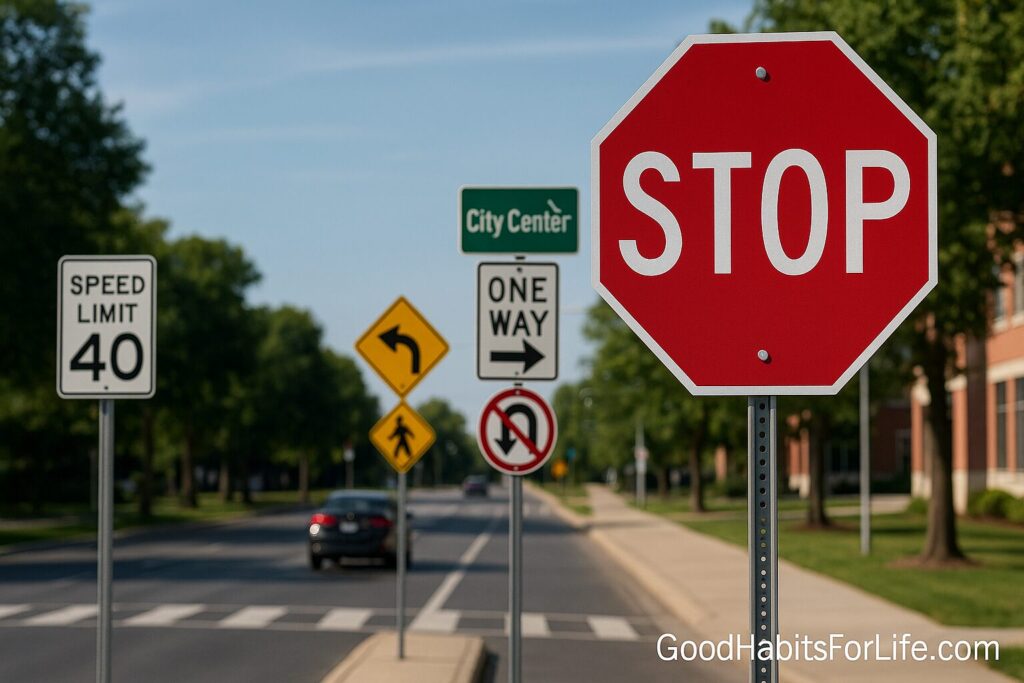
Examples: STOP, YIELD, Speed Limit, No Entry, One-Way, Do Not Pass, Turn Restrictions.
-
-
Warning (hazards or changes ahead)
-
Curves, Intersections, Pedestrian Crossing, School Zone, Merge, Narrow Bridge, Slippery When Wet.
-
-
Guide/Information (directions & services)
-
Route markers, Exit signs, City/Street names, Hospital/Fuel/Food/Lodging.
-
-
Temporary/Work Zone
-
Road Work Ahead, Flaggers, Lane Shifts, Detours, Temporary Speed Limits.
-
-
Recreational/Tourist & Special Use
-
Park/Trail signs, Scenic routes, Bicycle routes, Transit lanes, HOV/Carpool.
-
🧠 Color & Shape: The Fastest Cheat-Code
Memorize this tiny table; it’s 80% of the game.
| Shape | Typical Meaning | Examples |
|---|---|---|
| Octagon (red) | STOP only | Stop |
| Triangle down (red/white) | YIELD | Yield |
| Circle (red slash) | Prohibition | No Entry, No U-Turn |
| Vertical rectangle (white/black/red) | Regulatory | Speed Limit, One-Way |
| Diamond (yellow/amber) | Warning | Curve, Merge, Deer Crossing |
| Pennant (yellow, left-pointing) | No-Passing Zone | No Passing Area |
| Horizontal rectangle (green/blue/brown) | Guide/Info | Exits, Services, Parks |
| Orange diamonds/rectangles | Work Zone Warning/Regulatory | Road Work Ahead |
| Fluorescent yellow-green | School/Ped/Bike emphasis | School Crossing |
Remember: color tells category, shape tells function (rule vs warning vs guide).
🛠️ Quick Start: Learn Today in 10 Minutes
-
1 min: Scan the shape–color table above.
-
4 min: Flash-review Top 20 signs (see list below). Say name → action out loud.
-
3 min: Do Mini-Test A (Multiple Choice).
-
2 min: On your next walk/ride, narrate the next three signs you see.
Repeat daily for a week. That’s it.
📅 A Practical 7-Day Habit Plan
-
Day 1: Shapes & colors + Top 20 regulatory signs.
-
Day 2: Top warning signs (curves, intersections, crossings, speed changes).
-
Day 3: Guide signs (exits, route numbers, destinations) + lane use signs.
-
Day 4: Work zone orange signs; learn how lanes shift and merge speeds.
-
Day 5: Mixed review + Mini-Tests B & C below.
-
Day 6: Real-world drive/walk: photograph confusing signs; annotate what they mean.
-
Day 7: Full review + Mini-Tests D & E; plan two mock routes and call out every sign.
Keep each day to 10–15 minutes. Use spaced-repetition flashcards if possible.
📚 Top 50 Everyday Signs (Plain-English Meanings)
Regulatory (must/ must not):
-
STOP: Full stop → yield to all who have right-of-way.
-
YIELD: Slow; give way to traffic/pedestrians; proceed if clear.
-
Speed Limit: Maximum legal speed under ideal conditions.
-
No Entry/Do Not Enter: Wrong way if you continue.
-
One-Way: Traffic flows in one direction only.
-
No U-Turn / No Left / No Right: Turn prohibited where shown.
-
Turn Only (Left/Right): Lane must turn as indicated.
-
Keep Right/Left: Pass to the side shown (islands/medians).
-
Do Not Pass / No-Passing Zone (pennant): Stay in your lane; insufficient sight distance.
-
Lane Use Control (HOV/Bus/Bike): Lane reserved for specific vehicles/times.
-
Roundabout Direction: Enter and move counter-clockwise; yield to circulating traffic.
-
Parking signs (P, hours, permits): Where/when you can or cannot park.
Warning (prepare/adjust):
-
Curve/Turn Ahead (left/right ↩︎): Slow to advisory speed.
-
Winding Road / S-Curves: Multiple curves; reduce speed.
-
Merge / Added Lane: Either another lane joins (merge) or you gain a lane (added).
-
Lane Ends / Road Narrows: Prepare to merge; check mirrors/blind spots.
-
Traffic Signal Ahead: Be ready for a red light.
-
Stop/Yield Ahead: Prepare to stop/give way soon.
-
Pedestrian Crossing / School Crossing: Slow; be ready to yield.
-
Deer/Animal Crossing: Scan verges; reduce speed at night.
-
Railroad Crossing (⚟ / crossbuck): Slow; look and listen; stop if train approach.
-
Slippery When Wet: Increase following distance; brake gently.
-
Steep Hill / Truck Descent: Lower gear; check brakes.
-
Bridge/Icy Bridge: Can freeze earlier; slow, no sudden moves.
Guide/Info (find your way):
-
Route Markers (numbered shields/discs): Highway or route identification.
-
Exit Signs (green): Next exits, distances, lane arrows.
-
Destination/Distance: City names and kilometers remaining.
-
Service Signs (blue): Fuel, food, lodging, hospital, phone.
-
Tourist/Recreation (brown): Parks, trails, scenic byways.
-
Airport/Transit: Airplane/train symbols, station directions.
Temporary/Work Zone (orange):
-
Road Work Ahead / Men at Work: Expect workers; slow.
-
Lane Shift / Left/Right Lane Closed: Follow arrows; merge early.
-
Flagger Ahead: Be prepared to stop and follow hand signals.
-
Detour: Follow signed alternative route; watch for small confirmation arrows.
🧪 Simple Self-Tests (with Answer Keys)
Mini-Test A — Multiple Choice (5 Qs)
-
A red octagon means…
a) Do Not Enter b) Stop c) Yield d) No U-Turn -
A yellow diamond with a curved arrow means…
a) Roundabout b) Curve ahead c) Lane ends d) Added lane -
A white vertical rectangle usually indicates…
a) Warning b) Guide c) Regulatory d) Tourist info -
Orange diamond with workers pictogram means…
a) School zone b) Work zone warning c) Prohibition d) Parking only -
A left-pointing yellow pennant on the left side indicates…
a) No-passing zone b) Merge left c) Added lane d) Detour left
Answer Key: 1-b, 2-b, 3-c, 4-b, 5-a.
Mini-Test B — Action Prompt (3 Qs)
Say what you’d do:
-
YIELD at a roundabout entrance: __________
-
Lane Ends (right): __________
-
School Crossing at 15:00: __________
Suggested actions: 1) Slow; give way to cars in the circle; enter when clear. 2) Mirror-signal-shoulder; merge smoothly left. 3) Slow to posted school speed; watch and yield to children.
Mini-Test C — Speed Clues (3 Qs)
Which signs most often require slowing down immediately?
-
a) Curve Ahead
-
b) Added Lane
-
c) Destination/Distance
Answer: a) Curve Ahead.
Mini-Test D — Spot the Category
-
Green exit sign → Guide
-
White Speed Limit → Regulatory
-
Yellow “Slippery When Wet” → Warning
-
Orange “Lane Shift Ahead” → Work Zone
Mini-Test E — Right-of-Way (3 Qs)
-
Two cars reach a STOP at a four-way: who goes first? → Car that stops first; if tied, right-hand driver.
-
Turning left with Yield to oncoming traffic: when is it safe? → When oncoming lane is clear or they yield.
-
Pedestrian at marked crosswalk with Ped Crossing sign: → Yield; allow full crossing.
🌍 Variations by Country & Test Tips
-
Core shapes are global: STOP (octagon) and YIELD (triangle down) are near-universal.
-
Text vs pictograms: Some regions use worded signs (“GIVE WAY,” “SPEED LIMIT”), others rely on symbols.
-
Color differences: School/pedestrian emphasis can be fluorescent yellow-green; some countries keep it standard yellow.
-
Speed units: km/h vs mph—read the unit on the plate.
-
Test tip: When unsure, treat unknown yellow diamonds as caution and unknown red/white regulatory signs as rules to obey.
⚠️ Common Mistakes & Myths
-
Myth: “If I match traffic, I’m fine.” → No: Speed Limit is legal max; conditions may require less.
-
Mistake: Reading the text first. Better: recognize shape/color, then glance for details.
-
Mistake: Late merges at Lane Ends → Merge early and smoothly.
-
Myth: “No-Passing only applies if a car is coming.” → No: it applies regardless; it’s about sight distance.
-
Mistake: Ignoring temporary orange signs—they often override regular limits.
🗣️ Real-Life Study Scripts (Copy-Paste)
-
Passenger drill: “Yellow diamond, curve right—slowing to 30 km/h; checking mirrors.”
-
Driver self-talk: “Speed limit 50; wet road → 40 is safer.”
-
Walk-and-point: “No Entry ahead—this side is one-way against me.”
-
Roundabout entry: “Yield sign—waiting for a gap; entering to the left; exit 2.”
🧰 Tools, Apps & Resources
-
DMV/State/Regional handbooks (official PDFs): Most accurate illustrations and wording.
-
Pros: Test-aligned, up-to-date. Cons: Dense.
-
-
Anki / Flashcards: Build shape-color decks; spaced repetition sticks.
-
Pros: Efficient memory. Cons: Setup time.
-
-
Practice test apps (official or reputable) for your region.
-
Pros: Exam-style feedback. Cons: Varying quality—prefer official sources.
-
-
Street-view sessions: Virtually “drive” and call out signs.
-
Pros: Real contexts. Cons: Not all areas current.
-
✅ Key Takeaways
-
Learn shape + color first, then details.
-
Prioritize regulatory and warning signs—the ones that change your speed/lane/priority.
-
Short, daily practice beats cramming.
-
Use self-tests and real-world narration to lock in meanings.
-
When in doubt: slow, scan, yield.
❓ FAQs
1) What’s the difference between “Merge” and “Added Lane”?
Merge → two lanes become one; someone must yield. Added Lane → a new lane appears; no merge conflict immediately.
2) Are advisory speeds (yellow) enforceable like Speed Limits (white)?
Advisory (yellow/black) are recommendations for safety; Speed Limit (white/black) is legal and enforceable.
3) How do I handle a “STOP Ahead” sign I almost missed?
Ease off accelerator early, check mirrors, and brake progressively. Don’t slam the brakes unless necessary.
4) What if signs conflict—like a temporary orange speed vs regular limit?
Temporary work-zone signs override the usual ones unless officers direct otherwise.
5) Do I always yield to pedestrians at crossings?
At marked crosswalks and signals, generally yes; local laws may specify details—when in doubt, yield.
6) How can I tell a No-Passing Zone without the pennant sign?
Look for solid centerlines and limited sight distance—but if the pennant appears, treat it as absolute.
7) Are roundabout rules the same everywhere?
Almost universally: yield to circulating traffic, enter when clear, and signal your exit; verify local nuances.
8) How many signs do I need for the test?
Expect 40–80 key signs depending on your region; master the Top 50 here and then study your official handbook.
9) Any tip for remembering parking signs?
Read time/day arrows left-to-right; photograph the sign, then translate to a simple rule: “Weekdays 8–18, 30-min limit.”
📚 References
-
Federal Highway Administration (FHWA). Manual on Uniform Traffic Control Devices (MUTCD). https://mutcd.fhwa.dot.gov/
-
U.S. National Highway Traffic Safety Administration. Traffic Signs & Signals Basics. https://www.nhtsa.gov/
-
The Highway Code (UK). Road Signs. https://www.gov.uk/guidance/the-highway-code/road-signs
-
Transport Canada. Road Signs & Meanings. https://tc.canada.ca/
-
Ministry of Road Transport & Highways (India). Traffic Signs and Symbols. https://morth.nic.in/
-
Australian Government, Department of Infrastructure, Transport, Regional Development. Australian Road Rules—Traffic Control Devices. https://www.infrastructure.gov.au/
-
World Health Organization. Road Traffic Injuries—Risk Factors & Prevention. https://www.who.int/
-
New Zealand Transport Agency (Waka Kotahi). Traffic Signs. https://www.nzta.govt.nz/
⚖️ Disclaimer
Driving rules and sign designs can vary by region and change over time; always follow your official local road code/handbook and posted signs.