
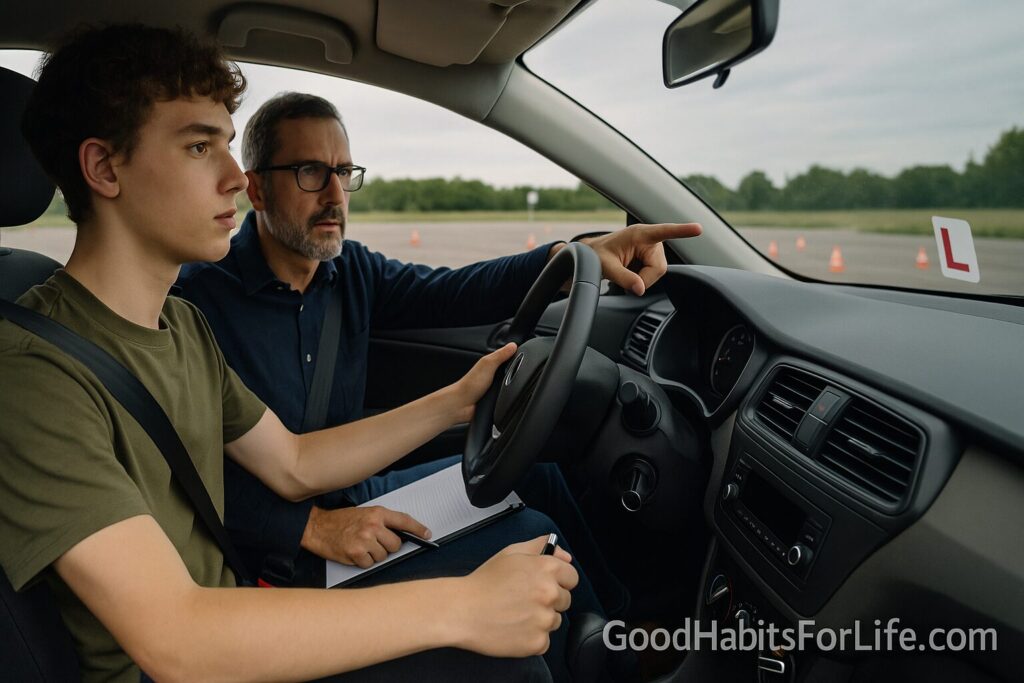
First 10 Hours Behind the Wheel: A Safe Practice Plan
First 10 Hours Driving: A Safe Practice Plan
Table of Contents
🧭 What This Plan Covers & Why the First 10 Hours Matter
The first 10 hours of behind-the-wheel practice lay the foundation for safe habits that last for years. New drivers face the highest crash risk during the early months of licensure. Structured, supervised practice—especially in varied conditions—reduces that risk by building hazard perception, space management, and self-control.
You’ll learn to:
-
Control the vehicle smoothly (starting, stopping, steering, reference points).
-
Scan correctly, manage speed and space, and make safe decisions under pressure.
-
Park, reverse, and handle tight, low-speed maneuvers.
-
Drive at night and in wet weather with extra safety margins.
Use this plan alongside your local laws and any graduated licensing requirements.
✅ Pre-Drive Safety & Setup Checklist
Vehicle basics (2–3 minutes)
-
Seat adjusted (hips low, slight knee bend; chest ≥25 cm/10 in from airbag).
-
Head restraint at eye level; seatbelt snug and flat.
-
Steering wheel height/tilt so hands are just below shoulder level.
-
Mirrors: rearview frames the rear window; side mirrors set for “BGE” wide view (minimize overlap).
-
Clean windshield; remove dash clutter; select a calm route.
Mental model
-
“S.E.E.” every 2–3 seconds: Search ⟶ Evaluate ⟶ Execute.
-
Two-second following gap (three or more in rain/night).
-
Phone off; music low; one calm passenger only (the coach).
⚡ Quick Start: Your First Session Today (60–90 minutes)
-
Choose an empty lot.
-
Practice smooth starts/stops; aim for “no head bob.”
-
Drive straight lines using distant focal points; add gentle “S-curves.”
-
Big figure-8s; then tighter ones at walking speed.
-
Practice parking box-to-box, forward and reverse.
-
Debrief: What felt easy? What felt risky? Set goals for Hour 2.
🛠️ The 10-Hour Practice Plan (Hour-by-Hour)
Advance only when you can perform each hour’s Checkpoints consistently. Repeat an hour if needed—mastery beats mileage.
| Hour | Environment | Focus Skills | Drills | Checkpoints to Advance |
|---|---|---|---|---|
| 1 | Empty lot | Pedal finesse, steering control, reference points | Straight lines, big figure-8s, smooth stops | Stops without jerk; tracks straight using distant targets |
| 2 | Empty lot → very quiet cul-de-sac | Turns, lane positioning, right-of-way basics | 90° right/left turns; 3-point turns | Turns at walking-to-jog pace; wheels straight before moving |
| 3 | Quiet residential | Scanning, speed control (20–30 km/h / 10–20 mph) | Parked-car clearance, yield to pedestrians, unmarked intersections | Keeps 1 m (3 ft) clearance; full stops; looks L-R-L |
| 4 | Residential with light traffic | Lane discipline, communication | Turn-signal timing, right-of-way at 4-way stops | Signals ≥3 sec early; smooth right-of-way decisions |
| 5 | Arterials (40–60 km/h / 25–35 mph) | Lane changes with SMOG (Signal, Mirrors, Over-shoulder, Go) | Merge from minor road; cancel signal habit | Zero drift during head checks; maintains gap |
| 6 | Multi-lane roads | Merging, overtaking, roundabouts | On-ramp practice (if available); lane choice by destination | Enters at traffic speed; keeps ≥2-sec following gap |
| 7 | Parking lots/curbs | Parking mastery | Angle & perpendicular parking, reverse bay, parallel | Centers car in the box; ≤1 correction; controlled speed |
| 8 | Mixed routes | Complex decisions | Unprotected lefts, lane splits, stale green lights | Reads stale green, plans escape routes, no hard braking |
| 9 | Night (same routes as 5–6) | Sight distance, glare management | Dim-bright practice; increase following gaps | Adds 1–2 seconds to gap; looks to right edge for glare |
| 10 | Wet or low-grip (rain, light gravel) or hills/rural | Traction & stopping distance | Gentle inputs; ABS awareness; downhill engine braking | Doubles following gap; smooth throttle/brake; no wheelspin |
Tip: If rain or night isn’t available, swap Hour 9/10 with additional practice and return later.
🧠 Techniques & Frameworks That Keep You Safe
-
S.E.E. (Search, Evaluate, Execute): Constantly scan 12–15 seconds ahead; check mirrors every 5–8 seconds.
-
IPDE: Identify hazards → Predict conflicts → Decide → Execute calmly.
-
SMOG for lane changes: Signal → Mirrors → Over-shoulder check → Go when clear.
-
Space cushion: Minimum 2 seconds dry / 3–4 seconds rain or night / 5+ seconds in fog.
-
Commentary driving: Say what you see: “Crosswalk ahead—foot off; car at side street—cover brake.” Talking builds hazard perception.
-
Eyes lead hands: Look where you want to go; your hands will follow.
-
Speed discipline: Arrive with time, not speed. Enter turns slower than you think; exit only when straight.
🗣️ Supervision & Communication: How to Coach Calmly
Before the drive
-
Agree on today’s 1–2 goals (e.g., “two safe lane changes,” “three smooth parallel parks”).
-
Use a shared language (S.E.E., SMOG).
-
Decide a correction phrase: “Pause—reset” or “My control” if you must intervene.
During
-
Praise → Prompt → Pause. “Nice mirror check. Next time, start signaling earlier… Let’s try one more.”
-
Keep tone even; avoid last-second shouts. If a mistake happens, pull over and debrief.
After (5 minutes max)
-
What went well? What one thing to improve? Plan the next route and targets.
👥 Variations (Teens, Adult Learners, Urban/Rural, Manual/Automatic)
-
Teens: Limit passengers; practice a parent-teen driving agreement (curfew, phone rules, seatbelts).
-
Adult learners: Bring prior road experience (cycling, motorbikes) but reset habits; schedule shorter, more frequent sessions.
-
Urban: Emphasize low-speed precision, mirrors, and pedestrian scanning. Add bus lanes, cyclists, and ride-hail zones to practice.
-
Rural: Watch for animals, hidden driveways, and high-closing-speed situations; build “overtake discipline.”
-
Manual transmission: Add clutch control drills in the lot (friction-point holds on level ground → gentle launches → hill starts with handbrake).
-
Left-/Right-hand traffic: Use lane-position cues (center line just left/right of the driver’s shoulder) and say “Keep left/right” at each turn early on.
⚠️ Mistakes & Myths to Avoid
-
Myth: “Parking can wait.” → Low-speed crashes are common and costly—master parking early.
-
Mistake: Looking only near the bumper; you’ll weave and overcorrect. Look far, glance near.
-
Mistake: Lane change with mirrors only. Always do an over-shoulder blind-spot check.
-
Mistake: Following too closely. You need time to see and think.
-
Myth: “Hands-free phone is safe.” Conversation still strips attention—save calls for parked time.
-
Mistake: Rushing into heavy traffic before you can manage quiet streets reliably.
🧾 Real-Life Examples & Copy-Paste Scripts
Supervisor cue cards
-
“Signal early, then mirror-mirror, quick shoulder, gentle steer.”
-
“Space first, speed second—if space is tight, you slow.”
-
“Talk me through this intersection—who has priority?”
-
“Stale green ahead—what’s your plan?”
Driver self-talk
-
“Eyes up, mirrors every eight seconds.”
-
“Two-second gap—count it out.”
-
“If I’m unsure, I wait. Patience beats panic.”
Parallel park steps (short wheelbase example)
-
Align rear bumpers; 60–90 cm (2–3 ft) gap.
-
Reverse straight until your seatback aligns with the other car’s rear axle.
-
Steer full lock toward the curb; reverse to ~45°.
-
Counter-steer to straighten as front clears.
-
Center in the space; finish wheels straight.
🧰 Tools, Apps & Resources
-
Logbook apps: Track hours, conditions, and debrief notes.
-
Dash-mounted phone cradle: For navigation when legal; set destination before moving.
-
Reflective cones or soft markers: Create parking boxes in empty lots.
-
Official handbooks: Your jurisdiction’s driver handbook & hazard-perception resources.
-
Parent-teen agreements: Print and sign to set rules (seatbelts, passengers, night driving).
🔑 Key Takeaways
-
Build skills in layers: lot → quiet streets → traffic → night/wet.
-
Use S.E.E., IPDE, and SMOG every single drive.
-
Park early, not last.
-
Coach with praise-prompt-pause; debrief in 5 minutes.
-
Keep bigger following gaps than you think you need—especially at night and in rain.
❓ FAQs
1) How many supervised hours should a new driver get?
Follow your local graduated licensing rules; many programs suggest 40–50 hours across day, night, and varied conditions. More diverse practice = better risk reduction.
2) When should I try highways or multi-lane roads?
After you can hold lane position, change lanes with SMOG, and merge from a minor road at traffic speed on simpler roads (Hours 5–6).
3) Is night driving required early?
Yes—dedicate at least one session (Hour 9) to night. Increase following gaps and manage glare proactively.
4) Should I practice in rain?
If safe and legal, yes. Do this with a skilled supervisor and gentle inputs to learn how traction changes (Hour 10).
5) Manual vs automatic—what’s best for beginners?
Either is fine. If manual, add clutch control drills and hill-start practice before traffic.
6) What’s a safe following distance?
Two seconds minimum in dry daylight; add seconds for rain, darkness, or heavy traffic.
7) How do I know I’m ready to drive solo?
You can complete the Hour-by-Hour checkpoints reliably across conditions, make calm decisions, and self-correct without prompts.
8) Any quick tip for unprotected left turns?
Wait centered, wheels straight; choose a gap that lets you accelerate without forcing others to brake. If unsure—don’t go.
9) I feel anxious. What helps?
Short sessions, familiar routes, commentary driving, and one clear goal per session. Progress only when checkpoints are met.
10) Do I need professional lessons?
A qualified instructor accelerates learning and ensures best practices. Combine professional lessons with home practice for the strongest results.
📚 References
-
Centers for Disease Control and Prevention (CDC). Teen Drivers: Get the Facts. https://www.cdc.gov/transportationsafety/teen_drivers/teendrivers_factsheet.html
-
Insurance Institute for Highway Safety (IIHS). Graduated licensing laws & teens. https://www.iihs.org/topics/teenagers/graduated-licensing
-
National Highway Traffic Safety Administration (NHTSA). Teen Driving Safety. https://www.nhtsa.gov/road-safety/teen-driving
-
AAA Foundation for Traffic Safety. Teaching Your Teen to Drive / Supervised Driving Research. https://aaafoundation.org/
-
National Safety Council (NSC). Defensive Driving Tips. https://www.nsc.org/road/safety-topics/defensive-driving
-
World Health Organization (WHO). Road traffic injuries—key facts. https://www.who.int/news-room/fact-sheets/detail/road-traffic-injuries
-
UK Driver & Vehicle Standards Agency (DVSA). Learn to drive a car: step by step. https://www.gov.uk/learn-to-drive-a-car
-
Transport for NSW. Hazard Perception Test resources. https://www.nsw.gov.au/driving-boating-and-transport/licences/driver-hazard-perception-test
Disclaimer: This guide is educational; always follow your local road rules and licensing requirements and seek a qualified driving instructor where appropriate.