
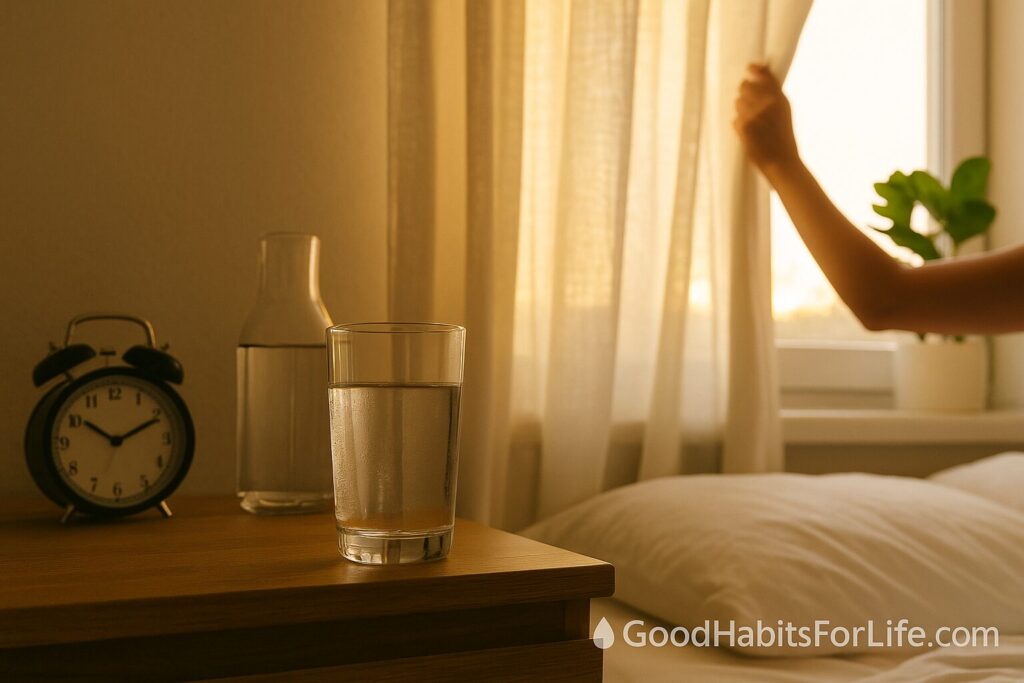
Hydration + Light: A 5Minute WakeUp That Works
Morning Light & Hydration: 5-Minute Wake-Up That Works
Table of Contents
🧭 What this routine is & why it works
Definition. A super-short morning opener combining bright light exposure and a glass of water. The goal is to rapidly reduce sleep inertia, set your circadian clock, and start the day hydrated—without coffee dependence.
Why it works (in brief):
-
Morning light → circadian anchor. Bright light (ideally outdoor daylight) shortly after waking suppresses melatonin, shifts your circadian phase earlier, improves alertness, and helps you fall asleep earlier that night.
-
Hydration → alertness & performance. You can wake up mildly dehydrated after 7–8 hours without fluids. Drinking 250–500 ml water (1–2 cups) helps restore plasma volume and may improve mood and cognitive performance.
-
Consistent cueing → habit formation. Pairing light + water at the same time each day strengthens the habit via context cues (alarm → open curtains → drink water).
Benefits you’ll notice:
-
Easier wake-ups in 3–7 days
-
More consistent energy in the first 2–3 hours of the morning
-
Earlier, more predictable sleep timing after ~1–2 weeks
-
Reduced reliance on snoozing and late-morning caffeine
✅ The 5-minute quick start (do this today)
What you need: a glass/bottle of water, a window/balcony/doorway—or a bright, 5 000–10 000 lux light source if outdoors isn’t feasible.
Step-by-step (≈5 minutes):
-
00:00 — Alarm off, curtains open. Immediately open blinds or step outside. Aim your eyes toward daylight (no sunglasses).
-
00:30 — Drink 250–500 ml water. Plain water is perfect. Add a squeeze of lemon if you like.
-
01:00 — Light exposure continues. Stay in daylight or near a window. If outdoors is impossible, switch on a bright lamp or 10 000 lux light box placed ~50–60 cm away (eyes open, not staring into the light).
-
02:00 — 1 minute of gentle movement. March in place, calf raises, or a slow set of 10–15 squats.
-
03:30 — 90 seconds of box breathing. Inhale 4s → hold 4s → exhale 4s → hold 4s × 6 cycles.
-
05:00 — Done. Proceed to breakfast or a short walk if time allows.
Timing tips:
-
Do it within 30 minutes of waking; 5–20 minutes of light is great (more if it’s overcast).
-
If sunrise is late, use a dawn-simulating alarm or a bright light box, then switch to outdoor light once available.
🛠️ Techniques & frameworks (make it stick)
Habit stacking (BJ Fogg). After I turn off my alarm, I will open the curtains and take two big sips of water.
Implementation intention (Gollwitzer). If it’s raining, then I’ll use my 10 000-lux light for 10 minutes by the kitchen table.
Environment design. Pre-fill a bottle and place it beside your phone. Clip the curtains slightly open so daylight cues you.
Anchoring window. Keep wake time within a ±30-minute band, even on weekends, to stabilize your clock.
Caffeine timing. Delay coffee 60–90 minutes after waking to allow adenosine to naturally clear and avoid a mid-morning crash.
Hydration guardrails.
-
Typical daily water needs vary; a simple anchor is ~2–3 litres/day for many healthy adults (from drinks and food). Morning 250–500 ml counts toward this.
-
Add electrolytes only if you sweat heavily, train early, or live in very hot climates.
📅 7-Day starter plan
Goal: Nail consistency first; then optimize light dose.
-
Day 1–2: Prep the environment. Pre-fill water (500 ml). Stage curtains. Choose light alternative (balcony, terrace, or 10 000-lux lamp). Do the 5-minute routine.
-
Day 3–4: Extend daylight time to 10 minutes if possible (brief stroll). Log wake time and “sleepiness on waking” (1–5 scale).
-
Day 5: Add 2–3 minutes of mobility (neck, shoulders, ankles) during light exposure.
-
Day 6: Keep caffeine delayed to +90 minutes. Note energy from 08:00–10:00.
-
Day 7: Review your log. If you still feel groggy, move light exposure earlier and increase duration to 15 minutes (especially in winter/overcast).
Checkpoint (end of week):
-
Average wake time within ±30 minutes?
-
Light ≥ 5–15 minutes most days?
-
Water ≥ 250–500 ml at wake?
-
Subjective grogginess score trending down?
🧠 Audience variations
Students & night owls. Start with gradual shifts: move wake-time 15 minutes earlier every 2–3 days; keep light immediately on waking.
Parents of infants. Keep a 500 ml bottle at the crib/sofa. If outdoors is tricky, stand by a bright window while feeding; use a low-blue night light overnight to protect sleep.
Professionals with early commutes. Use a dawn alarm + light box while dressing. Hydrate, then finish with 5-minute outdoor light at the bus stop.
Seniors. Morning light is especially helpful for advanced or irregular sleep patterns. Pair with a short outdoor walk for balance and mood.
Athletes & hot climates. Consider electrolyte (sodium 300–500 mg) if you sweat heavily early.
Shift workers. On day shifts, treat first wake-up as “morning” and follow the same routine. On night shifts, avoid bright light after shift if you need to sleep soon; save the light-plus-water combo for the start of your “day.”
⚠️ Mistakes & myths to avoid
-
Myth: “Phone light counts.” → Phone brightness is far too low compared with daylight.
-
Mistake: Doing light before waking (scrolling in bed). Get vertical first; open curtains; then drink.
-
Mistake: Overdoing electrolytes daily without need. Most people don’t need them first thing.
-
Myth: “Sunglasses are fine.” → Skip them during the first light unless medically necessary.
-
Mistake: Inconsistent weekends. Large schedule swings blunt the circadian benefits.
-
Myth: “Coffee replaces water.” → Caffeine is mildly diuretic; it doesn’t replace hydration.
💬 Real-life examples & scripts
Script—Alarm Routine (30 seconds):
Alarm → Sit up → “Curtains first.”
Walk to window, open curtains, take two big sips from pre-filled bottle, “Five slow breaths.”
Script—Rainy Day Plan:
“If it’s raining at wake-up, I switch on the light box at the kitchen table for 10 minutes while I sip water.”
Example—Tiny Habits recipe:
-
After I turn off the alarm, I will open the curtains.
-
After I open the curtains, I will drink half my bottle.
-
After I drink, I will do 10 calf raises.
Team challenge (office or family): Track days-in-a-row for “Light + Water” on a shared calendar; reward streaks ≥7.
🧰 Tools, apps & resources
-
Dawn-simulating alarms (wake-up lights)
-
Pros: gentler waking, useful before sunrise. Cons: not as strong as real daylight.
-
-
10 000-lux light boxes
-
Pros: reliable light dose in winter/indoors. Cons: avoid late-evening use; check contraindications if you have eye conditions or bipolar disorder—speak with a clinician.
-
-
Hydration helpers (750–1 000 ml bottles, time-marked)
-
Pros: visible cue; easier habit stacking. Cons: can be bulky for travel.
-
-
Apps (sleep/wake trackers, habit trackers)
-
Pros: reminders and streaks. Cons: don’t let tracking delay doing.
-
📌 Key takeaways
-
Morning daylight + 250–500 ml water is a compact, science-backed way to cut grogginess.
-
Consistency matters more than perfection—same wake window daily.
-
Start with 5 minutes; extend light to 10–15 minutes for bigger effects.
-
Pair with movement and breathing for a smoother transition from sleep to action.
-
Expect meaningful improvements in one week.
❓ FAQs
1) How much light do I need?
Aim for outdoor daylight for 5–15 minutes. If using a device, 10 000 lux at ~50–60 cm for 10–20 minutes is typical.
2) What if sunrise is late in winter?
Use a dawn alarm and/or light box on waking, then get outside when possible.
3) Can I drink coffee instead of water?
Enjoy coffee later, but still drink 250–500 ml water first to rehydrate.
4) Will sunglasses ruin the effect?
During your first light exposure, skip them unless medically necessary. Wear them later if it’s bright.
5) I wake at 05:00 some days and 08:00 others—does this still work?
Yes, but it works best with a ±30-minute wake window. Aim to tighten your schedule.
6) Is sparkling water, lemon water, or tea OK?
Yes—plain water is simplest; unsweetened options are fine. Herbal tea counts toward fluids.
7) I’m very groggy—how long until I feel different?
Most people feel easier wake-ups in 3–7 days and better sleep timing in 1–2 weeks of consistency.
8) Any risks with bright light?
If you have retinal disease, photosensitivity, or bipolar disorder, consult a clinician before using bright-light devices.
9) Does this help jet lag?
Yes—morning light in the new time zone helps advance your clock. Combine with consistent wake time and short walks.
10) How does this affect sleep at night?
Regular morning light strengthens your circadian rhythm, making night sleep more predictable and earlier.
📚 References
-
National Institute of General Medical Sciences. Circadian Rhythms Fact Sheet. https://www.nigms.nih.gov/education/fact-sheets/Pages/circadian-rhythms.aspx
-
American Academy of Sleep Medicine. Light Exposure and the Sleep–Wake Cycle. https://sleepeducation.org/
-
Stanford Medicine. Why morning light matters for your body clock. https://med.stanford.edu/ (search “circadian light”)
-
NHS. Water, drinks and your health. https://www.nhs.uk/live-well/eat-well/water-drinks-nutrition/
-
Harvard T.H. Chan School of Public Health—The Nutrition Source. Water. https://www.hsph.harvard.edu/nutritionsource/water/
-
National Library of Medicine (MedlinePlus). Light therapy. https://medlineplus.gov/lighttherapy.html
-
U.S. CDC. Sleep and Sleep Hygiene. https://www.cdc.gov/sleep/
-
American College of Sports Medicine. Exercise, hydration, and performance position statements. https://www.acsm.org/
-
Sleep Health Foundation (AU). Bright light therapy. https://www.sleephealthfoundation.org.au/
-
Cochrane Library. Light therapy for improving sleep problems. https://www.cochranelibrary.com/ (search “light therapy sleep”)
Disclaimer: This article is for general education only and is not a substitute for personalized medical advice.