
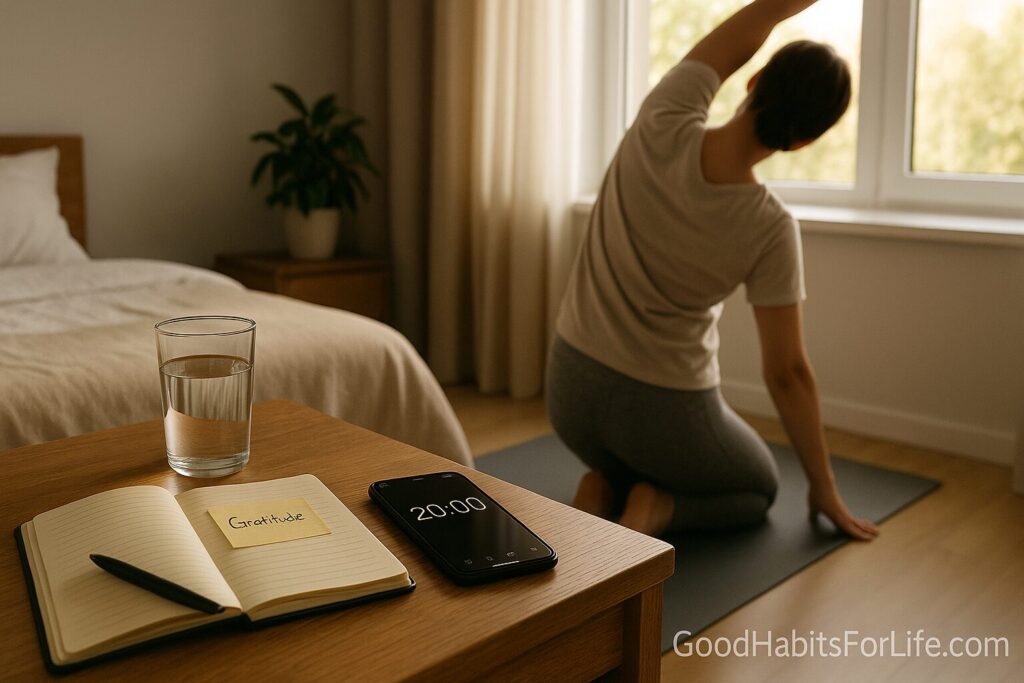
Morning Routine 2025: A 20Minute Starter Youll Keep
Morning Routine 2025: A 20-Minute Starter You’ll Keep
Table of Contents
🧭 What This Routine Is & Why It Works
A “starter” routine is a compact, repeatable, research-aligned set of actions that primes your body clock, attention, and motivation—without needing willpower. The focus is consistency over intensity:
-
Morning light cues your circadian clock, improving alertness and sleep timing.
-
Brief movement elevates mood and cognition via increased blood flow and neurotransmitters.
-
Mindfulness or breathing calms the stress response and improves focus.
-
Implementation intentions (“If it’s 8:00, then I’ll…”) help you follow through.
-
Gratitude/reflective writing nudges a positive mental state and resilience.
-
A tiny win builds momentum for the rest of the day.
✅ The 20-Minute Quick Start (Do This Today)
Minute 0–1: Light + Water
-
Open curtains/balcony or step outdoors if safe; look toward daylight (no direct sun-staring).
-
Drink ~250–300 ml water (8–10 oz).
Minute 1–3: Calm Breathing
-
4-second inhale → 6-second exhale, repeat for 2 minutes.
Minute 3–10: Move (7 minutes)
-
1’ neck/shoulder rolls + thoracic twists
-
3’ dynamic lower body (hip circles, lunges, ankle rocks)
-
2’ activation (plank, glute bridge)
-
1’ easy cardio (march in place or stair walk)
Minute 10–15: Plan Your Day (5 minutes)
-
Write your Top 3 outcomes.
-
For each, add an If-Then: “If it’s 10:00 and I’m at my desk, then start Outline v1.”
-
Block first deep-work sprint (30–60 minutes) on your calendar.
Minute 15–18: 3-Line Journal
-
1 thing you’re grateful for
-
1 person to appreciate/check in with
-
1 friction to remove today
Minute 18–20: Tiny Win
-
Reset desk, pack bag, load dishwasher, send one thank-you text—something you can finish.
Time-pressed? Halve the movement to 3–4 minutes and keep everything else. The shape matters more than the size.
🛠️ 7-Day Starter Plan
Goal: Lock in location, trigger, and sequence. Keep it small; add intensity later.
-
Day 1–2: Do the full 20-minute routine at the same place (e.g., kitchen + balcony) and same cue (“after brushing teeth”).
-
Day 3–4: Add a timer and a simple habit tracker (checkbox on fridge or app).
-
Day 5: Nudge difficulty: a slightly longer plank or brisk 60-second stair walk.
-
Day 6: Pre-commit: set out water bottle, journal, and workout mat the night before.
-
Day 7: Review streak, tweak one element (e.g., switch movement flow), and set a 10-day streak challenge.
Checkpoint: If you miss a day, restart the next day—no penalties. Consistency over perfection.
🧠 Techniques & Frameworks That Make It Stick
-
Habit stacking: Attach the routine to an existing anchor (e.g., after brushing teeth → light + water).
-
Implementation intentions: “If [time/place], then [action].” Proven to raise follow-through on goals.
-
BJ Fogg’s tiny-habit principle: Start tiny to reduce friction, then scale.
-
Identity cueing: Call it “I’m a person who primes my day.” Put it on your tracker.
-
Environment design: Keep curtain rod easy to pull, mat visible, journal open with pen.
-
Goldilocks rule: Slightly challenging, never overwhelming; aim for easy + repeatable.
-
Visual streaks: Paper calendar ticks are surprisingly motivating.
👥 Variations by Audience
Students: Do 1 page of spaced-repetition flashcards during the planning block.
Professionals: Convert Top 3 into calendar blocks; silence notifications for the first deep-work sprint.
Parents: Involve kids—3-minute family stretch + one “thank-you note” drawing.
Seniors: Emphasize joint-friendly mobility; add a brief balance drill holding a countertop.
Teens: Keep it fun—music for the 7-minute move block; gamify with streaks.
⚠️ Mistakes & Myths to Avoid
-
Myth: “Mornings must be 5 a.m.” → Not required. Keep a consistent wake time for your body clock.
-
Mistake: Starting too hard (HIIT, 45-minute journaling). Start tiny.
-
Mistake: Vague plans. Use Top 3 + If-Then scripts.
-
Myth: “Breakfast fixes everything.” → Nutrition helps, but the cue-sequence-consistency matters more for routine sticking.
-
Mistake: Skipping daylight. Indoor low-lux lighting often isn’t enough for circadian cues.
🗣️ Real-Life Examples & Scripts
-
If-Then Plan: “If it’s 07:15 and I enter the kitchen, then I open the blinds, drink water, and start 4-6 breathing.”
-
Two-Sentence Journal: “Grateful for: Mom’s call. Remove friction: put charger in bag now.”
-
Tiny Win Menu: Reset bed, wipe sink, queue one playlist, fill two bottles, pre-prep oats.
🧰 Tools, Apps & Resources
-
Timers: Any phone timer; or Focus To-Do / Forest for the first deep-work sprint.
-
Habit Tracking: Streaks, Habitify, Loop (Android), or a paper wall calendar.
-
Mobility: Nike Training Club, FitOn, or YouTube 7-minute mobility flows.
-
Journaling: Day One, Journey, Apple Notes, or a simple A5 notebook.
Pros/Cons (quick):
-
Apps add reminders and data, but can distract.
-
Paper is friction-free and visible, but not searchable.
📌 Key Takeaways
-
Lock a 20-minute, same-place sequence: light + water → breathe → move → plan → journal → tiny win.
-
Use If-Then scripts and streak tracking to keep it automatic.
-
Keep it tiny and repeatable; scale movement later.
-
Morning daylight and planning your Top 3 punch above their weight.
❓ FAQs
1) What time should I do this?
Any consistent time soon after waking works. Align it with your household schedule.
2) Can I have coffee first?
Sure. Keep the first minute as light + water, then enjoy coffee/tea.
3) What if I work night shifts?
Shift the routine to your personal “morning” after waking; still seek light exposure (bright indoor light box if needed—check with a clinician).
4) Is 7 minutes of movement enough?
For mood/activation—yes. You can add separate workouts later to meet weekly activity targets.
5) Do I need breakfast?
Optional. Prioritize light, movement, and planning. Eat according to your nutrition and health needs.
6) How long until it feels automatic?
Habits can take weeks to months; averages around 2 months, with wide variation.
7) Can I do it with kids around?
Yes—keep it playful; involve them in the 3-minute journal (draw a thank-you sun!).
8) What if I miss a day?
Restart the next day. Track streaks and focus on returning to your anchor.
📚 References
-
Lally, P. et al. (2009). How are habits formed in the real world? European Journal of Social Psychology. https://onlinelibrary.wiley.com/doi/10.1002/ejsp.674
-
CDC. How Much Sleep Do I Need? https://www.cdc.gov/sleep/about_sleep/how_much_sleep.html
-
CDC. Benefits of Physical Activity. https://www.cdc.gov/physicalactivity/basics/pa-health/index.htm
-
Goyal, M. et al. (2014). Meditation Programs for Psychological Stress and Well-being. JAMA Intern Med. https://jamanetwork.com/journals/jamainternalmedicine/fullarticle/1809754
-
WHO. Guidelines on Physical Activity and Sedentary Behaviour (2020). https://www.who.int/publications/i/item/9789240015128
-
Emmons, R., & McCullough, M. (2003). Counting Blessings Versus Burdens. Journal of Personality and Social Psychology. https://psycnet.apa.org/record/2003-10073-012
-
Czeisler, C. & Gooley, J. (2010). Exposure to Light and the Human Circadian System. (Review) https://www.ncbi.nlm.nih.gov/pmc/articles/PMC2831986/
-
Gollwitzer, P. (1999). Implementation Intentions: Strong Effects of Simple Plans. American Psychologist. https://psycnet.apa.org/record/1999-15155-002
Disclaimer
This article is for general information only and is not medical advice; consult a qualified professional for personal health concerns.