
Camping & Treks: Boil, Filter, or Tablets?: AI workflows (2025)
Camping Water Purification 2025: Boil, Filter or Tablets?
Table of Contents
🧭 What This Is & Why It Matters
Safe water on treks, camps, and fieldwork isn’t optional. Clear-looking sources can carry bacteria (e.g., E. coli), protozoa (Giardia, Cryptosporidium), and viruses (norovirus, rotavirus). Untreated water risks diarrhea, dehydration, and trip-ending illness. Boiling reliably inactivates microbes; filters remove many organisms; chemical disinfectants and UV finish the job when used correctly (see References).
Bottom line: There’s no universal best—choose based on water quality (clear vs turbid), altitude, time available, and gear you carry.
✅ Quick Start: Today/This Trip
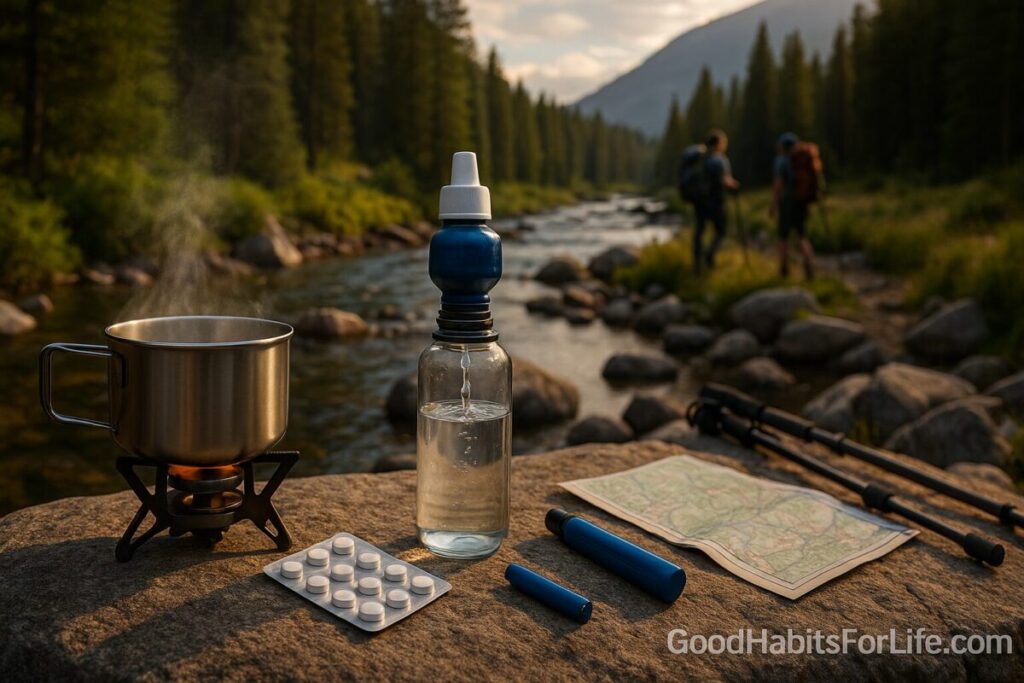
Pre-trip pack (fits in a 1-L pouch):
-
Squeeze microfilter (0.1–0.2 μm) + soft bottle.
-
Chlorine dioxide tablets (not iodine) for virus assurance.
-
Metal mug or stove pot to boil if needed.
-
Pre-filter (coffee filter/bandana) for silty water.
-
Spare tablets and a tiny dropper with unscented household bleach (backup).
-
Zip bag for tablets; sharpie to note wait times.
On-trail 3-step routine (most scenarios):
-
Pre-filter cloudy water.
-
Filter into your bottle/bladder.
-
Disinfect (chlorine dioxide or UV) if viruses are a concern (crowded sites, downstream of villages, tropical travel).
When in doubt: Boil (rolling boil 1 minute; 3 minutes above 2,000 m / 6,562 ft).
🧠 AI Workflows: Fast Decisions in the Field
Use these copy-paste prompts on your phone (offline notes or an AI assistant) to get a context-aware pick. Replace brackets with your details.
1) Risk triage prompt
“I’m trekking at [altitude], water is [clear/turbid], near [settlement/livestock/remote], I have [filter 0.1 μm/chlorine dioxide/UV/stove]. Time available: [X minutes]. Recommend the fastest safe treatment and exact steps + wait times.”
2) Virus risk prompt
“Given [country/region], crowding level [low/medium/high], and recent outbreaks [if known], rate virus risk [low/med/high] and whether I must add chemical/UV after filtering.”
3) Supplies math prompt
“I need [N] liters/day for [Y] days. With [tablets/boil fuel/UV battery], calculate if I have enough and suggest the lightest backup.”
4) High-altitude boil prompt
“We’re at [altitude]. Confirm exact boil time and a backup if fuel runs low.”
🛠️ Methods Compared: Boil vs Filter vs Tablets vs UV vs Bleach
| Method | What it handles well | Weaknesses / Watch-outs | Typical time | Best use |
|---|---|---|---|---|
| Boiling | Bacteria, protozoa, viruses | Fuel/time cost; can’t remove chemicals/sediment taste | 1–3 min boil (+cool) | High risk, cold/remote camps, illness outbreak |
| Hollow-fiber filter (0.1–0.2 μm) | Bacteria, protozoa; fast flow | Not viruses; can clog with silt/freezing damage | Instant flow | Streams/lakes; pair with chem/UV for viruses |
| Chemical tablets (chlorine dioxide) | Bacteria, viruses; most protozoa | Crypto needs up to 4 h; cold water slows action | 30–45 min (clear water) | Lightweight, backups, travel |
| UV purifiers | Bacteria, viruses, protozoa (in clear water) | Needs clear water & batteries; no residual | ~90 sec/L | Lodge/tap water, clear springs |
| Unscented bleach (NaOCl) | Bacteria, viruses (not reliable for protozoa cysts) | Taste; dosing precision; not great in turbid water | 30 min | Emergencies when tablets unavailable |
Pro tips
-
Combine a filter + chlorine dioxide or UV when virus risk is non-trivial (crowded campsites, downstream of settlements, tropical travel).
-
In cold (<10 °C) or turbid water: double contact time for chemical treatment and pre-filter first.
-
Protect filters from freezing; ice crystals can damage fibers.
📅 Habit Plan: 7-Day Starter
Goal: Make safe water a default routine you follow without thinking.
-
Day 1 (Home): Practice assembling your kit and dosing 1 L with chlorine dioxide (timers + notes).
-
Day 2: Back-to-back filter → tablet drill; log times.
-
Day 3: Boil drill with your actual stove/pot; confirm boil times at your usual trek altitude.
-
Day 4: UV drill in tap water; learn maintenance and battery checks.
-
Day 5: Cloudy water simulation: pre-filter (coffee filter/bandana) then treat.
-
Day 6: Pack a redundant backup (tablets or bleach) and create a 1-page water plan in your phone.
-
Day 7: Mini hike: treat 2–3 L using your chosen workflow; review what felt slow or fiddly and refine.
👥 Variations by Audience & Context
-
Students / first-timers: Carry tablets as fail-safe even if you have a filter. Label wait times on the pouch.
-
Parents with kids: Prefer filter + boil at camp; kids often sip before wait times finish. Pack extra fuel.
-
Professionals on fieldwork: For speed, filter on the move, UV for lodgings/tap, tablets as backup. Keep documentation for agency policies (NSF/ANSI, P231 ratings).
-
Seniors / immunocompromised: Choose high-assurance workflows (boil, or filter + chlorine dioxide). Avoid iodine.
-
High-altitude treks: Plan for 3-minute boil; fuel weight increases—so bring tablets/UV to save fuel.
-
Monsoon / silty rivers: Pre-filter aggressively; consider gravity filter with backflush.
-
International travel (hostels, trains): UV or chlorine dioxide for taps; keep a collapsible bottle.
⚠️ Mistakes & Myths to Avoid
-
“Crystal-clear mountain water is safe.” ❌ Wildlife upstream can contaminate it.
-
“Iodine fixes everything.” ❌ Not effective against Cryptosporidium; avoid in pregnancy/thyroid disease.
-
“Short boil is fine at altitude.” ❌ Longer boil above 2,000 m.
-
“Filters remove viruses.” ❌ Most backpacking filters do not; you need a purifier or add chemical/UV.
-
“More bleach is better.” ❌ Over-chlorination tastes awful and still won’t fix protozoa in turbid water.
💬 Real-Life Scripts & Checklists
30-second creek script (moderate risk):
-
“Water looks clear but near a trail—filter 1 L.”
-
“Add chlorine dioxide; set 45-min timer.”
-
“Label bottle cap ‘treated @ 10:30’.”
Camp-wide precaution (outbreak rumor):
-
“Tonight we boil for all cooking/drinking. Backup: tablet the cold bottles.”
Pack list (paste into Notes):
-
Filter 0.1 μm + backflush syringe
-
Chlorine dioxide tablets (count for trip + 20%)
-
Metal pot + stove + fuel
-
Pre-filter cloth/coffee filters
-
UV pen (optional) + spare batteries
-
Unscented bleach dropper (backup)
-
Zip bags, timer watch/phone, marker
🧰 Tools, Apps & Resources
-
NSF/ANSI P231 or P248-certified purifiers: Look for certification listings when buying.
-
REDCap/Notes/Notion: store your water plan and dosing table.
-
Offline map apps (e.g., Gaia/OSMAnd): mark reliable sources, note livestock zones.
-
Timer app: name timers “Clo2 45” / “Boil 3m (alt)”.
🔑 Key Takeaways
-
Match treatment to risk, clarity, and context; combine methods when needed.
-
Boil = broadest kill, filter = fast flow, chlorine dioxide/UV = virus assurance.
-
Practice at home; carry redundant backup; use the AI prompts to decide fast.
❓FAQs
Is boiling better than filtering?
Different jobs: boiling inactivates bacteria, protozoa and viruses; filters remove bacteria/protozoa and sediments but usually not viruses. In high-risk settings, boil—or filter then add chemical/UV.
How long should I boil?
Bring water to a rolling boil for 1 minute; at >2,000 m (6,562 ft) keep it boiling 3 minutes.
Are purification tablets safe?
Chlorine dioxide tablets are widely recommended when used as directed. They need 30–45 minutes for clear water and up to 4 hours for Cryptosporidium. Always follow manufacturer instructions.
Do UV pens really work?
Yes—on clear water with correct dose/time. They don’t leave residual protection and don’t remove chemicals or sediment; pre-filter if cloudy.
Can I just use household bleach?
In emergencies: dose unscented bleach properly and wait 30 minutes. It’s less reliable for protozoa, especially in turbid/cold water.
What pore size should my backpacking filter be?
0.1–0.2 μm hollow-fiber filters are common; they remove bacteria and protozoa. For virus protection add chemical or UV, or choose a purifier certified to NSF/ANSI P231.
What about iodine tablets?
Iodine is not effective against Cryptosporidium and is not advised for pregnant individuals or long-term use.
Best option for India treks or crowded campsites?
Assume virus risk: filter + chlorine dioxide (or UV) or simply boil at camp.
Do I need to wait longer in cold water?
Yes. Chemical reactions slow down—double contact times below ~10 °C and keep bottles insulated while waiting.
📚 References
-
Centers for Disease Control and Prevention (CDC). Water Disinfection for Travelers — boiling, chemical (chlorine dioxide/iodine), and UV guidance. https://www.cdc.gov/healthywater/drinking/travel
-
CDC. Boil Water Advisory—time/altitude specifics. https://www.cdc.gov/healthywater/emergency/drinking
-
U.S. Environmental Protection Agency (EPA). Emergency Disinfection of Drinking Water—household bleach dosing. https://www.epa.gov/ground-water-and-drinking-water
-
World Health Organization (WHO). Guidelines for Drinking-water Quality (latest edition). https://www.who.int/water_sanitation_health
-
NSF International. NSF/ANSI Standards & Protocols (e.g., P231/P248 for microbiological purifiers). https://www.nsf.org/certified-products
-
CDC Yellow Book. Safe Food and Water (travel medicine). https://wwwnc.cdc.gov/travel/page/yellowbook-home
-
U.S. Army Public Health. Field Water Sanitation (boiling & disinfection principles). https://phc.amedd.army.mil
-
WHO. Household Water Treatment and Safe Storage—chlorination, filtration, boiling, UV. https://www.who.int/teams/environment-climate-change-and-health/water-sanitation-and-health
Disclaimer
This guide is educational and not a substitute for professional medical or public-health advice—follow local advisories and product instructions.