
20Minute Power Nap vs Coffee Nap: Zone 2 + NEAT (2025)
20-Min Power Nap vs Coffee Nap: Zone 2 & NEAT (2025)
Table of Contents
🧠 What’s the difference?
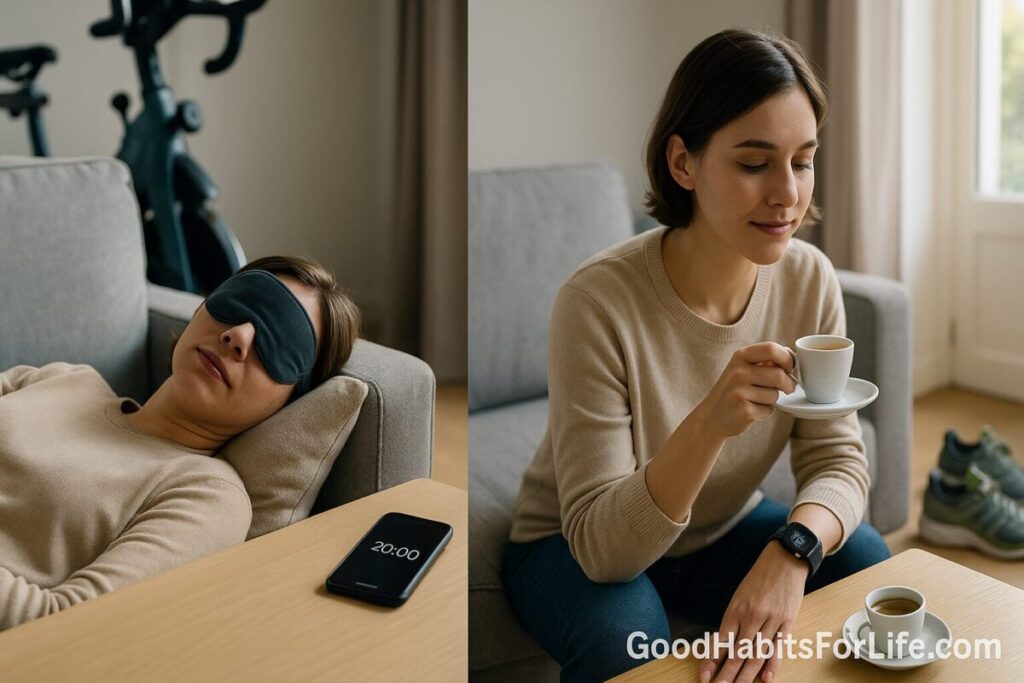
Power nap (10–20 min, no caffeine): A brief light-sleep nap that rapidly restores alertness and mood with little sleep inertia. Best kept to 20 min or less. Astronaut and aviation fatigue programs show short strategic naps can stabilize performance for hours. NASA Technical Reports Server
Coffee nap (caffeine + 15–20 min nap): Drink a small coffee/espresso (about 150–200 mg caffeine), then immediately nap. By the time you wake, caffeine is entering the bloodstream while the nap has reduced brain adenosine, so caffeine has less to compete with—result: greater alertness than coffee or nap alone in controlled driving-simulator studies. NCBIPubMedWiley Online Library
Timing physiology: Peak plasma caffeine typically occurs between ~15–120 min post-ingestion (often around an hour), which is why a 15–20 min nap pairs so well with a pre-nap coffee. NCBI
Night sleep caution: Even “afternoon” caffeine can cut ~1 hour of sleep when taken 6 h before bed. Plan coffee naps early. PMC
✅ When to use which (decision grid)
| Situation | Choose | Why |
|---|---|---|
| You slept OK, just a mid-day dip | Power nap | Quick reset, minimal grogginess |
| Short on sleep & must perform (driving, exam, post-lunch meeting) | Coffee nap | Stronger effect vs either alone in simulator studies |
| After 3 p.m. or within 6 h of bedtime | Power nap (no coffee) or skip | Caffeine now risks impairing night sleep |
| Caffeine-sensitive, pregnant, hypertensive, or advised to limit caffeine | Power nap | Avoid stimulant side-effects |
| You need sustained energy across the day | Power nap + Zone 2 + NEAT | Movement improves daytime alertness and nights’ sleep quality |
Evidence for coffee-nap superiority and caffeine timing comes from controlled trials and sleep-medicine guidance. PubMedWiley Online LibraryPMCSleep Education
🛠️ Quick start: perfect 20-minute nap (with or without coffee)
-
Pick the window: Early afternoon (about 13:00–15:00) aligns with a natural circadian dip and protects night sleep. Harvard Health
-
Dose (coffee-nap only): 1 small coffee or double espresso ≈150–200 mg caffeine. Drink quickly.
-
Dark + cool + quiet: Eye mask, earplugs/white noise, 18–20 °C room if possible.
-
Set a 20-min alarm: You want light sleep (Stage N2), not deep sleep. Harvard Health
-
Feet up, phone down: Recline, 4 slow breaths, release shoulders.
-
Wake & move: On waking, light stretch + 2–3 min brisk walking to shake off inertia.
🧭 7-Day “Alertness Stack”: Nap + Zone 2 + NEAT
Why stack movement with naps?
Zone 2 (moderate-intensity) cardio improves aerobic efficiency and mitochondrial function, while NEAT (non-exercise activity thermogenesis) keeps energy stable by adding constant low-level movement. Together they reduce over-reliance on caffeine and naps. Zone 2 ≈ 64–76% of max HR or the Talk Test (you can talk but not sing). NEAT = all non-exercise movement: walking, stairs, chores, fidgeting. PMCCDCPubMed
Plan (repeat weekly):
-
Daily NEAT goals:
-
8–10k steps, stairs instead of lifts, 5-minute “movement snacks” every hour.
-
-
3–4×/week Zone 2 (30–45 min):
-
Nap strategy:
-
Mon/Wed/Fri: Power nap 10–20 min at 14:00.
-
Tue/Thu (sleep-deprived days): Coffee nap before high-stakes tasks—complete by 14:30 to protect night sleep. PMC
-
-
Cutoff rules: No caffeine within 6 h of bedtime; no naps after 16:00. PMC
🧪 Techniques & frameworks
The Coffee-Nap Protocol (CNP):
-
Brew 150–200 mg caffeine (size varies by brew; adjust if sensitive).
-
Drink → lie down immediately.
-
15–20 min light nap.
-
3–5 min brisk walk on waking.
Why it works: Napping reduces adenosine buildup; caffeine (an adenosine A1/A2A receptor antagonist) binds more effectively as you wake. Trials show combined caffeine + short nap reduces sleepiness and driving impairments more than either alone. PMCPubMed
The Power-Nap Protocol (PNP):
-
No caffeine.
-
Same timing and setup; cap at 20 min to avoid inertia. Aviation fatigue programs and sleep-medicine guidance back short, strategic naps. NASA Technical Reports Server
Zone 2 Finder:
-
Formula: HRmax ≈ 220 − age. Aim for 64–76% HRmax for Zone 2; conversation in short phrases. PMC
NEAT Ladder:
-
Park farther → stairs → standing calls → walking 2 stops → tidy a room → stretch + fidget breaks. Classic NEAT research shows small actions add up substantially. PubMed
👥 Audience variations
-
Students: Coffee nap before dense study or a late-afternoon lab; otherwise stick to power naps. Pair with 30 min campus walk (Zone 2) to consolidate alertness.
-
Professionals: Post-lunch 15-min power nap in a quiet room; calendar-block it. Use walking 1:1s (NEAT).
-
Parents: Micro-nap (10–15 min) while the baby sleeps; reserve coffee naps for days with severe sleep debt and complete by early afternoon.
-
Seniors: Favor power naps ≤20 min; check caffeine tolerance and meds. Use low-impact Zone 2 (brisk walk).
-
Shift workers: Coffee nap during scheduled breaks in the circadian low before a safety-critical task (e.g., pre-drive). Follow employer policy. PubMed
⚠️ Mistakes & myths to avoid
-
Myth: Longer naps are always better. → Reality: 10–20 min best for quick alertness; longer naps raise inertia risk. Harvard Health
-
Mistake: Coffee nap late in the day. → Fix: Keep caffeine ≥6 h before bedtime. PMC
-
Myth: Zone 2 is “too easy to matter.” → Reality: It targets aerobic metabolism; talkable pace is the sweet spot. CDC
-
Mistake: Ignoring NEAT. → Fix: Frequent small movements meaningfully lift daily energy expenditure. PubMed
🗣️ Real-life scripts
-
Before a long drive (sleep-restricted):
“I’m taking a 20-minute coffee nap at 13:00, quick stretch at 13:25, then we start.” PubMed -
At the office:
“Block ‘Focus Reset’ 14:00–14:20 (power nap). Walk the stairs right after.” -
At home:
“Timer 20 minutes. Eye mask on. After, 5-minute tidy sprint (NEAT).”
📱 Tools, apps & resources
-
Timers/Alarms: Any phone or smartwatch (vibration helps).
-
White noise: Apps or fans for masking noise.
-
HR tracking for Zone 2: Any basic heart-rate watch; verify with the Talk Test (can talk, not sing). CDC
-
Step counters: Phone or wearable to nudge NEAT.
Pros/Cons quick look
-
Coffee nap: Biggest alertness boost; cons: timing & caffeine sensitivity. PubMed
-
Power nap: Fast, safe, flexible; cons: needs quiet space.
-
Zone 2: Enduring energy & metabolic benefits; cons: consistency required. PMC
-
NEAT: Easy habit hooks; cons: easy to forget—set hourly prompts. PubMed
🔑 Key takeaways
-
Use power naps for a clean 10–20 min reset; use coffee naps only when you truly need extra punch—and only early day. PMC
-
Anchor afternoons with Zone 2 sessions and sprinkle NEAT all day to keep energy stable. PMCPubMed
-
Guard night sleep: stop caffeine ≥6 h before bed. PMC
❓ FAQs
1) How much caffeine for a coffee nap?
About 150–200 mg (a small strong coffee). Adjust if you’re sensitive. Peak levels often occur around an hour after ingestion. NCBI
2) What if I can’t fall asleep?
Resting quietly with eyes closed still helps. Keep the environment dark/cool and try again tomorrow—consistency matters.
3) Will a coffee nap wreck my night sleep?
It can, if taken late. Keep all caffeine ≥6 h before bedtime. PMC
4) Is Zone 2 the same as “easy cardio”?
It’s moderate intensity—breathing faster but still able to talk; roughly 64–76% HRmax. PMC
5) What counts as NEAT?
All non-exercise movement: walking between rooms, stairs, household chores, even fidgeting. Small actions add up. PubMed
6) Are coffee naps safe for everyone?
Avoid if your clinician has advised limiting caffeine (e.g., certain heart conditions, pregnancy) or if you’re very sensitive. Use power naps instead. Sleep Education
7) Best time of day to nap?
Early afternoon (1–3 p.m.). Later naps raise the risk of nighttime sleep disruption. Harvard Health
8) How often can I nap?
Daily short naps are fine for many people; if you need long or frequent naps, check your night sleep quality or discuss with a clinician.
📚 References
-
Horne JA, Reyner LA. Counteracting driver sleepiness: Effects of napping, caffeine, and placebo. J Sleep Res. 1996. (driving-simulator study). Wiley Online Library
-
Reyner LA, Horne JA. Suppression of sleepiness in drivers: Combination of a nap and caffeine. Psychophysiology. 1997. Wiley Online Library
-
NIH Bookshelf. Pharmacology of Caffeine. Peak plasma timing and kinetics. NCBI
-
Hilditch CJ. The benefits of napping for safety. NASA/FAID fatigue management slides, 2019. NASA Technical Reports Server
-
Sleep Foundation. NASA Nap: How to Power Nap Like an Astronaut. 2023. Sleep Foundation
-
Drake C et al. Caffeine effects on sleep taken 0, 3, or 6 hours before bedtime. J Clin Sleep Med. 2013. PMC
-
American Academy of Sleep Medicine (SleepEducation.org). Sleep and Caffeine. Guidance summary. Sleep Education
-
ACSM/Exercise Intensity. Aerobic Exercise Intensity (Infographic). Moderate = ~65–75% HRmax. 2025. ACSM
-
CDC. Measuring Physical Activity Intensity—Talk Test. 2023. CDC
-
Levine JA. Non-exercise activity thermogenesis (NEAT). Nutr Rev. 2004; and overview papers. PubMedPMC
Disclaimer: This article provides general educational information and is not a substitute for personalized medical advice.