
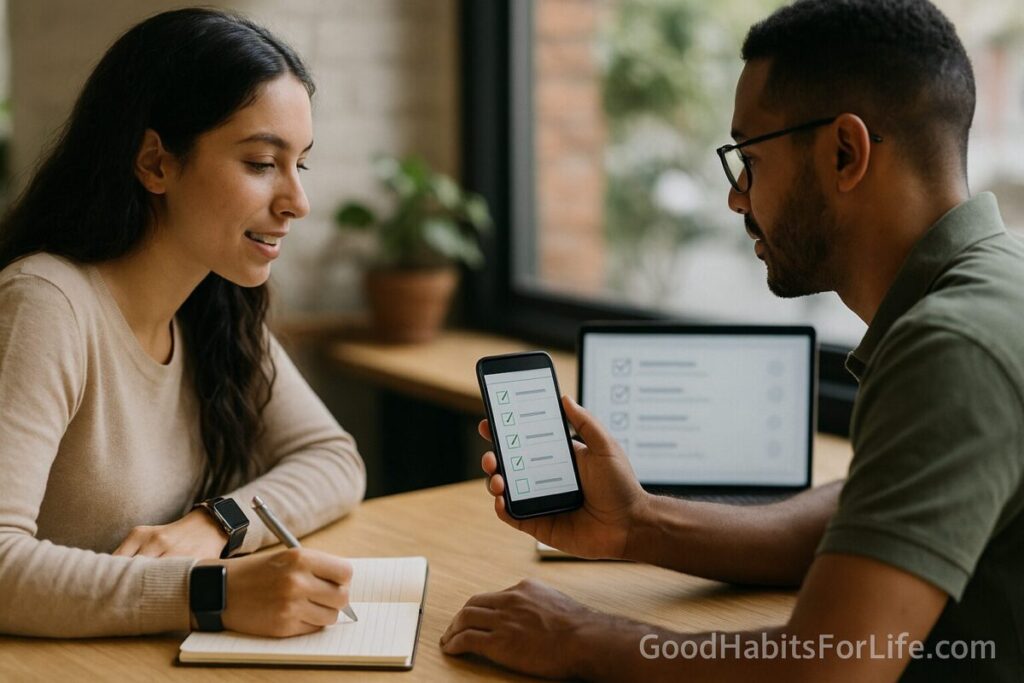
Accountability Buddies: Build Habits Together
Find an Accountability Buddy (and Make It Work)
Table of Contents
🧭 What an Accountability Buddy Is—and Why It Works
An accountability buddy is a peer you regularly report progress to on a specific habit or goal. You both agree to clear rules (what, when, how you’ll check in) and you both track results.
Why it works
-
Progress monitoring + reporting: Tracking goals and telling someone about your progress significantly improves attainment. Meta-analyses show that recording and sharing progress outperforms tracking alone.
-
Implementation intentions: Pre-deciding the when/where (“If it’s 7:00, then I start my walk.”) reduces friction and increases follow-through.
-
Habits compound: Repetition builds automaticity over weeks; check-ins help you stay consistent long enough to reach the “automatic” phase.
-
Social support: Having a partner, team, or friend increases adherence to health and learning behaviors.
-
Goal clarity: Specific, challenging, time-bound goals outperform vague intentions.
✅ What “good” looks like
-
One specific behavior (e.g., “30-minute brisk walk, 5×/week”).
-
A weekly 10–15 minute meeting or message thread.
-
A shared tracker (sheet/app) with binary daily entries.
-
A short debrief: what worked, what didn’t, next tweak.
-
Light consequences/rewards (optional), agreed in writing.
⚡ Quick Start: Do This Today
-
Pick one habit you can measure daily. Format: verb + amount + frequency.
-
Example: “Read 10 pages, 5 days a week.”
-
-
Choose your buddy: someone reliable, similar schedule, positive tone. Avoid power dynamics (e.g., direct reports).
-
Make a 2-line pact (paste into WhatsApp/Notes):
“We’ll check in Sundays 18:30 for 15 minutes.
Goal: [your habit]; Tracker: [link]; Missed check-in → rebook within 24h.” -
Set your first “if-then”: “If it’s 07:00 at my desk, then I open the reading app.”
-
Create a shared tracker (Google Sheet or app). Columns: Date | Did it? (Y/N) | Notes.
-
Do Day 1 now (a 2-minute starter). Log it. Send a selfie or screenshot as proof.
🗺️ 30-60-90 Day Habit Plan
Days 0–30 (Build the loop)
-
Goal: Consistency over intensity; hit 70–80% of planned days.
-
Cadence: 1× weekly check-in (10–15 min), 30-second daily proof message or auto-logged app data.
-
Checkpoint (Day 30): Review streak %, friction points, ideal time of day. If <60% success, shrink the habit (e.g., from 30 to 15 minutes).
Days 31–60 (Strengthen & personalize)
-
Add a “habit trigger stack”: place new habit after an existing one (e.g., after morning tea, write 3 lines).
-
Introduce one performance metric (pace, weight, pages, minutes).
-
Checkpoint (Day 60): Move from manual to automatic cues (calendar reminder → visual cue at the place/time you do the habit). Consider a light commitment device (e.g., charity pledge if week total <3/5).
Days 61–90 (Automate & expand)
-
Upgrade rule: Only make it harder if last 2 weeks ≥80% success.
-
Add “stretch reps” 1–2 days/week (e.g., read 20 pages instead of 10).
-
Checkpoint (Day 90): Decide to (a) keep, (b) level up (more days/volume), or (c) replace with a new habit. Refresh your pact.
Use this mini table in your tracker:
| Phase | Weekly target | Check-in focus | If-then example |
|---|---|---|---|
| 0–30 | 5 tiny reps | Remove friction | “If 7:00, start for 2 min.” |
| 31–60 | 5 standard reps | Optimize cues | “If commute ends, walk 10 min.” |
| 61–90 | 5 reps + 1 stretch | Automate | “If Sunday 18:30, debrief 10 min.” |
🧠 Techniques & Frameworks That Multiply Results
Implementation Intentions (If-Then Planning)
Write one cue per habit: “If it’s [time/place], then I [action].” Proven to increase execution by turning choices into reflexes.
WOOP (Wish-Outcome-Obstacle-Plan)
-
Wish: “Walk 30 min 5×/week.”
-
Outcome: “Better energy; 3 kg down by 12 weeks.”
-
Obstacle: “Late meetings.”
-
Plan: “If meeting runs late, then walk after dinner.”
Progress Monitoring & Public Reporting
Use a visible log (shared sheet/app). Reporting to a buddy boosts effect sizes versus silent tracking.
Goal-Setting Theory (Locke & Latham)
Make goals specific + time-bound + moderately challenging; add feedback loops each week.
Habit Formation Timeline
Automaticity grows over weeks; expect 6–12+ weeks for it to feel natural—consistency matters more than perfection.
Commitment Devices (optional)
Small stakes (e.g., donate ₹200/$5 to charity if you miss the weekly minimum) increase follow-through. Use sparingly and with consent.
👥 Audience Variations
Students
-
Pair within your class or hostel; align on timetable blocks.
-
Use Pomodoro co-working on video for 25-minute sprints; share screenshots of completed sessions.
Professionals
-
15-minute Friday “done list” call.
-
Protect a non-negotiable slot on workdays (calendar + door cue). Keep goals work-adjacent (learning, deep work, wellness).
Parents
-
Stack habits onto family routines (after drop-off, 10-minute walk).
-
Make the buddy a co-parent or friend; keep check-ins asynchronous (voice notes).
Seniors
-
Prioritize mobility/safety; track minutes walked or light strength reps.
-
Keep tech simple (phone calls + printed checklist).
Teens
-
Tie goals to existing communities (study groups, sports, music practice).
-
Keep rewards immediate (stickers, XP points, short game time).
⚠️ Mistakes & Myths to Avoid
-
Vague goals (“get fit”) → switch to “walk 30 min, 5×/week.”
-
No written pact → write 2 lines with meeting time + tracker link.
-
Over-coaching your buddy → you’re peers, not bosses. Ask, don’t tell.
-
Skipping debriefs → always review: what worked, friction, one tweak.
-
All-or-nothing thinking → log partials; keep the streak of showing up.
-
Myth: You must be similar → values alignment and reliability matter more than identical goals.
-
Myth: Willpower is enough → structure beats motivation on low-energy days.
🗣️ Real-Life Examples & Copy-Paste Scripts
1) Outreach message
“Hey [Name]! I’m starting a simple habit—[habit]. Want to be accountability buddies for 4 weeks? 10-minute weekly check-in, shared tracker, judgment-free. If it’s helpful, we can extend.”
2) 10-minute weekly check-in agenda
-
Wins (60s each)
-
Numbers review (2 min)
-
Obstacles + brainstorm (4 min)
-
One tweak + next week’s targets (2 min)
-
Close with when and where you’ll do the first rep next week (30s)
3) Gentle nudge when they miss
“You good? No pressure—want to reschedule our 10-min check-in in the next 24 hours? I’m here to help you get a small win this week.”
4) Boundary if the pairing isn’t working
“I’m noticing we’re missing check-ins. Can we try Sundays 19:00 for 3 weeks? If not, totally fine—I’ll find a better-fit schedule.”
5) Mini-contract (paste into Notes/Sheet)
-
Habit: [verb + amount + frequency]
-
Check-in: Day/Time (10–15 min)
-
Proof: Photo/app screenshot/Yes-No log
-
If miss check-in: Rebook within 24h
-
Review date: [30 days from now]
6) Example pairs
-
Health: Neighbors tracking blood-pressure walks 5×/week.
-
Money: Colleagues auto-saving ₹1,000/week; send weekly snapshot.
-
Learning: Friends complete 3 online lessons/week; quiz each other.
🛠️ Tools, Apps & Resources
Pick one; keep it simple.
-
Google Sheets / Excel
-
Pros: Free, flexible, great for pairs.
-
Cons: Manual; needs discipline.
-
-
HabitShare / SnapHabit
-
Pros: Built for buddy tracking; easy streaks and comments.
-
Cons: Feature set varies by platform.
-
-
Strava / Apple Fitness / Google Fit
-
Pros: Auto-logs workouts; social proof.
-
Cons: Best for physical habits only.
-
-
StickK / Beeminder (commitment contracts)
-
Pros: Stakes increase follow-through.
-
Cons: Not for everyone; start small.
-
-
WhatsApp / Telegram (low-tech)
-
Pros: Ubiquitous; voice notes.
-
Cons: Harder to analyze data; threads get noisy.
-
Tip: Decide one: your tracker of record. Everything else is optional.
📌 Key Takeaways
-
An accountability buddy works because you monitor and report progress.
-
Keep scope tiny for 30 days, then optimize and upgrade.
-
Use if-then plans, weekly debriefs, and a shared tracker.
-
Pairing success = clear rules + reliability + kindness.
-
Review at 30/60/90 days; keep what works, change what doesn’t.
❓ FAQs
1) How often should we check in?
Weekly for 10–15 minutes works best for most habits; add a quick mid-week text if you like.
2) What if my buddy quits?
Thank them, archive the tracker, and invite a new buddy within 48 hours to keep momentum.
3) Can my spouse be my buddy?
Yes—if feedback stays kind and brief. Some people prefer a friend to reduce emotional load.
4) Do we need punishments or money stakes?
No. They can help, but clarity + consistency usually suffice. If you try stakes, keep them small and mutual.
5) What if I’m introverted?
Use asynchronous check-ins (shared sheet + weekly text/voice notes). Keep live calls optional.
6) What’s the best time of day to do my habit?
When energy is reliably available. Morning often works, but your consistent slot is the best slot.
7) We have different goals. Is that OK?
Totally. You’re exchanging accountability, not doing identical tasks.
8) How do we measure success?
Start with binary daily (did/didn’t). Add performance metrics later (minutes, pages, pace).
9) How do we avoid nagging?
Follow the 10-minute agenda, ask questions (“What would make this 10% easier?”), and keep tone supportive.
10) What if we miss a week?
Rebook within 24 hours; do one 2-minute “restart rep” today to rebuild momentum.
📚 References
-
Harkin, B., Webb, T. L., et al. (2016). The effects of monitoring progress on goal attainment: A meta-analysis. Psychological Bulletin. https://doi.org/10.1037/bul0000059
-
Gollwitzer, P. M. (1999). Implementation intentions: Strong effects of simple plans. American Psychologist. https://doi.org/10.1037/0003-066X.54.7.493
-
Lally, P., van Jaarsveld, C. H. M., Potts, H. W. W., & Wardle, J. (2010). How are habits formed: Modelling habit formation in the real world. European Journal of Social Psychology. https://doi.org/10.1002/ejsp.674
-
Carron, A. V., Hausenblas, H. A., & Mack, D. (1996). Social influence and exercise: A meta-analysis. Journal of Sport & Exercise Psychology. https://doi.org/10.1123/jsep.18.1.1
-
Wing, R. R., & Jeffery, R. W. (1999). Benefits of recruiting participants with friends in a weight-loss program. Annals of Behavioral Medicine. https://pubmed.ncbi.nlm.nih.gov/10574174/
-
Locke, E. A., & Latham, G. P. (2002). Building a practically useful theory of goal setting and task motivation. American Psychologist. https://doi.org/10.1037/0003-066X.57.9.705
-
American Psychological Association. The Power of Social Support. (Web article summarizing evidence). https://www.apa.org/topics/relationships/social-support
-
WHO. (2020). Guidelines on physical activity and sedentary behaviour. (Adherence benefits and health outcomes). https://www.who.int/publications/i/item/9789240015128
-
Oettingen, G. (2012). Future thought and behaviour change (WOOP framework). Social and Personality Psychology Compass. https://doi.org/10.1111/j.1751-9004.2012.00458.x