
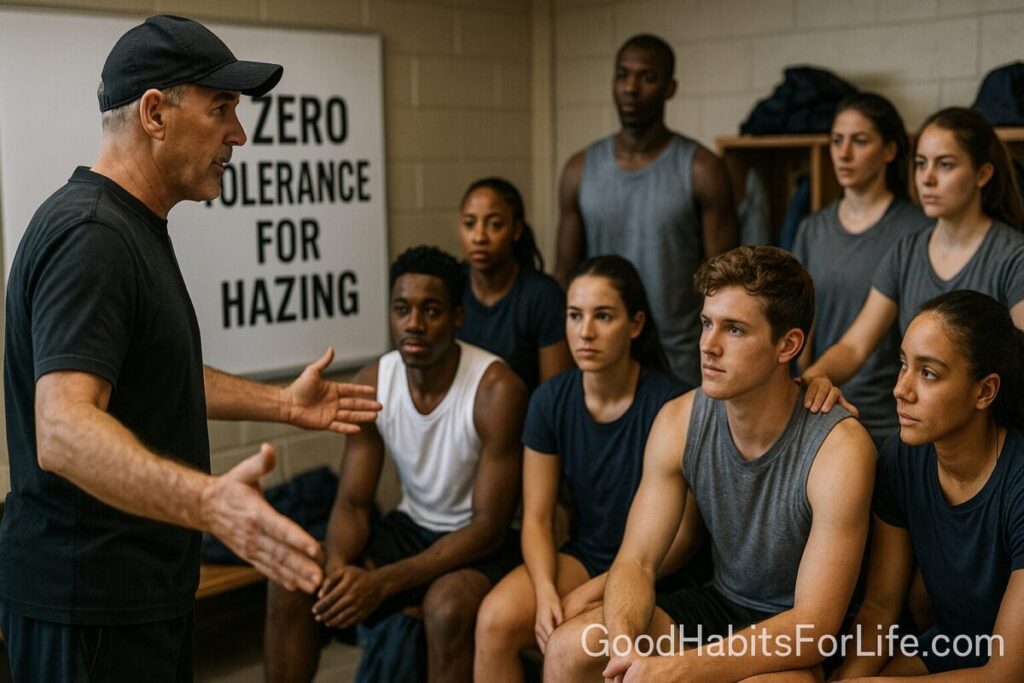
Teams & Hazing: ZeroTolerance and Real Support
Hazing on Teams: Zero Tolerance, Real Support
Table of Contents
🧭 What Hazing Is—and Why It Persists
Definition (plain-language): Hazing is any activity expected of someone to join or maintain membership in a group that humiliates, degrades, abuses, or endangers—regardless of a person’s willingness. It includes forced or coerced drinking, sleep deprivation, physical tasks causing harm, social isolation, and sexualized or online humiliation.
Why it persists
-
Belonging pressure & power dynamics: New members want acceptance; upperclassmen or veterans control access.
-
“We did it, you do it” fallacy: Harmful traditions get rebranded as “bonding.”
-
Alcohol as a tool: Drinking games or “chug to prove loyalty” accelerate risk and silence.
-
Silence & bystander effect: People fear social backlash or don’t know what counts as reportable.
Why zero tolerance + support matters
-
Reduces injuries, alcohol poisoning, and long-term mental health harms.
-
Improves performance: psychologically safe teams communicate better, retain talent, and recover faster from mistakes.
-
Aligns with school, league, and state laws; protects everyone—especially leaders—from legal and reputational risk.
✅ Quick Start: Do-This-Today Checklist
For students & teammates
-
Save help contacts (phone & web) for your school, league, and national hotlines (see Resources).
-
Use the “3D” bystander rule: Direct (say stop), Distract (change the situation), or Delegate (call a coach/RA/security).
-
Document privately: dates, names, screenshots.
-
Refuse scripts (below) and leave unsafe spaces—your safety > team tradition.
For captains & coaches
-
Post a 1-page policy in the locker room and team chat: definitions, examples, reporting links, and consequences.
-
Set a “no initiations” norm: all “welcome events” must be sober, opt-in, and coach-approved.
-
Name a Safe Contact (not a student leader) for confidential reporting.
-
Run a 15-minute huddle: role-play bystander lines; acknowledge past harm and your open-door policy.
For parents
-
Ask two questions tonight: “How are new members welcomed?” and “What happens after practice on Fridays?”
-
Share ride-home code (“TEXT 🛑 = pick-up no questions”).
-
Know the school’s process and state law; bookmark it.
🛠️ 30-60-90 Day Team Roadmap
Goal: Build a durable, high-trust, high-performance culture with zero hazing.
Days 1–30: Clarify & Train
-
Publish a clear policy: definitions, examples (including alcohol-related coercion), sanctions, and amnesty for medical help-seeking.
-
Orientation module for all athletes and staff (20–30 min): hazing 101, alcohol poisoning signs, bystander skills, and reporting flow.
-
Anonymous baseline survey to detect hidden risk hotspots.
-
Replace “initiations” with coach-approved bonding (team service day, skills clinics, welcome breakfast).
Days 31–60: Embed & Monitor
-
Captain contracts: leadership standards, must model refusal, sober hosting rules.
-
Practice-week rhythm: 2-minute safety check at Monday practice; Friday reminder of weekend expectations.
-
Peer advocates (2–3 trained students) paired with adult liaisons; rotate monthly.
-
Incident drill: simulate an anonymous report and run the exact response timeline.
Days 61–90: Sustain & Improve
-
Mid-season survey + focus huddles; share anonymized learnings and adjustments.
-
Public scoreboard (intranet): trainings completed, safe-event ideas adopted, response times (not case details).
-
Celebrate culture wins: shout-outs for bystander action, safe captains’ events, and inclusive traditions.
-
Annual review: update policy to match new state laws and league guidance.
🧠 Techniques & Frameworks That Work
-
Bystander “3D” Model: Direct, Distract, Delegate—simple enough to recall in tense moments.
-
Protective Behavioral Strategies for alcohol (where legal): buddy system, pace drinks (or choose alcohol-free), avoid “chugging games,” call for help early.
-
Psychological Safety Routines: weekly “one hard thing / one help offer” round; leaders speak last.
-
Amnesty/Good-Samaritan policies: encourage calling for medical help without fear of team penalties for the caller.
-
Choice Architecture: schedule early-morning practice after “risk nights,” provide attractive sober events, and make reporting links one tap away.
👥 Audience Variations
Students & rookies
-
Ask in advance: “How are rookies welcomed? Is alcohol involved?”
-
Use a buddy for all off-campus gatherings; pre-agree on a text code to leave.
-
Know the medical emergency signs (confusion, vomiting, slow/irregular breathing, blue-tinged skin); call for help immediately.
Captains & upperclassmen
-
Treat leadership as duty of care: your silence reads as approval.
-
Shift identity from “gatekeeper” to mentor: pair rookies with skill mentors, not hazing “handlers.”
Coaches & activity directors
-
Bake expectations into syllabi and rosters; training is required before first competition.
-
Use anonymous reporting managed by a non-coaching administrator to minimize conflicts of interest.
Parents & caregivers
-
Watch for red flags: secret late-night meetings, excessive exhaustion, unexplained bruises, sudden fear of teammates, or new alcohol use.
-
Keep communication lines open: “I will always pick you up—any time, no lecture.”
School leaders
-
Create a central reporting portal, publish aggregate stats, and maintain partnerships with counseling & community services.
-
Review state law annually; align discipline with due process and education.
⚠️ Mistakes & Myths to Avoid
-
“It’s tradition, not hazing.” If it humiliates, coerces, or endangers—even once—it’s hazing.
-
“They agreed.” Consent under social pressure or power imbalance isn’t meaningful.
-
“Only fraternities do this.” Hazing occurs across sports, bands, clubs, and online groups.
-
“A little drinking is fine.” Coerced alcohol use is hazing and dramatically increases medical risk.
-
“Reporting ruins the team.” Cover-ups ruin teams. Accountability + support rebuild trust.
🗣️ Real-Life Scripts You Can Use
Student to teammate (direct):
“I’m here to play, not to be humiliated. I’m out. If this continues, I’m reporting.”
Student to host (distract):
“Coach wanted photos for the team page—let’s set up a quick skills challenge instead.”
Student to adult (delegate):
“Anonymous tip: First-years are being forced to drink tonight at [location]. Please check now.”
Captain to team (pre-season):
“No initiations, no exceptions. We welcome with respect—service day and team breakfast are our traditions.”
Coach to parents (email line):
“If your child texts 🛑, pick them up—no questions. We’ll talk later and support them.”
Parent to teen (ride-home):
“If anyone asks you to do something unsafe or humiliating, my answer is no—and I’ll back you up.”
📚 Tools, Apps & Resources
-
School/League Links: Your school’s hazing policy, reporting portal, and counseling center.
-
Anonymous reporting platforms: Some schools use EthicsPoint, LiveSafe, or in-house portals.
-
Hotlines & help:
-
SAMHSA National Helpline (US): 1-800-662-HELP — treatment/referral for substance use and mental health.
-
Crisis services: Use your country’s crisis line; many schools partner with local services and text lines.
-
-
Evidence-based education: NCAA and national hazing prevention organizations (see References).
-
Alcohol education (for legal-age contexts): NIAAA college drinking resources; medical amnesty info where applicable.
Tip: Print a wallet card (or save a phone note) with your campus reporting link, a trusted adult’s number, and crisis contacts.
🔑 Key Takeaways
-
Hazing is abuse—not a rite of passage.
-
Zero tolerance works when paired with real support, training, and easy reporting.
-
Leaders must model safe, inclusive traditions; silence signals approval.
-
Everyone needs bystander tools and scripts ready before risky nights.
-
Quick action + documentation protect people and programs.
❓ FAQs
Is any “initiation” automatically hazing?
No. Welcoming events that are voluntary, respectful, sober, and not tied to membership or status are fine. Anything humiliating, coerced, or risky is hazing.
What if I “agreed” to participate?
Apparent consent under pressure, power imbalance, or misinformation doesn’t erase harm or policy violations. You can still report and get help.
Can our team be punished if only a few people did it?
Yes. Teams and organizations can face sanctions if the culture enables hazing. Clear expectations and swift reporting protect everyone.
What are signs of alcohol poisoning?
Confusion, vomiting, seizures, slow/irregular breathing, pale or blue-tinged skin, unconsciousness. Call emergency services immediately.
Will reporting get me in trouble if I was drinking?
Many schools and teams use medical amnesty or Good-Samaritan policies that prioritize safety over discipline when you seek help. Check your policy.
How do we replace hazing with real bonding?
Service projects, skill-sharing clinics, mentorship pairs, friendly in-house competitions, or a team breakfast—planned and sober.
What if the coach looks the other way?
Use anonymous reporting to an administrator or compliance office. Document details and escalate to school leadership if needed.
Does hazing happen online?
Yes—group chats and social media can be used to coerce or humiliate (e.g., forced posts, doxxing). Digital hazing is still hazing.
Are there legal consequences?
Many regions have specific hazing laws; penalties range from school sanctions to criminal charges. Know your local law and school code.
How can parents help without making it worse socially?
Agree on a code to exit events, keep check-ins low-drama, and coordinate with administrators rather than confronting students directly.
📖 References
-
National Institute on Alcohol Abuse and Alcoholism (NIAAA). College Drinking—Harmful and Underage Drinking Prevention. https://www.niaaa.nih.gov
-
Centers for Disease Control and Prevention (CDC). Alcohol and Public Health. https://www.cdc.gov/alcohol
-
Substance Abuse and Mental Health Services Administration (SAMHSA). National Helpline. https://www.samhsa.gov/find-help/national-helpline
-
StopHazing Research Lab (University of Maine). Hazing definitions, research, and prevention resources. https://www.stophazing.org
-
NCAA. Hazing Prevention and Intervention Resources for Athletics. https://www.ncaa.org
-
American College Health Association (ACHA). Position statements on campus safety and substance use. https://www.acha.org
-
U.S. Department of Education. Campus safety and Clery Act resources. https://www2.ed.gov/admins/lead/safety/campus.html
-
HazingPrevention Network. Education and awareness resources. https://hazingpreventionnetwork.org
Disclaimer: This guide is for educational purposes only and is not legal or medical advice; consult your school policies, local laws, and qualified professionals for specific guidance.