
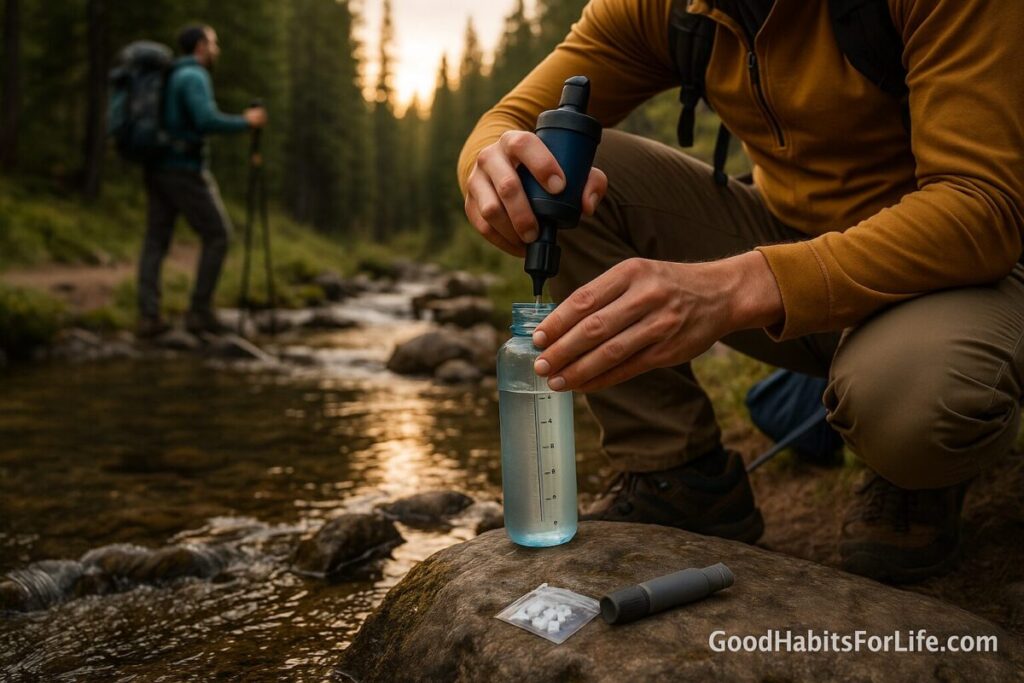
Trail Days: Filters, Tablets & Safe Streams
Trail Days: Filters, Tablets & Safe Streams
Table of Contents
🧭 What This Guide Covers & Why It Matters
Backcountry water can look pristine yet carry bacteria, viruses, and parasites like Giardia and Cryptosporidium. Untreated water risks diarrhea, vomiting, and ruined trips. The safest hierarchy is: boil first when possible; otherwise filter and then disinfect (chemical or UV). CDCNational Park Service
Benefits of doing it right
-
Lower risk of GI illness and lost training days
-
Less pack weight (treat on route vs. hauling all water)
-
Confidence to choose routes with limited spigots
-
Scalable from day hikes to multi-day treks
✅ Quick Start: “Do This Today” Trail Protocol
Follow this field-tested sequence for most hikes:
-
Collect smart. Scoop from flowing water near the source; avoid stagnant pools, downstream of campsites, or grazing areas. Dip just below the surface. National Park Service
-
Filter first. Use a microfilter (0.1–1 µm) with an absolute pore rating to remove protozoa (e.g., Giardia, Crypto) and most bacteria. WMSCDC
-
Then disinfect.
-
Chlorine dioxide tablets for broad coverage (30 min typical; 4 hours for Cryptosporidium). foodsmartcolorado.colostate.edu
-
Bleach/iodine: effective for bacteria/viruses but unreliable for parasites—use only after filtration; avoid iodine if pregnant or with thyroid issues. CDC
-
UV purifier: fast and effective in clear water; pre-filter silty water. CDC
-
-
Protect the clean. Use a dedicated “clean” bottle or bladder; keep the “dirty” scoop bottle separate.
-
Store covered. Cap immediately; avoid re-contaminating spouts.
-
Poop protocol. Bury human waste ≥20 cm (8 in) deep and ≥60 m (200 ft) from water. CDC
🗓️ Habit Plan: 7-Day Starter
Goal: Make safe water treatment automatic.
-
Day 1 (Home): Read your filter/tablet instructions. Mark bottles DIRTY/CLEAN with tape.
-
Day 2: Practice assembling the filter blindfolded (gloves on) to simulate cold conditions.
-
Day 3: Run 1 L of tap water through the filter; “dose” with chlorine dioxide per label (time each step).
-
Day 4: Field walk—collect from a park stream (no drinking); practice site selection and back-flush.
-
Day 5: Recharge your UV device; test on clear tap water (watch contact time).
-
Day 6: Pack a mini-kit (see list below) and do a 2-hour hike; treat and drink 1–2 L safely.
-
Day 7 (Review): Clean/dry gear, restock tablets, and log what slowed you down.
🛠️ Techniques & Frameworks
🧪 Microfilters, Ultrafilters & “Purifiers” (Know the Differences)
-
Microfilter (≈0.1–1 µm): removes protozoa and most bacteria; does not reliably remove viruses. Great day-to-day trail option. WMS
-
Ultrafilter/Nanofilter/RO: progressively finer; capable of virus removal (trade-offs: bulk, pressure, cost). wmsdev.imiscloud.com
-
NSF P231-certified “purifier”: independently tested to meet microbiological reductions for bacteria, viruses, and cysts—look for this when viral risk is non-trivial (human/animal activity in watershed). nsf.org
How to read specs
-
Prefer absolute pore ratings (not nominal). CDC notes ≤1 µm for cyst reduction; ≤0.3 µm covers bacteria/parasites. CDC
-
Maintain flow by back-flushing; clogged fibers reduce effectiveness.
🔥 Boiling
-
Bring water to a rolling boil for 1 minute (≥3 minutes above ~2,000 m / 6,500 ft). Kills viruses, bacteria, and parasites. CDCNational Park ServiceUS EPA
-
Pros: universally effective; works in cloudy water. Cons: fuel/time; hot water management.
💊 Chemical Disinfection
-
Chlorine dioxide: broad spectrum; allow 4 hours for Cryptosporidium; 30 minutes is typical for others—always follow the label. foodsmartcolorado.colostate.edu
-
Household bleach (sodium hypochlorite): practical emergency option; see EPA dosage table; less effective for protozoa—use after filtration. US EPA
-
Iodine: similar to bleach (bacteria/viruses), not reliable for protozoa; avoid if pregnant/thyroid disease and don’t use for more than a few weeks. CDC
🔦 UV Purifiers
-
Inactivates protozoa, bacteria, and viruses in clear water; pre-filter first and respect manufacturer contact time. Battery dependent. CDCNational Park Service
🧪 Combining Methods (Best Practice)
-
Filter → Disinfect is the all-rounder for trails: filtration removes particulates & parasites; disinfection handles viruses/bacteria. CDC
🌊 Finding Safe Sources on Trail
-
Favor moving water (riffles/streams) and upstream of campsites & grazing. Avoid stagnant ponds. National Park Service
-
If water is murky, let sediment settle, then pre-filter through a cloth/coffee filter before treatment. US EPA
-
Never attempt to treat water contaminated by chemicals, heavy metals, algal toxins, or radiation—seek another source. US EPA
🎒 Gear Setup & Packing List
-
Primary: Microfilter (absolute ≤0.3 µm) + chlorine dioxide tablets. CDC
-
Add-ons by risk:
-
Containers: 1 DIRTY scoop bottle + 1–2 CLEAN bottles/bladders.
-
Maintenance: Back-flush syringe, spare gasket, stuff sack.
-
Hygiene: Alcohol gel, zip bags, trowel (for 20 cm/8 in catholes, ≥60 m/200 ft from water). CDC
-
Redundancy: Waterproof matches (for boiling), extra tablets.
👥 Audience Variations
-
Students / new hikers: Choose a squeeze microfilter + tablets; laminate a 4-step card (“Collect → Filter → Disinfect → Protect”).
-
Parents with kids: Pre-dose tablets in labeled baggies; bring a soft bottle just for kids’ refills.
-
Professionals / guides: Carry a P231 purifier or UV as secondary; log daily treatment in trip paperwork. nsf.org
-
Seniors: Favor pump or gravity systems (less hand strain); pre-fill in camp and let tablets work while resting.
⚠️ Mistakes & Myths to Avoid
-
“Crystal-clear water is safe.” False; microbes are invisible. CDC
-
“Filtering alone is enough everywhere.” Not where viral contamination is possible. Add disinfection or use a P231 purifier. CDCnsf.org
-
“UV works in any water.” It fails in cloudy/silty water; always pre-filter. CDC
-
“Iodine is fine for everyone.” Avoid if pregnant/thyroid issues; limit duration. CDC
-
“Boiling removes chemicals.” It kills microbes but does not remove metals or most chemicals. US EPA
🧾 Real-Life Scripts & Checklists
30-Second Stream Script
“We’ll collect from that fast riffle, fill the DIRTY bottle, run it through the filter into CLEAN, then drop a chlorine dioxide tablet. It’s hot today, so we’ll give it 30 min; if Crypto risk, we’ll wait 4 hours before drinking.”
Camp Pack-Up Checklist
-
Back-flush filter (10–20 strokes)
-
Dry and cap both ends
-
Count remaining tablets
-
Recharge or swap UV batteries
-
Separate DIRTY/CLEAN gear in pack
Decision Tree (fast)
-
Clear and fast-moving? → Filter → Disinfect (tablet or UV).
-
Silty? → Settle → Pre-filter cloth → Filter → Disinfect.
-
Viral risk (heavy use, downstream of villages/pastures)? → Use P231 purifier or Filter → Disinfect; avoid if uncertain. nsf.org
-
Chemical spill/algal bloom suspected? → Skip source. US EPA
🧰 Tools, Apps & Resources (pros/cons)
-
Microfilter squeeze or gravity kits — Light, fast; needs back-flush; viruses not covered. WMS
-
Chlorine dioxide tablets — Tiny, reliable; 4-hour wait for Crypto. foodsmartcolorado.colostate.edu
-
UV purifier — Very fast; dependent on clear water and batteries. CDC
-
P231-certified purifier — Virus-level protection; heavier/costlier. nsf.org
-
EPA dosage sheet (bleach) — Good emergency backup; taste + protozoa limits. US EPA
📌 Key Takeaways
-
Treat all natural water; don’t trust appearances. CDC
-
The gold-standard flow: Filter → Disinfect; boil when practical. CDC
-
Match method to risk: microfilter for protozoa/bacteria; P231 purifier or chemical/UV step for viruses. WMSnsf.org
-
Respect contact times—especially 4 hours for Crypto with chlorine dioxide tablets. foodsmartcolorado.colostate.edu
-
Keep clean and dirty systems separate to avoid re-contamination.
❓ FAQs
Do I need to boil after filtering?
Not if you filter and then properly disinfect; boiling is an alternative that kills all classes of microbes when done long enough. CDC
What micron rating should I buy?
Choose an absolute pore size. A microfilter in the 0.1–1 µm range removes protozoa and bacteria but not viruses; look for NSF P231 if you want purifier-level (virus) performance. WMSnsf.org
How long do chlorine dioxide tablets take?
Plan for 30 minutes for most microbes but up to 4 hours to inactivate Cryptosporidium. Follow the label. foodsmartcolorado.colostate.edu
Is iodine safe?
It’s effective for bacteria/viruses but not reliable for protozoa; avoid if pregnant, with thyroid disease, or for prolonged use. CDC
Do UV purifiers work in muddy water?
No—suspended particles can shield germs from the light. Pre-filter to clear the water before using UV. CDC
Does boiling remove chemicals or metals?
No. Boiling/disinfection kills microbes but doesn’t remove metals, salts, or most chemicals. Choose another source. US EPA
How far from water should I bury waste?
At least 60 m (200 ft) from lakes/streams and ≥20 cm (8 in) deep. CDC
When should I consider a “purifier” instead of a filter?
If your route passes through heavily used areas, downstream of settlements/grazing, or international destinations where viral contamination is plausible. Look for NSF P231 certification. nsf.org
📚 References
-
Centers for Disease Control and Prevention (CDC). About Water Treatment Options When Hiking, Camping, or Traveling (2025). CDC
-
National Park Service. Two Ways to Purify Water (2022). National Park Service
-
U.S. Environmental Protection Agency (EPA). Emergency Disinfection of Drinking Water (2025). US EPA
-
NSF. Standards for Water Treatment Systems (P231 and related) (accessed 2025). nsf.org
-
Wilderness Medical Society. Water Treatment for Wilderness, International Travel, and Austere Situations (2024 summary/CPG). CDC Stacks+1
-
Colorado State University Extension. Guide to Treating Water in the Backcountry (2022). foodsmartcolorado.colostate.edu
Disclaimer: This guide is educational and not a substitute for professional medical advice; use your judgment and follow product instructions and local advisories.