
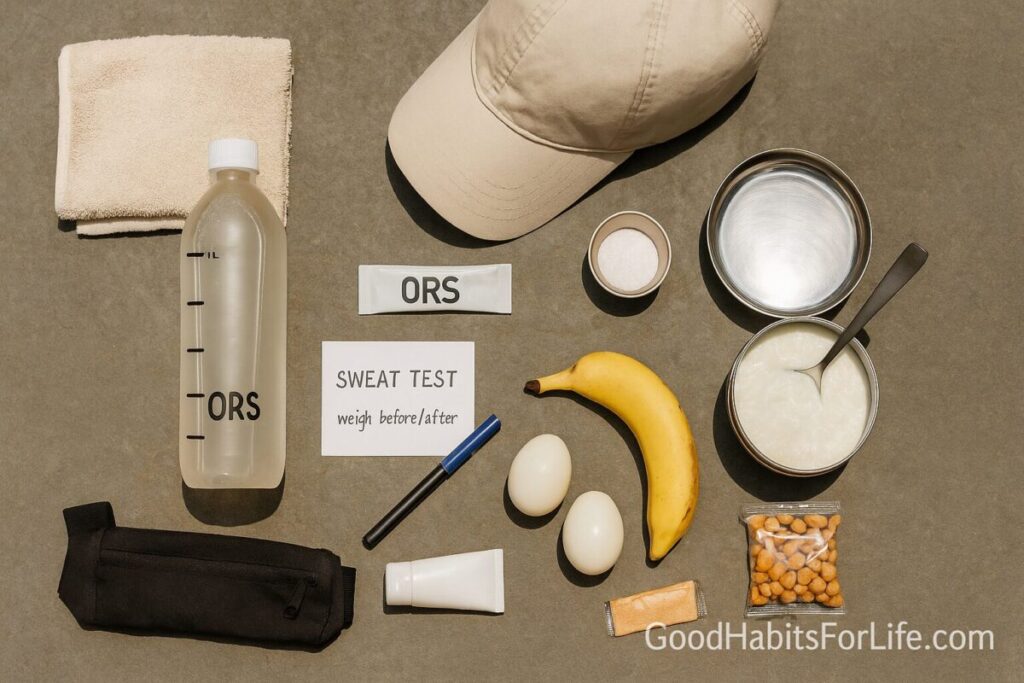
Sodium Strategies for Sweaty Climates (India): Protein-Forward Plan (2025)
Sodium for Sweaty Climates (India): Protein-Forward Plan
Table of Contents
🧭 What this guide covers & why sodium matters in heat
If you train, commute, or work outdoors in hot Indian climates, you sweat—often a lot. Sweat contains water and electrolytes (notably sodium). Replace too little sodium and you risk headaches, muscle cramps, and, in extreme cases, exercise-associated hyponatremia (EAH). Replace too much indiscriminately and you may overshoot daily limits important for heart health. This guide shows how to find your personal sweet spot using sweat-rate testing, ORS, and a protein-forward eating pattern that helps recovery in heat. Emergency Medicine CasesWorld Health Organization
Baseline reality: WHO recommends adults keep average sodium intake below 2,000 mg/day (~5 g salt). You can still go strategic around long, sweaty sessions without making high salt your everyday default. World Health Organization
🧮 How much sodium do you really need?
General population: Keep daily intake under 2,000 mg sodium (about 1 teaspoon of salt) for long-term health. In India, ICMR-NIN and FSSAI align with this limit. Use iodized salt to prevent iodine deficiency. FSSAINational Institute of Nutrition
When you sweat a lot: Sweat sodium loss varies by person and conditions—models show ~20–80 mmol/L sodium with sweat rates of 0.5–2.5 L/hour. Translation: some people are “salty sweaters.” Personalization matters. PubMed
Avoid extremes: The EAH consensus warns against over-drinking plain water; plan fluids to limit mass loss ≤2% and consider sodium in long/hot efforts. Many athletes do best with a drink-to-plan approach guided by sweat data, not thirst alone. Emergency Medicine CasesPMC
🛠️ Quick Start: Today’s sodium + hydration moves (India)
-
Know your day’s heat risk. During heat-wave alerts, prioritize ORS or lightly salted fluids; the Health Ministry specifically advises ORS, lemon water with a pinch of salt, and chaas. NCDC
-
Do a mini sweat-rate test tonight. Weigh before and after a 45–60 min walk/run in similar heat; every 1 kg lost ≈ 1 L fluid. Aim to limit loss to ≤2% next time. drugfreesport.org.za
-
Use a simple pre/during/post plan (see below).
-
Salt smarter. Keep everyday food modest in salt; add sodium around long sweat sessions (e.g., salty chaas, ORS, a salted banana-peanut chaat). World Health OrganizationNCDC
-
Go protein-forward. Target 0.83 g/kg/day (general) and 1.4–2.0 g/kg/day when training to support recovery. National Institute of NutritionPMC
🍱 Build your protein-forward, heat-savvy day (sample Indian menu)
Goal: Steady protein for recovery + measured sodium around sweat.
Breakfast (6–8 am)
-
2 eggs or paneer bhurji + whole-wheat roti; OR 200 g curd + millet poha with peanuts.
-
Hydrate: 300–500 mL water; if training next, sip 300–500 mL ORS/chaas. NCDC
Mid-morning (10–11 am)
-
Chaas (250–300 mL) with a small pinch of iodized salt + roasted chana. NCDC
Lunch (1–2 pm)
-
Dal + rice/millets + mixed veg + curd; add iodized salt sparingly while cooking.
-
Optional: buttermilk (unsweetened).
Pre-workout (30–60 min before)
-
Banana + whey in water or milk (if used) or peanut chikki; 300–500 mL water.
During long/hot sessions (>60–90 min)
-
0.4–0.8 L/hour fluid guided by sweat-rate test; use ORS or sports drink in the heat. drugfreesport.org.za
Post-workout (within 60 min)
-
20–40 g protein (dal+roti, paneer wrap, egg roll, or whey) + 300–600 mL fluid; add salty foods if you see heavy salt rings on clothes/skin. BioMed Central
Dinner (7–8:30 pm)
-
Grilled fish/tofu/pulses + veg + roti/millet; simple spices; minimal added salt.
📅 30–60–90 Habit Plan (with checkpoints)
Days 1–7 (Setup)
-
Measure sweat rate twice in typical heat. Log body-mass change.
-
Replace ~80% of losses in-session; keep day’s total sodium near baseline (<2,000 mg) except on long-sweat days. drugfreesport.org.zaWorld Health Organization
-
Hit 0.83 g/kg protein daily via staples (dal, dairy, eggs, soy, fish). National Institute of Nutrition
Days 8–30 (Personalize)
-
If sweat tests show >1 L/h, pre-hydrate (5–7 mL/kg 4 h pre-exercise) and consider ORS during long sessions. drugfreesport.org.za
-
Track signs of salt need: salty sweat stains, cramps late in long sessions; experiment with 300–600 mg sodium per hour via ORS/salted foods if needed. (Stay within daily limits off-day.) Emergency Medicine Cases
Days 31–90 (Lock-in & heat-waves)
-
Create two playbooks: Normal-heat vs Heat-wave (more ORS/chaas, shaded breaks). Follow Health Ministry advisories during extreme heat. NCDC
-
Move toward training-day protein 1.4–2.0 g/kg if performance or recovery lags; keep fiber, fruits, and potassium-rich foods high. PMC
🧪 Techniques & frameworks
Sweat-rate test (home version)
-
Empty bladder; weigh yourself nude (or same dry clothes).
-
Do your usual session (45–60 min). Track fluids consumed.
-
Towel off; re-weigh.
-
Sweat loss (L) ≈ (kg lost) + (L consumed) − (urine L).
Use this to plan 0.4–0.8 L/h during similar sessions, to keep ≤2% body-mass loss. drugfreesport.org.za
Pre/During/Post framework (ACSM)
-
Pre (4 h prior): drink 5–7 mL/kg. If urine remains dark or no output, add 3–5 mL/kg 2 h prior.
-
During: drink to plan (guided by sweat rate).
-
Post: drink 1.25–1.5 L per 1 kg body mass lost over the next few hours; include sodium to speed rehydration. drugfreesport.org.za
ORS vs sports drinks vs homemade
-
ORS: WHO-style electrolyte solution; excellent for heat-stress rehydration and illness. Good during heat waves and very sweaty, long efforts. NCDC
-
Sports drink: Useful during long efforts; typically ~20–25 g carbs/500 mL and some sodium.
-
Homemade: Lemon water + small pinch of salt + a little sugar; or chaas with a pinch of salt. Keep it lightly salted. NCDC
👥 Audience variations
Students & office commuters: Carry a 750 mL bottle; sip through the day. Use chaas or coconut water + salty snack after sweaty travel. Keep canteen food lower-salt; add a pinch post-sweat if needed. World Health Organization
Recreational runners/cyclists: Use sweat-rate data; in summer, plan 0.4–0.8 L/h fluid, add sodium if you’re a “salty sweater.” Avoid over-drinking plain water. drugfreesport.org.zaEmergency Medicine Cases
Workers in the sun (delivery, construction, farms): Follow governmental heat advisories: ORS, shaded breaks, light clothing. Pair lunch with curd/dal for protein. NCDC
Seniors: Prioritize steady fluids and protein (curd, dal, eggs, fish/soy). Monitor blood pressure and meds with a clinician before changing sodium. World Health Organization
Competitive athletes: Maintain protein 1.4–2.0 g/kg/day and personalize sodium with a sports dietitian; lab sweat testing if available. PMC
⚠️ Mistakes & myths to avoid
-
“More salt = more performance.” Not true. Use targeted sodium; keep daily average low for heart health. World Health Organization
-
Only water during long, hot sessions. Risk of EAH; include electrolytes and carbs as needed. Emergency Medicine Cases
-
Ignoring iodine. In India, choose iodized salt unless medically advised otherwise. National Institute of Nutrition
-
Protein last. In heat, recovery matters; hit your daily protein target consistently. National Institute of NutritionPMC
-
No plan for heat waves. Use ORS/chaas, rest in shade, watch advisories. NCDC
💬 Real-life examples & scripts
-
At the canteen: “Please go easy on the salt while cooking. I’ll add a pinch after my training if needed.”
-
During a group run: “Let’s plan 500–600 mL per hour with one ORS bottle in the second half—too much plain water makes me crampy.” drugfreesport.org.zaEmergency Medicine Cases
-
At home: “We’ll use iodized salt, but keep the curry lightly salted. I have chaas after my mid-day commute.” National Institute of Nutrition
🧰 Tools, apps & resources
-
Digital scale (±0.1 kg): for sweat-rate tests.
-
1 L marked bottle: easy hourly tracking.
-
ORS sachets in the gym bag (follow label exactly). NCDC
-
Food diary/app: track sodium, protein.
-
Light, breathable clothing + cap for heat days. NCDC
✅ Key takeaways
-
Keep baseline sodium low (<2,000 mg/day); add strategically when sweating heavily. World Health Organization
-
Measure, don’t guess: Use sweat-rate testing; aim ≤2% body-mass loss. drugfreesport.org.za
-
Prefer ORS/chaas in heat waves or very sweaty sessions; avoid over-drinking plain water. NCDCEmergency Medicine Cases
-
Go protein-forward (0.83 g/kg/day; 1.4–2.0 g/kg with training) for recovery. National Institute of NutritionPMC
❓ FAQs
1) Do I need salt tablets?
Not usually. Start with ORS or lightly salted fluids during long, hot sessions and base changes on sweat-rate data or lab testing. Consult a clinician if you have BP/kidney issues. drugfreesport.org.zaEmergency Medicine Cases
2) Can’t I just drink when thirsty?
Thirst is not perfect in heat. Use a plan informed by your sweat rate to avoid both dehydration and overhydration. PMC
3) What are signs I need more sodium?
Persistent cramps late in long sessions, salt crust on clothing/skin, feeling “flat” despite fluids. Trial small, measured sodium increases during long efforts. Emergency Medicine Cases
4) Is coconut water enough?
Great potassium; relatively low sodium. Pair with a salty snack/chaas/ORS on very sweaty days. NCDC
5) How much ORS is safe?
Use as directed on sachets; it’s designed for rehydration. In routine training, small bottles can cover long/hot efforts; don’t rely on ORS all day. NCDC
6) Can children/teens follow this?
Yes—with adult supervision and modest sodium aligned to body size and activity. WHO advises children consume less than adult sodium limits, scaled to energy needs. World Health Organization
7) Protein powders or food?
Foods first (dal, dairy, eggs, soy, fish). Powders are convenient to hit 20–40 g after sessions if needed. BioMed Central
8) What about office days with AC?
Stay near baseline sodium; sip water regularly; no need for ORS unless you’ve had a sweaty commute or workout. World Health Organization
📚 References
-
World Health Organization. Sodium reduction: Fact sheet. 2025. https://www.who.int/ … World Health Organization
-
ICMR-NIN. Dietary Guidelines for Indians (2024). https://www.nin.res.in/ … National Institute of Nutrition
-
FSSAI Direction referencing RDA 2020 (sodium 2,000 mg/day). 2022. https://fssai.gov.in/ … FSSAI
-
Ministry of Health & Family Welfare (India). Public Health Advisory: Extreme Heat/Heatwave. 2024–2025. https://ncdc.mohfw.gov.in/ … NCDCTND PHP Management Portal
-
American College of Sports Medicine et al. Nutrition and Athletic Performance. 2016. https://pubmed.ncbi.nlm.nih.gov/26891166/ Swasti
-
Kenefick RW. Planned Drinking Vs Drinking to Thirst. 2018. https://pmc.ncbi.nlm.nih.gov/articles/PMC5790864/ PMC
-
Hew-Butler T, et al. EAH Consensus Statement. 2015. https://emergencymedicinecases.com/… Emergency Medicine Cases
-
McCubbin AJ, et al. Modelling sodium requirements across sweat [Na+] (20–80 mmol·L⁻¹). 2023. https://pubmed.ncbi.nlm.nih.gov/35616504/ PubMed
-
Rivera-Brown AM, et al. Normative data for sweat rate & sodium in tropical athletes. 2020. https://pubmed.ncbi.nlm.nih.gov/32454460/ PubMed
-
Jäger R, et al. ISSN Position Stand: Protein and Exercise. 2017. https://jissn.biomedcentral.com/articles/10.1186/s12970-017-0177-8 BioMed Central
Disclaimer: This guide is educational and not a medical diagnosis or individualized nutrition plan; consult your clinician—especially for heart, kidney, BP, or electrolyte conditions.