
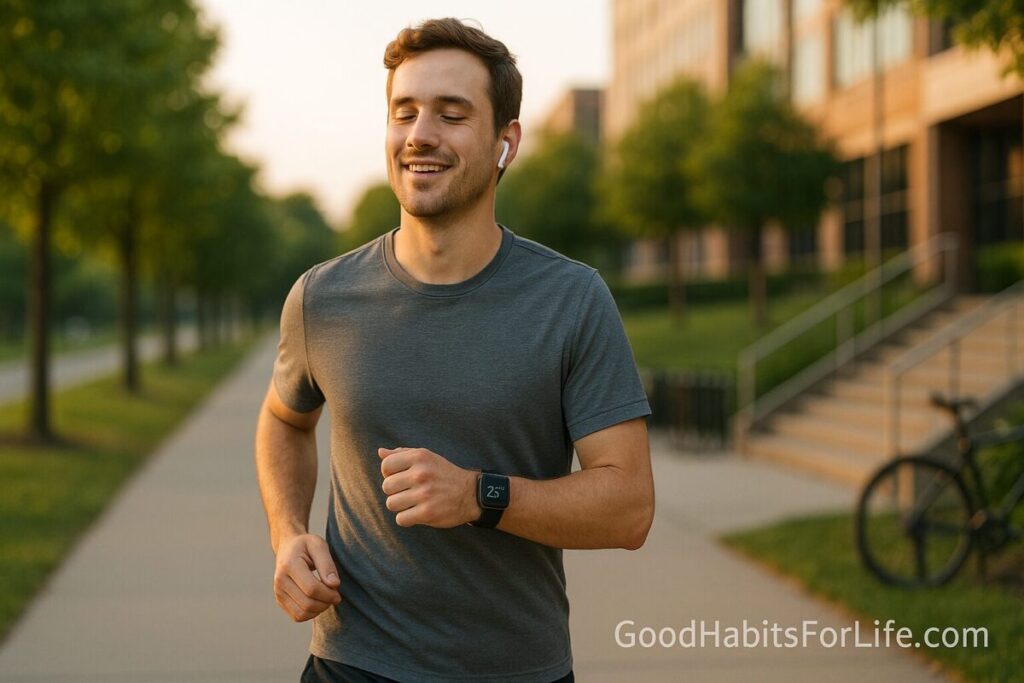
ADHD-Friendly Mindfulness: Movement First: Zone 2 + NEAT (2025)
ADHD-Friendly Mindfulness: Movement First (Zone 2 + NEAT)
Table of Contents
🧭 What “Movement-First Mindfulness” Means—and Why It Works
The idea: For many people with ADHD, starting with movement makes “mindfulness” doable. You gently elevate your heart rate with Zone 2 cardio (an easy, conversational pace), then ride that calmer, more alert state into a short mindfulness block. You maintain stability across the day with NEAT—non-exercise activity thermogenesis—the small, frequent movements that add up (walking between tasks, stairs, standing, fidgets).
Why it helps ADHD:
-
Aerobic movement can boost dopamine and norepinephrine signaling, improving attention and working memory.
-
Zone 2 (roughly 60–70% of max heart rate) is low stress: you can speak in full sentences; you feel warm but not wiped.
-
NEAT smooths energy spikes/dips without formal workouts.
-
Mindfulness after movement is easier: the body is settled, restless energy is off-loaded, and the brain’s “noise” is lower—ideal for brief, sensory-based practice.
Definitions in 20 seconds
-
Zone 2: Easy steady cardio where you can talk but not sing; ~60–70% HRmax.
-
NEAT: All daily movement that isn’t formal exercise—steps, standing, chores, pacing on calls.
-
ADHD-friendly mindfulness: Short, concrete, sensory-anchored attention (e.g., feel feet, count breaths), not long silent sits.
✅ Quick Start: Do This Today
Time needed: ~15–25 minutes. No equipment required.
-
Prime with movement (10–20 min):
-
Pick one: brisk walk, easy cycle, gentle jog, elliptical, marching in place.
-
Talk test: Can you chat in sentences? Perfect. Too breathless → slow down.
-
Optional: set HR target ≈ (220 − age) × 0.6–0.7.
-
-
Mindfulness (3–7 min):
Choose one:-
Feet-to-floor scan (standing or seated): feel pressure of heels, toes, arches; count 20 slow breaths.
-
Box breathing 4-4-4-4: inhale 4s, hold 4s, exhale 4s, hold 4s.
-
5-4-3-2-1 grounding: name 5 things you see, 4 feel, 3 hear, 2 smell, 1 taste.
-
-
NEAT add-on (2–10 min):
-
Put kettle on → do 200–400 steps.
-
Take stairs once today.
-
Pace on one phone call.
-
-
Capture the win:
-
Mark a ✅ on a wall calendar or app. Streaks > stats.
-
Safety note: If you have medical conditions, injuries, or you’re new to exercise, speak to a clinician before starting. Warm up for 2–3 minutes and stop if you feel unwell.
🛠️ 30-60-90 Day Habit Plan (with checkpoints)
Days 1–30: Foundation
-
Goal: 90–120 min total Zone 2/week; steps: 6–8k most days.
-
Structure: 4×/week (10–20 min Zone 2 → 3–5 min mindfulness).
-
NEAT anchors: after meals (5 min walk), after calls (2 min pace).
-
Mindfulness menu: feet-to-floor, box breathing, or 5-4-3-2-1.
-
Checkpoint (Day 30): 12+ sessions done? Average steps ≥6k? If yes, add time; if no, shrink to 8–12 min blocks and rebuild streak.
Days 31–60: Consistency
-
Goal: 150 min Zone 2/week (global guideline) and 7–9k steps/day average.
-
Structure: 5×/week movement-first blocks.
-
Extend mindfulness to 5–7 min after 2–3 sessions/week.
-
Add “micro-NEAT”: stand for emails, calf raises while brushing teeth, 10 squats after bathroom breaks.
-
Checkpoint (Day 60): Energy steadier? Fewer tabs open in your head? Keep what works; drop what doesn’t.
Days 61–90: Personalization
-
Option A: Keep Zone 2 steady; add one strength session (20–30 min) weekly.
-
Option B: Add one longer Zone 2 (30–45 min) on weekends.
-
Mindfulness variations: walking meditation, sound-only attention (rain, traffic), or “single-point” focus (sip of tea).
-
Checkpoint (Day 90): Which combo gives you the best focus in the first 2–3 hours after? Lock that in as your weekday routine.
🧠 Techniques & Frameworks That Pair Well With ADHD
Implementation intentions (If-Then):
-
If I brew my morning tea, then I walk 10 minutes and do 3 minutes of box breathing.
Temptation bundling:
-
Only listen to a favorite podcast during Zone 2 walks.
The 10-Minute Rule:
-
Tell yourself you only need 10 minutes. You can stop after—most days you won’t.
Time blindness helpers:
-
Use a visual timer or a watch with gentle vibration intervals (every 2–3 minutes).
Cue design:
-
Shoes by the door, headphones on the charger, playlist pre-queued. Reduce friction to near zero.
Reward loop:
-
After each session, score a 1-sentence win in Notes: “Did 12 min walk; calmer; inbox less scary.”
Environment:
-
Low-decision routes (same loop daily), minimal gear, weather-proof options (hallway laps, stairs).
Mindfulness micro-skills:
-
Name it to tame it: silently label “thinking,” “hearing,” “feeling warm.”
-
Single sensory anchor: e.g., feel breath at nostrils only.
-
Counted breaths: 1 to 10, start over when lost—no judgment.
🧩 Variations for Different Audiences
Students:
-
Between classes: 8–12 min campus loop → 3 min grounding before study.
-
Use library stairs; pace while quizzing flashcards.
Professionals/Remote workers:
-
Calendar holds: “MF block” 10:20–10:40 daily.
-
Walk on one meeting; post-meeting 3-minute breath reset before deep work.
Parents & Caregivers:
-
Stroller walks at conversational pace; mindfulness = “sound hunt” with kids.
-
Evening dish-wash → calf raises + 2 minutes of slow nasal breathing.
Seniors or lower fitness:
-
Choose flat routes; use rate of perceived exertion (RPE 3–4/10).
-
Seated marching for 8–10 min; mindfulness = hand-to-chair tactile focus.
Teens:
-
Music-assisted walks; mindfulness = 5-4-3-2-1 game.
-
Gamify steps with friends; streak charts on the fridge.
⚠️ Mistakes & Myths to Avoid
-
Myth: “Mindfulness = sitting perfectly still.”
Reality: Walking, standing, or even dish-washing attention counts. -
Mistake: Going too hard.
Zone 2 should be easy. If you can’t talk in sentences, back off. -
Myth: “If I miss a day, I blew it.”
Streaks survive misses. Resume tomorrow—same plan, smaller dose. -
Mistake: Only doing long weekend workouts.
For ADHD, frequency beats length. Short daily beats long occasional. -
Myth: “NEAT is pointless.”
Daily movement snacks add considerable energy burn and mood stability.
🗣️ Real-Life Examples & Copy-Paste Scripts
Morning (12 + 4):
-
“Shoes on → 12-min brisk walk around block. Back home → stand, feel feet, count 24 breaths.”
Between tasks (8 + 3):
-
“Finish email → 8-min hallway laps. Then 3 minutes of box breathing at my desk.”
Stress reset (10 + 5):
-
“Ruminating → 10-min Zone 2 cycle. Then 5-4-3-2-1 grounding on the balcony.”
NEAT stackers:
-
“Every bathroom break → 10 slow squats.”
-
“Microwave on → 300 steps in place.”
🧰 Tools, Apps & Resources (brief pros/cons)
-
Wearables (Apple Watch, Garmin, Polar, Fitbit): easy HR and reminders; costs money; don’t over-optimize numbers.
-
Timers (TimeTimer, Engross, Focus To-Do): visual cues reduce time blindness; simple beats fancy.
-
Mindfulness apps (Headspace, Calm, Insight Timer): have walking and short sessions; avoid long sits early on.
-
Step trackers (Pacer, Google Fit, Apple Health): keep NEAT visible; turn on stand reminders.
-
Habit trackers (Streaks, Habitica, Done): streak-friendly; set tiny daily minimums (e.g., “3 mindful breaths”).
📌 Key Takeaways
-
Move first, then mind: 10–20 min of easy Zone 2 unlocks 3–7 min of ADHD-friendly mindfulness.
-
NEAT is your steady baseline: small movements across the day smooth energy and focus.
-
Short + frequent wins: daily micro-sessions beat long, rare ones.
-
Make it automatic: cues, if-then plans, and friction-free routes keep it going.
-
Track feelings, not just numbers: note focus and mood after sessions to personalize your plan.
❓ FAQs
1) How do I find Zone 2 without a heart-rate monitor?
Use the talk test: you can speak in full sentences but wouldn’t want to sing. You feel warm, breathing a bit faster, but you’re not straining.
2) Can I replace mindfulness with more cardio?
Cardio helps, but brief attention training builds the skill of noticing and redirecting. Keep at least 3 minutes of mindfulness after movement.
3) I’m on ADHD medication—should I still do this?
Many people find movement-first complements medication. Follow your clinician’s advice; start gently and watch how timing interacts with your meds.
4) What if I only have 8 minutes?
Do 6 minutes Zone 2 + 2 minutes grounding. Consistency beats duration.
5) Is strength training okay instead of Zone 2?
Strength work is great but can be arousing. If focus dips afterward, keep a short easy walk (5–10 min) before mindfulness.
6) Desk job—NEAT ideas that aren’t awkward?
Stand for emails, take stairs once daily, 2-minute hallway laps after calls, calf raises while reading, water breaks every 60–90 minutes.
7) Morning or evening?
Use whichever gives you the best 1–3 hour focus window. Many people prefer morning to set tone for the day.
8) How many steps should I aim for?
A practical range is 7–9k most days; personalize by how you feel and what your schedule allows.
📚 References
-
NIMH. Attention-Deficit/Hyperactivity Disorder. https://www.nimh.nih.gov/health/topics/attention-deficit-hyperactivity-disorder-adhd
-
American College of Sports Medicine. ACSM Guidelines for Exercise Testing and Prescription. https://www.acsm.org
-
WHO. Guidelines on Physical Activity and Sedentary Behaviour (Adults). https://www.who.int/publications/i/item/9789240015128
-
Cerrillo-Urbina AJ, et al. The effects of physical exercise in children with ADHD: A meta-analysis. J Atten Disord. https://doi.org/10.1177/1087054714559642
-
Den Heijer AE, et al. Aerobic exercise for adult ADHD: A randomized controlled study. Med Sci Sports Exerc. https://doi.org/10.1249/MSS.0000000000000795
-
Zylowska L, et al. Mindfulness meditation training in adults and adolescents with ADHD: A feasibility study. J Atten Disord. https://doi.org/10.1177/1087054707308502
-
Cairncross M, Miller CJ. The effectiveness of mindfulness-based therapies for ADHD: A meta-analytic review. Clin Psychol Rev. https://doi.org/10.1016/j.cpr.2016.10.003
-
Levine JA. Non-exercise activity thermogenesis (NEAT). Nutr Rev. https://doi.org/10.1111/j.1753-4887.2004.tb00094.x
-
Harvard Health Publishing. Zone 2 training: Build endurance with easier effort. https://www.health.harvard.edu
-
U.S. CDC. Physical Activity Basics & The Talk Test. https://www.cdc.gov/physicalactivity/basics/index.htm
-
Britton E, et al. Walking, wellbeing and mental health: A systematic review. Scand J Med Sci Sports. https://doi.org/10.1111/sms.14152
-
American Psychological Association. Mindfulness: The research and benefits. https://www.apa.org/topics/mindfulness
⚖️ Disclaimer
This article is educational and is not a substitute for personalized medical or mental-health advice; consult a qualified professional for your situation.