
The One-Task Rule: Mindful Monotasking for Busy Days: Zone 2 + NEAT (2025)
One-Task Rule: Mindful Monotasking + Zone 2 & NEAT (2025)
Table of Contents
🧭 What Is the One-Task Rule (and Why It Works)
Definition. The One-Task Rule means you deliberately do one cognitively meaningful task at a time—no parallel inboxing, no micro-switching—until a clear checkpoint is reached. It is mindful because you bring attention back to the present task whenever you drift.
Why it works.
-
Task switching costs. Each context switch creates a cognitive “reconfiguration” penalty; across a day, this can waste a large chunk of effective time. Research shows measurable costs to switching and “attention residue” that lingers from the prior task and reduces performance on the next.
-
Attention residue. Even tiny peeks at email or chat leave part of your attention behind, lowering accuracy and depth on the main task.
-
Heavy multitaskers perform worse. In classic experiments, self-identified heavy multitaskers were more distractible and less able to filter irrelevant information.
Mindful monotasking reduces noise, raises completion rates, and pairs well with active recovery (light movement) to keep energy steady through the day.
✅ Quick Start: Do This Today
-
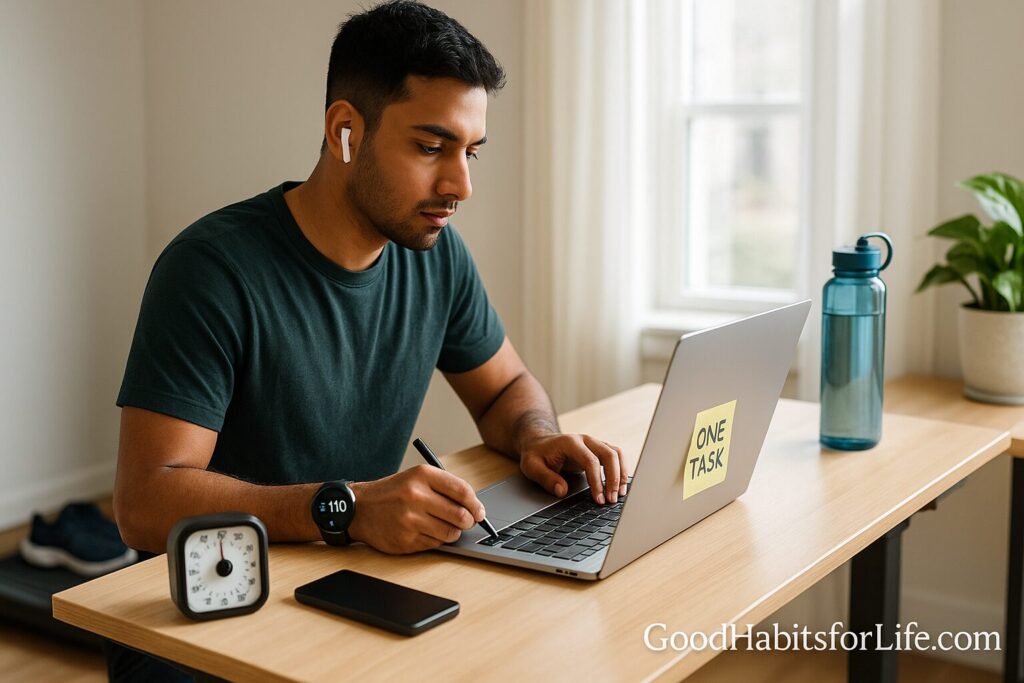
Pick one impact task for the next 50 minutes (or 25 if you’re warming up). Write it on a sticky: “Finish section 2 draft.”
-
Clear the runway. Silence notifications, close extra tabs, full-screen the work surface.
-
Start a visible timer (25–50 min). Work only on that task. When attention drifts, gently label it “wandering,” breathe once, and return.
-
Checkpoint & log. When the timer ends, mark a micro-win: “2 pages drafted.” Note the next step.
-
Active recovery (5–10 min). Walk, climb stairs, or do easy cycling—keep breathing through your nose and able to talk in full sentences (a Zone 2 cue).
-
Repeat for 2–4 blocks, then take a longer break (20–30 min).
-
Inbox windows. Batch messages 2–3 times/day—never mid-block.
🛠️ 30-60-90 Habit Plan
Days 1–30 — Install the routine
-
Daily anchor. 1–2 One-Task blocks right after your morning routine. Start with 25+5 (25 min focus + 5 min recovery) and one afternoon block.
-
NEAT baseline. Aim for 6,000–8,000 steps/day; stand on calls; walk for short chats.
-
Movement check. Add 2×/week Zone 2 (20–30 min easy jog, brisk walk, cycling).
-
Weekly review (15 min). What blocks produced the most progress? Where did switching creep in?
Days 31–60 — Build capacity
-
Raise focus blocks to 40–50 min (still 5–10 min recovery).
-
Scale Zone 2 to 30–45 min 2–3×/week; keep NEAT above baseline.
-
Create protected calendar blocks (shared with team/family).
Days 61–90 — Systematize
-
Standardize block recipes (e.g., “Research → Outline → Draft → Edit”).
-
Add deep work day (3–4 blocks) weekly.
-
Integrate automations (email filters, scheduled Do Not Disturb).
-
Keep NEAT high on busy weeks; use Zone 2 as low-stress cardio to stabilize energy.
🧠 Techniques & Frameworks That Amplify Monotasking
-
Attention label + breath. When you catch distraction: “Label it” → one slow exhale → return.
-
Single target metric (STM). Each block has one measurable output: “500 words,” “10 invoices,” “3 pages edited.”
-
Two-tab rule. Only your primary work tab and a scratchpad.
-
Hard edges. Blocks start/stop on the timer; recovery starts when the timer rings.
-
Timeboxing with overflow. If the task doesn’t finish, log the next step and put it in the next block—don’t spill over.
-
Context menus. Pre-create checklists for common block types (writing, analysis, study) to reduce warm-up time.
-
Mindful micro-pauses. 10-second eye/neck resets every 10–15 minutes to prevent strain without breaking focus.
-
Brief breaks improve vigilance. Tiny resets prevent vigilance decline in long tasks.
🫀 Zone 2 Cardio & 🚶 NEAT: The Movement Pairing
Zone 2 = easy aerobic work where you can talk comfortably; typically ~60–70% of max heart rate. It improves mitochondrial function and metabolic health without heavy fatigue, making it ideal between cognitively demanding work bouts.
NEAT (Non-Exercise Activity Thermogenesis) = all the movement you do outside formal exercise—standing, walking, housework. It can meaningfully raise daily energy expenditure and counteract long sitting.
How to pair them with monotasking
-
Use recovery windows for 5–10 min of NEAT: stair laps, office walk, light chores.
-
Schedule 2–3 Zone 2 sessions/week on days with heavy mental work to sustain energy without “exercise hangover.”
-
Keep Zone 2 truly easy: breathe through your nose, speak full sentences; if tracking, aim for the lower aerobic zone.
Public-health anchors. Adults benefit from 150–300 min/week of moderate activity plus strength work; NEAT helps you reach the total.
🧩 Audience Variations
Students
-
Use 25+5s for readings/problem sets; swap the phone for a basic timer.
-
Walk the corridor or campus loop in your 5–10 min recovery; schedule Zone 2 on non-lab days.
Professionals
-
Protect 2 morning focus blocks on the calendar.
-
Batch Slack/email post-block; use standing 1:1s for NEAT; 2× Zone 2 on meeting-heavy weeks.
Parents & Caregivers
-
Run micro-blocks (15–20 min) during nap times or while kids are occupied.
-
Stroller walks = NEAT; family bike rides for Zone 2.
Seniors
-
Favor longer, gentler blocks (35–40 min) with more frequent micro-pauses.
-
Choose joint-friendly Zone 2 (walking, recumbent bike); add light balance exercises during NEAT.
⚠️ Mistakes & Myths to Avoid
-
Myth: “I’m good at multitasking.” Even high performers pay switching costs.
-
Mistake: Treating breaks as optional. Skipping recovery tanks vigilance; brief breaks preserve output.
-
Myth: Zone 2 must hurt to work. It should feel easy-steady; if you can’t talk, you’re likely too high.
-
Mistake: Ignoring NEAT on busy days. It’s the easiest lever to maintain energy and counter sitting.
-
Mistake: Letting inboxes invade blocks. Create 2–3 daily inbox windows and enforce them.
🗣️ Real-Life Examples & Copy-Paste Scripts
Team status message (calendar/Slack)
“Focus block (no notifications) 10:00–10:50. I’ll check Slack/emails at 11:00.”
Home boundary
“I’m doing a 25-minute focus sprint. If it can wait, I’ll handle it at the break.”
Self-prompt to re-center
“Label: ‘wandering.’ One breath. Return to: outline subsection B.”
Walking recovery menu (choose one)
-
5-minute stair loop
-
8-minute outdoor lap (no phone)
-
10-minute easy spin on the bike
Weekly review notes
-
“Blocks completed: 7. Best window: 9–11am. Distraction: email pop-ups → turned off.”
📚 Tools, Apps & Resources
Focus & timers
-
Forest / Focus To-Do / Be Focused. Simple timers, session logs. Pros: frictionless. Cons: limited analytics.
-
RescueTime / Rize. Automatic time tracking. Pros: awareness. Cons: can nudge perfectionism.
-
Notion / Obsidian. Project checklists and block recipes. Pros: customizable. Cons: setup time.
Movement
-
Any pedometer or smartwatch. Track steps/NEAT. Pros: passive. Cons: can distract—turn off extra alerts.
-
Heart-rate monitor (Polar, Garmin). Helps keep Zone 2 easy. Pros: objective. Cons: not required for beginners.
Education
-
WHO / CDC physical-activity pages for evidence-based targets.
-
APA on multitasking to explain switching costs to teams.
📌 Key Takeaways
-
Do one meaningful task per block; define a measurable output before you start.
-
Protect hard edges: visible timer, no inbox during blocks, recovery on the bell.
-
Pair cognitive work with NEAT (every break) and Zone 2 (2–3×/week) to stabilize energy.
-
Run a 30-60-90 plan to install, build, and systematize.
-
Review weekly; remove friction; celebrate small, consistent wins.
❓ FAQs
How long should a monotask block be?
Start with 25 minutes if you’re new or distracted; move to 40–50 minutes once comfortable.
Is the One-Task Rule the same as Pomodoro?
They overlap. Pomodoro is a timer method; the One-Task Rule is a principle: one cognitive target only. You can use Pomodoro timers to enforce it.
How do I know I’m in Zone 2?
You can talk comfortably in full sentences and breathe mostly through your nose; heart rate is usually ~60–70% of max (varies by individual).
What are simple NEAT ideas for desk workers?
Standing calls, walking 5–10 minutes each hour, staircase breaks, light chores, parking farther, pacing while brainstorming.
Will breaks reduce my output on deadline days?
Counter-intuitively, brief breaks help maintain vigilance and accuracy over long sessions.
How many Zone 2 sessions do I need?
For general health, aim for public-health totals (150–300 min/week moderate activity). Zone 2 can cover a portion of this.
Can I do strength training instead of Zone 2?
Strength is great and recommended weekly, but aerobic work (like Zone 2) adds separate heart-metabolic benefits. Blend both.
What if my job requires constant messaging?
Create shorter blocks (15–25 min), set shared availability windows, and use status messages so colleagues know when you’ll respond.
Does mindfulness matter here?
Yes. Simple mindful noticing (“wandering → return”) reduces rumination and switching; mindfulness practices have evidence for stress and attention benefits.
📚 References
-
American Psychological Association. “Multitasking: Switching Costs.” https://www.apa.org/research/action/multitask.
-
Leroy, S. (2009). “Why is it so hard to do my work? The challenge of attention residue…” Organizational Behavior and Human Decision Processes, 109(2), 168–181. https://doi.org/10.1016/j.obhdp.2008.09.002
-
Ophir, E., Nass, C., & Wagner, A. (2009). “Cognitive Control in Media Multitaskers.” PNAS, 106(37), 15583–15587. https://doi.org/10.1073/pnas.0903620106
-
Lleras, A., et al. (2011). “Brief and rare mental ‘breaks’ keep you focused.” Cognition, 118(3), 439–443. https://doi.org/10.1016/j.cognition.2010.12.007
-
World Health Organization. “Physical Activity.” https://www.who.int/news-room/fact-sheets/detail/physical-activity
-
CDC. “How much physical activity do adults need?” https://www.cdc.gov/physicalactivity/basics/adults/index.htm
-
Cleveland Clinic. “Zone 2 Cardio: What It Is and Why It Matters.” https://health.clevelandclinic.org/zone-2-cardio
-
Seiler, S. (2010). “What is best practice for training intensity and duration distribution in endurance athletes?” Scand J Med Sci Sports, 20, 49–61. https://doi.org/10.1111/j.1600-0838.2010.01140.x
-
Levine, J. A. (2008). “Non-exercise activity thermogenesis (NEAT).” Endocrinology and Metabolism Clinics of North America, 37(3), 753–765. https://doi.org/10.1016/j.ecl.2008.06.005
-
NCCIH (NIH). “Mindfulness: What You Need To Know.” https://www.nccih.nih.gov/health/mindfulness
⚖️ Disclaimer
This article provides general educational information on productivity, movement, and health habits and is not a substitute for personalized medical or mental-health advice. If you have health conditions, consult a qualified professional before changing your activity routine.