
Morning Presence: 7-7-7 Breath to Begin Your Day: Zone 2 + NEAT (2025)
7-7-7 Breath Morning Routine: Zone 2 & NEAT (2025)
Table of Contents
🧭 What Is the “7-7-7 + Zone 2 + NEAT” Morning?
Morning Presence means opening the day with a short, structured routine that steadies attention and energy.
-
7-7-7 Breathing: inhale for a 7-count, hold for 7, exhale for 7—repeat calmly for 3–5 minutes. It’s a type of paced breathing that lengthens exhalation and promotes parasympathetic (calming) activity and heart-rate variability (HRV).
-
Zone 2 Cardio: light-to-moderate aerobic movement at about 60–70% of your max heart rate (or simply, you can talk in full sentences). This intensity builds endurance and metabolic health without leaving you wiped out.
-
NEAT (Non-Exercise Activity Thermogenesis): all the non-gym movements—standing, walking to the market, stairs—that significantly raise daily energy expenditure and counter long sitting.
Why this combo works
-
Paced breathing ↓ stress reactivity and primes focus.
-
Zone 2 provides mitochondria-friendly, sustainable cardio that boosts mood and energy.
-
NEAT keeps metabolism “idling higher” all day and reduces sedentary risks.
✅ Quick Start: Do This Today (10–25 minutes)
1) Set the scene (1 minute)
-
Open a window or step into daylight if possible.
-
Cue: after your alarm or while the kettle heats.
2) 7-7-7 Breath (3–5 minutes)
-
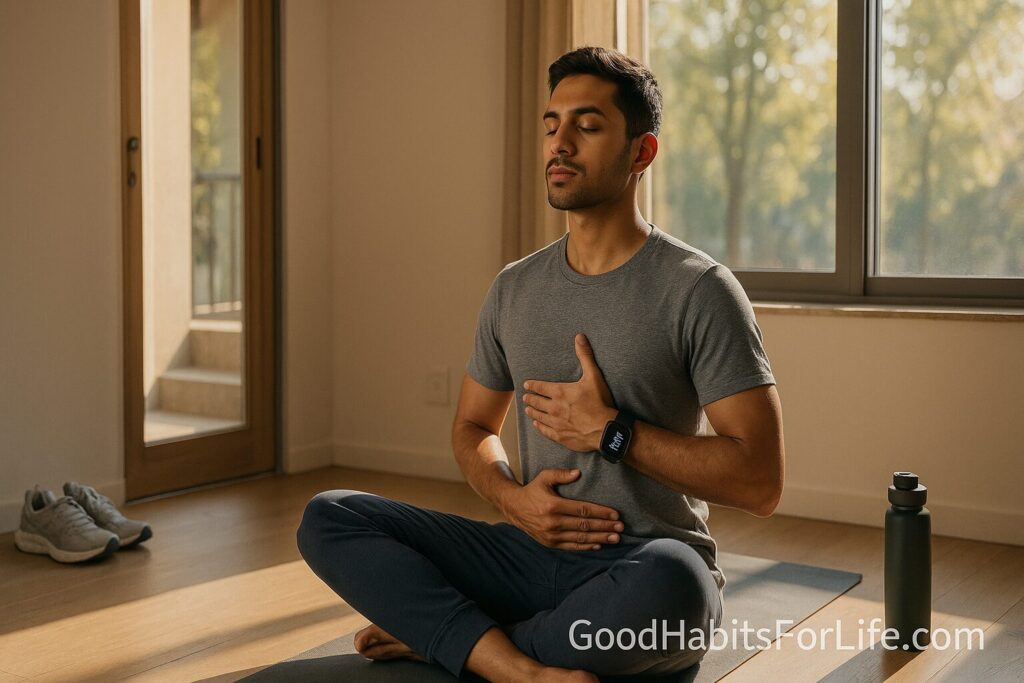
Sit tall; one hand on chest, one on belly.
-
Inhale 7 (quiet nose), hold 7, exhale 7 (soft nose or pursed lips).
-
Do 8–10 cycles. If dizzy, shorten to 5-5-5.
3) Zone 2 (10–20 minutes)
-
Options: brisk walk, easy cycling, light jog, low-impact steps.
-
Talk test: you could chat comfortably, not sing.
-
No tracker? Use RPE 4–6/10—comfortable but purposeful.
4) NEAT micro-moves (sprinkled through the morning)
-
5 × 1-minute movement breaks before lunch (stairs, hallway laps, calf raises, hip openers).
-
Aim 1,500–3,000 steps before noon if you track steps.
5) Track two numbers
-
Zone 2 minutes + steps (or stand breaks). Write them on a sticky note or in your phone.
🛠️ Techniques & Frameworks
🌬️ 7-7-7 Breath: How to Make It Safe & Effective
-
Counts, not seconds. Go by calm counting, not strict seconds; slow down gradually.
-
If 7-7-7 feels too long: try 5-5-5, 4-7-8, or 6-6 (inhale/exhale) and progress weekly.
-
Anchors: soft gaze, feel belly expand, exhale like fogging a mirror.
-
Stop if light-headed. Return to normal breathing and shorten counts next round.
🚶 Zone 2: Find Your “Easy-Enduring” Pace
-
Heart-rate guide: ~60–70% HRmax (HRmax ≈ 220 − age).
-
Talk test: full sentences without gasping.
-
Progression: start at 10–15 min, add 2–3 min every few days.
🔁 NEAT: Make Your Environment Do the Work
-
Default stairs, park one block away, stand for phone calls, water-break walks.
-
Micro-routines: 60-second mobility at the top of each hour in the morning.
-
Targets: 6,000–8,000 steps baseline (or 6–10 stand breaks if you don’t track steps).
🧩 Habit Stacking & Friction Design
-
Stack after a fixed cue: alarm → bathroom → breath → shoes → walk.
-
Lay out shoes/headphones at night.
-
Two-minute rule: if you resist, do 2 minutes only—momentum usually carries you.
📅 7-Day Starter Plan
| Day | 7-7-7 Breath | Zone 2 | NEAT Focus |
|---|---|---|---|
| Mon | 4 min (5-5-5 if new) | 12 min brisk walk | Take stairs all morning |
| Tue | 5 min | 15 min walk/cycle | Stand up every 45 min × 4 |
| Wed | 5 min | 15–18 min | 1 extra errand on foot |
| Thu | 4–5 min | 18 min | 3 × 1-min mobility snacks |
| Fri | 5 min | 20 min | Park farther + hallway laps |
| Sat | 5–6 min | 20 min (nature if possible) | Light chores after breakfast |
| Sun | 3–4 min (deload) | Optional 10–15 min | Stretching and easy stroll |
Checkpoint: by Day 7 you should feel calmer on waking, and the Zone 2 part should feel more automatic.
📈 30-60-90 Day Roadmap
-
Days 1–30: Lock the cue. Breath 4–6 min, Zone 2 15–20 min, 6–8 NEAT breaks by lunch.
-
Days 31–60: Breath 6–8 min, Zone 2 20–30 min 3–5×/wk, NEAT baseline 7,500–9,000 steps.
-
Days 61–90: Keep breath 5–8 min; add one longer Zone 2 (35–45 min) weekly; NEAT 9,000–11,000 steps or 10+ stand breaks.
👥 Audience Variations
-
Students/Teens: make Zone 2 a campus loop; NEAT = walk to class, carry a water bottle to trigger stand breaks.
-
Professionals: do breath while coffee brews; Zone 2 = commute walk; NEAT = “walk-and-talk” calls + printer-farther-away trick.
-
Parents: stroller walk; NEAT = tidy-burst (2 minutes per room).
-
Seniors: prioritize joint-friendly Zone 2 (flat walks, recumbent bike). Use handrail for stairs; talk to your clinician about intensity.
-
Beginners/De-conditioned: start 5-5-5 breathing; Zone 2 8–12 min; NEAT = stand every 30–45 min.
⚠️ Mistakes & Myths to Avoid
-
Myth: “If it’s not sweaty, it doesn’t count.” → Zone 2 works because it’s easy to repeat daily.
-
Mistake: Forcing 7-second holds when breath feels strained. → Shorten counts; comfort first.
-
Myth: “NEAT is just steps.” → It’s any light movement: standing, chores, stretches.
-
Mistake: Doing Zone 2 too hard (creeping into breathless Zone 3). → Use the talk test.
-
Myth: “Morning routines must be 60 minutes.” → 10–25 minutes is enough to change the tone of your day.
💬 Real-Life Scripts & Examples
-
Breath self-talk: “In for seven… soft pause… out slow.”
-
Commute stack: “After I lock the door, I start my 15-minute easy walk.”
-
Office NEAT: “Every time I send a message, I stand for one minute.”
-
Home cue: “Kettle on → 4 minutes breathing by the window.”
-
If motivation dips: “Just 2 minutes. If it still feels hard, I stop—no guilt.”
🧰 Tools, Apps & Resources
-
Breath timers: Oak, Insight Timer, Breathwrk (free timers, haptics).
-
Cardio trackers (optional): Apple Health/Watch, Google Fit, Garmin, Polar—display heart rate or Zone 2 estimates.
-
Step/NEAT helpers: Pedometer++ (iOS), Pacer (Android/iOS); simple stand-reminder apps or smartwatch nudges.
-
Environment aids: doorway stretch bands, under-desk stepper, a kettlebell near the kitchen (for 10 light swings—only if trained).
Pros: feedback builds momentum; Cons: gadgets can distract—don’t let tracking replace the habit.
🔑 Key Takeaways
-
A short breath → easy cardio → micro-moves structure is sustainable and powerful.
-
Use counts you can do calmly; progress gradually.
-
Keep Zone 2 comfortably conversational.
-
Let environmental defaults create automatic NEAT.
-
Track two simple metrics each morning: minutes of Zone 2 + steps/stand breaks.
❓ FAQs
1) What if 7-7-7 feels too hard?
Drop to 5-5-5 or 6-6 (inhale/exhale only). Build up weekly.
2) How do I know I’m in Zone 2 without a watch?
You can talk in full sentences. Breathing is faster but controlled.
3) Is morning the best time?
Morning gives a clean cue and momentum. If life happens, do it later—consistency beats timing.
4) How much Zone 2 is “enough”?
Start with 10–20 min daily. Across the week, aim for the public-health guideline of 150–300 min moderate activity.
5) Can I swap the cardio?
Yes: brisk walk, easy bike, elliptical, light jog. Keep it comfortable.
6) Will NEAT really make a difference?
Yes—light movement all day meaningfully boosts energy expenditure and reduces sedentary time.
7) Can I combine this with strength training?
Absolutely. Keep this morning protocol light; add 2–3 strength sessions/week later in the day.
8) Is breath-holding safe?
For most healthy adults, gentle breath holds are safe. If you feel dizzy, stop and shorten counts. If you have respiratory/cardiac issues, consult your clinician first.
9) How long before I feel results?
Many notice calmer mornings within 1 week and better stamina in 3–4 weeks.
10) Do I need supplements?
No. The power here is behavior + consistency.
📚 References
-
World Health Organization. Guidelines on physical activity and sedentary behaviour (2020). https://www.who.int/publications-detail-redirect/9789240015128
-
American Heart Association. Target Heart Rates (moderate intensity ranges; talk test). https://www.heart.org/en/healthy-living/fitness/fitness-basics/target-heart-rates
-
U.S. CDC. How much physical activity do adults need? https://www.cdc.gov/physicalactivity/basics/adults/index.htm
-
NCCIH (NIH). Relaxation Techniques: What You Need To Know (breath focus, benefits). https://www.nccih.nih.gov/health/relaxation-techniques-what-you-need-to-know
-
Cleveland Clinic. Resonance (Paced) Breathing: What It Is & How It Helps. https://health.clevelandclinic.org/what-is-resonance-breathing
-
Mayo Clinic. What are the risks of sitting and how can I move more? (NEAT concepts). https://www.mayoclinic.org/healthy-lifestyle/adult-health/expert-answers/sitting/faq-20058005
-
Levine, J.A. Non-exercise activity thermogenesis (NEAT). Best Pract Res Clin Endocrinol Metab. 2002;16(4):679–702. https://pubmed.ncbi.nlm.nih.gov/12468415/
-
Laborde, S. et al. The Effects of Slow Breathing on Stress, HRV, and Health. Frontiers in Human Neuroscience. 2017. https://www.frontiersin.org/articles/10.3389/fnhum.2017.00414/full
Disclaimer
This article provides general information on breathing and physical activity. If you have medical, cardiac, or respiratory conditions, consult a qualified professional before changing your routine.