
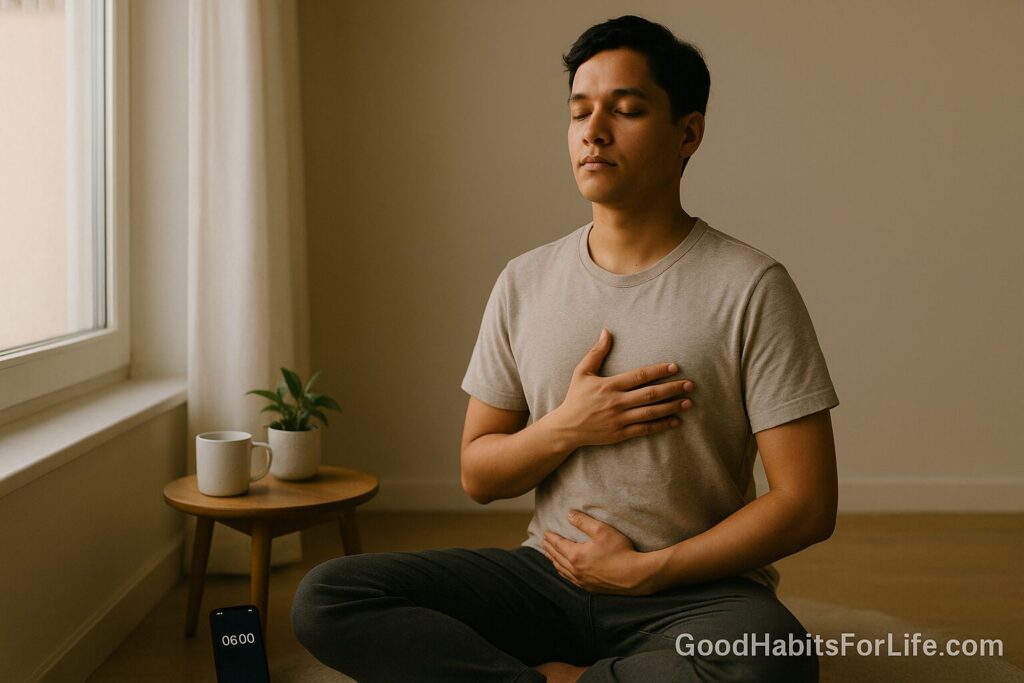
Mindfulness in 5 Minutes: A 2025 Starter Routine
Mindfulness in 5 Minutes: A 2025 Starter Routine
Table of Contents
🧭 What & Why
Mindfulness is paying attention to the present moment—on purpose and without judgment. In practice, that means gently noticing sensations, thoughts, and feelings, then returning to a chosen anchor (often the breath).
You don’t need long sessions to begin. Short, regular practice builds the skill of returning. Research reviews link mindfulness-based programs with reduced anxiety, depression, and stress, and improved attention and self-regulation. Brain-imaging studies also suggest structural and functional changes after training. See References for high-quality sources (NCCIH, APA, Harvard Health/JAMA, NHS, PNAS, and peer-reviewed studies).
Why five minutes works
-
Low friction → easier to keep daily.
-
Reps over time → stronger “notice and return” muscle.
-
Fits into micro-gaps (after coffee, before meetings, bedtime).
✅ Quick Start: Do This Today (5 Minutes)
Setup (30–60 sec)
-
Sit or stand comfortably; spine tall, shoulders soft.
-
Set a 5-minute timer.
-
Choose an anchor: breath (nostrils/chest), body (hands/feet), or ambient sound.
Practice (3.5–4 min)
-
Notice the anchor for 5–10 breaths.
-
When the mind wanders (it will), label it softly—“thinking,” “planning,” “worrying.”
-
Return to the anchor with one calmer breath.
-
Repeat. Aim for a kind tone, not control.
Close (30 sec)
-
Ask: How do I feel now—body, mood, energy?
-
Choose a one-line intention for the next activity: “I’ll bring this steadiness into my inbox.”
Tiny script
“Here and breathing. Noticing in, noticing out. When distracted, name it, smile, return.”
🗓️ Habit Plan: Your Simple 7-Day Starter
Goal: 5 minutes/day; same time, same place.
Habit stack: After I brush my teeth at night, I’ll sit for 5 minutes.
| Day | Focus | Prompt | Checkpoint |
|---|---|---|---|
| 1 | Breath | “Feel air at the nostrils.” | Did I return kindly 5+ times? |
| 2 | Body | “Scan hands → feet.” | Where was tension highest? |
| 3 | Sound | “Let sounds come and go.” | Did I label distractions? |
| 4 | Mix | 2 min breath, 2 min body, 1 min sound | Which anchor felt easiest? |
| 5 | Emotions | “Name: pleasant/neutral/unpleasant, return.” | Did naming soften reactivity? |
| 6 | Thoughts | “Thinking… returning.” | How fast did I notice? |
| 7 | Choice | Pick favorite anchor | Plan next week: same slot? |
Progress metric: Track show-ups per week (not minutes). Aim for 5/7 to “win” Week 1.
Level-up (Weeks 2–4): Add a second 1-minute micro-sit before your first meeting/class.
🧠 Techniques & Frameworks (Pick 1–2)
Breath Counting (1–10)
-
Inhale “one,” exhale “two”… up to “ten,” then restart.
-
If you lose count, smile, begin at “one.” Builds sustained attention.
3-Minute Breathing Space (from MBCT)
-
Awareness (1 min): What’s present—thoughts, feelings, body?
-
Gather (1 min): Narrow attention to breath at the belly.
-
Expand (1 min): Open to full-body sensations; carry awareness into action.
Body Scan (micro version)
-
Move attention through jaw → shoulders → hands → belly → feet.
-
At each point: feel → soften → return to breath.
“Noting”
-
Silently tag experiences: “hearing,” “pressure,” “planning,” “worrying.”
-
One word, then back to the anchor. Reduces stickiness.
RAIN (for tricky moments)
-
Recognize what’s happening.
-
Allow it to be there.
-
Investigate kindly (where do I feel it?).
-
Nurture (supportive phrase, hand on heart). Close by returning to breath.
👥 Variations by Audience
Students
-
Do a 5-minute pre-study primer: 10 breaths + 2-minute body scan.
-
During exams, use 3 breaths before each question to reset.
Professionals
-
Calendar a daily 5-minute “buffer” before your first meeting.
-
Try walking mindfulness between rooms: feel each footfall for 20–30 steps.
Parents & Caregivers
-
Practice during children’s screen-time or naps.
-
Use shared breaths: 3 slow breaths together before meals or bedtime stories.
Seniors
-
Chair-based practice; prioritize gentle body scan and sound as anchors.
-
Short loving-kindness phrases can lift mood: “May I be well; may others be well.”
Teens
-
Use music fade-in: notice the first 60–90 seconds of a calm track without judging; then breathe.
-
Keep it phone-timer simple; streak tracking helps motivation.
⚠️ Mistakes & Myths to Avoid
-
Myth: “Mindfulness means no thoughts.”
Reality: Minds think. The practice is noticing and returning. -
Mistake: Forcing relaxation.
Fix: Aim for awareness, not a specific feeling. -
Mistake: Inconsistent schedule.
Fix: Pair to a stable cue (tooth-brushing, kettle boil, commute). -
Myth: You must sit cross-legged.
Reality: Any safe, alert posture works—chair, standing, or walking. -
Mistake: Judging your session (“I did it wrong”).
Fix: Count returns as reps. Each return is success.
💬 Examples & Copy-Paste Scripts
Morning (desk) — 5 minutes
“Feet on floor. Inhale 4, exhale 6. Label ‘planning’ when it appears, return. Closing note: ‘Do first task with one calm breath.’”
Commute (walking) — 3 minutes
“Feel heel → toe. Notice sights as colors and shapes. If stories arise, name ‘thinking,’ feel the next step.”
Stress spike — 90 seconds
“Recognize: tight chest. Allow: ‘This is here.’ Investigate: warmth/pressure. Nurture: ‘I’ve handled things before.’ One slow exhale.”
Bedtime — 5 minutes
“Scan jaw → shoulders → belly → feet. If restlessness shows up, label ‘restless,’ soften belly, return to breath.”
🧰 Tools, Apps & Resources (quick takes)
-
UCLA Mindful (free audios & app): clear, research-aligned basics; no fluff.
-
Insight Timer (free tier): huge library; filter by duration/teacher.
-
Headspace / Calm (paid): structured courses; good for streaks and onboarding.
-
Plain timer: your phone’s 5-minute timer prevents over-engineering.
-
Notebook: jot a one-line post-sit note (“3 returns; softer shoulders”).
Pros/cons: Apps can help early consistency, but keep the practice light—no app required. See UCLA resource in References.
📌 Key Takeaways
-
Start today with just 5 minutes; anchor, notice, return.
-
Track show-ups; aim for 5 days a week.
-
Use scripts and habit stacks to make it automatic.
-
Evidence supports benefits for stress and attention; effects build with practice.
-
Keep a kind tone—perfection isn’t the goal; returning is.
❓ FAQs
1) Is five minutes really enough?
Yes—for building the habit. Short daily reps lay the foundation; extend later if you like.
2) What if I can’t stop thinking?
You’re doing it right. Label the thought (“planning”), then return to your anchor. The return is the rep.
3) Should I use music or silence?
Either. If music, pick something calm without lyrics and use it as a sound anchor.
4) When will I notice benefits?
Some people feel calmer within days; research on structured programs often measures changes over 8 weeks. Consistency matters more than session length.
5) Is mindfulness the same as meditation?
Mindfulness is a quality of awareness; meditation is a formal practice to train it. You can be mindful while washing dishes or walking.
6) Can mindfulness help with sleep?
It can reduce cognitive arousal (racing thoughts) for many people. Try a 5-minute body scan at bedtime. If insomnia persists, consult a clinician.
7) I have anxiety—can I still practice?
Yes, but go gently. If distress increases, shorten sessions, use open eyes, or shift to sound/feet anchors. Seek professional support as needed.
8) What posture is best?
Any safe, upright posture that you can maintain comfortably: chair, standing, or slow walking.
9) Do I need an app?
No. Apps can help structure, but a timer and simple script are enough.
10) How do I scale beyond five minutes?
Add 1–2 minutes each week, or insert a second micro-sit before a regular daily activity.
📚 References
-
NCCIH — 8 Things to Know About Meditation and Mindfulness. https://www.nccih.nih.gov/health/tips/8-things-to-know-about-meditation-and-mindfulness.
-
NCCIH — Meditation and Mindfulness: Effectiveness and Safety. https://www.nccih.nih.gov/health/meditation-and-mindfulness-effectiveness-and-safety.
-
APA — Mindfulness Meditation. https://www.apa.org/topics/mindfulness/meditation.
-
Harvard Health Publishing — Mindfulness meditation may ease anxiety, mental stress (summary of JAMA review). https://www.health.harvard.edu/blog/mindfulness-meditation-may-ease-anxiety-mental-stress-201401086967.
-
JAMA Internal Medicine — Goyal, M. et al. (2014). Meditation programs for psychological stress and well-being: A systematic review and meta-analysis. https://jamanetwork.com/journals/jamainternalmedicine/fullarticle/1809754 (PubMed: https://pubmed.ncbi.nlm.nih.gov/24395196/).
-
PNAS — Tang, Y.-Y. et al. (2007). Short-term meditation training improves attention and self-regulation. https://www.pnas.org/doi/10.1073/pnas.0707678104 (PubMed: https://pubmed.ncbi.nlm.nih.gov/17940025/).
-
Psychiatry Research: Neuroimaging — Hölzel, B. K. et al. (2011). Mindfulness practice leads to increases in regional brain gray matter density. Open-access summary: https://pmc.ncbi.nlm.nih.gov/articles/PMC3004979/.
-
NHS — Mindfulness. https://www.nhs.uk/mental-health/self-help/tips-and-support/mindfulness/.
-
UCLA Health — Mindful — Guided Meditations (free audio library & app). https://www.uclahealth.org/uclamindful/guided-meditations.
Disclaimer: This article is educational and not a substitute for professional medical or mental-health advice.