
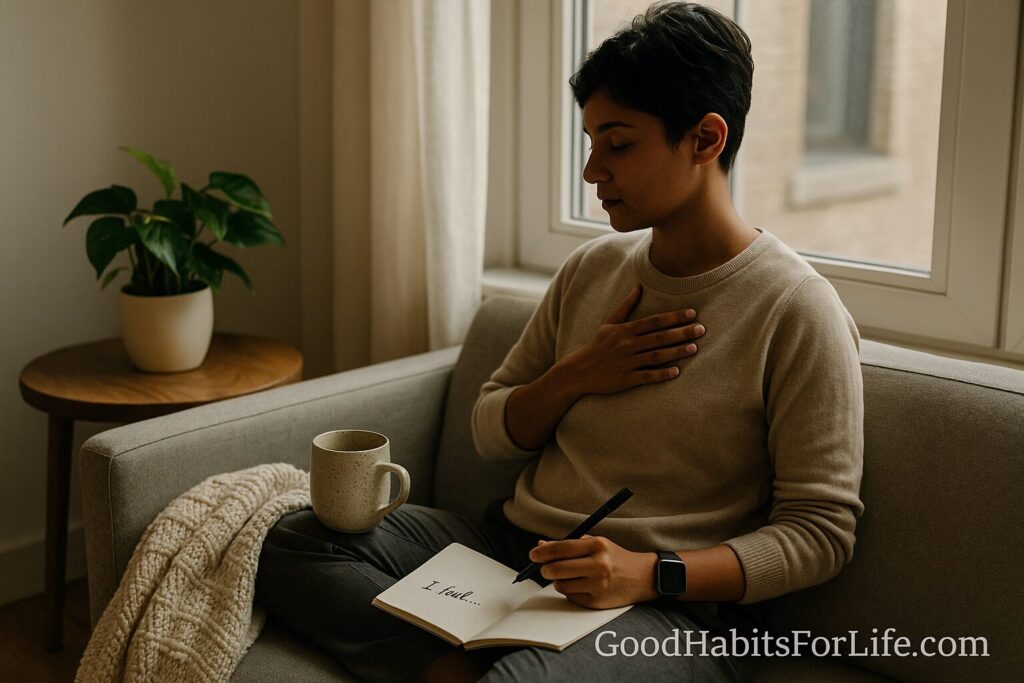
90Second Stress Reset: Ground Breathe Name
90-Second Stress Reset: Ground, Breathe, Name
Table of Contents
🧠 What Is the 90-Second Stress Reset & Why It Works
The 90-Second Stress Reset is a quick routine you can use anywhere to lower stress fast. It has three parts:
-
Ground your senses (the 5-4-3-2-1 method) to anchor attention in the present.
-
Breathe slowly (about 6–8 breaths per minute) to activate the parasympathetic nervous system and improve heart-rate variability (HRV).
-
Name the emotion (affect labeling) to help the brain regulate it.
Why it works (in brief):
-
Slow, paced breathing (around 0.1 Hz ≈ 6 breaths/min) can increase HRV and shift your autonomic state toward calm.
-
Grounding counters spirals of worry by orienting your attention to concrete, sensory details.
-
Labeling emotions (“I feel anxious and tense”) is shown to dampen amygdala activity and strengthen prefrontal control.
A widely shared idea suggests that emotion surges in the body can pass in roughly ~90 seconds if we don’t keep re-triggering them; treating those 90 seconds skillfully (with grounding, breathing, and labeling) makes a noticeable difference.
✅ The 90-Second Protocol (Do This Now)
Before you start: silently rate your stress 0–10. You’ll rate it again after.
0–25 seconds — GROUND (5-4-3-2-1)
-
5 things you can see
-
4 things you can feel (chair, feet, clothing, air)
-
3 things you can hear
-
2 things you can smell (or like the smell of)
-
1 thing you can taste (or a slow sip of water)
25–70 seconds — BREATHE (Paced breathing)
-
Inhale 4 seconds → pause 1 → exhale 6 seconds.
-
Aim for 5–6 cycles (that’s ≈ 45 seconds).
-
If you prefer symmetry, use box breathing (4-4-4-4) for 4–5 boxes.
70–90 seconds — NAME (Affect labeling)
-
Silently name your emotion in a few words:
-
“This is anxiety + tight chest.”
-
“I feel irritated and rushed.”
-
-
Add a need statement if helpful:
-
“I need one clear next step.”
-
“I need a 5-minute pause before replying.”
-
Now re-rate stress (0–10). If you didn’t get at least a 2-point drop, repeat one more cycle or extend breathing to 2–3 minutes.
🗺️ 7-Day Starter Plan (and 30-60-90 Habit Roadmap)
7-Day Starter (micro-commitment: 2 minutes/day)
-
Day 1–2: Practice the full sequence twice daily (morning & mid-afternoon). Log start/end stress scores.
-
Day 3–4: Add a cue (calendar ping or sticky note on monitor). Practice once on cue, once “in the wild” during real stress.
-
Day 5: Introduce box breathing as an alternative (pick the one you prefer).
-
Day 6: Add label + next action (“I feel overwhelmed → list top 3 tasks”).
-
Day 7: Review your log. Identify best time and biggest blocker. Decide your default pattern.
30-60-90 Roadmap
-
Day 30: Use the reset 3x/day on workdays (AM, pre-lunch, late PM). Track weekly averages of stress reduction.
-
Day 60: Layer in context rules (e.g., always before opening email, after difficult calls, during family transitions).
-
Day 90: Pair with brief reflection (What triggered it? What helped? What will I do next?). Consider adding HRV-friendly breathwork (5–10 min) 3–4 days/week.
Success metric: average drop of ≥2 points and fewer reactivity spikes (fewer “regret moments”).
🛠️ Techniques & Frameworks You Can Plug In
Grounding Options (swap into the “G” step)
-
Classic 5-4-3-2-1 (above)
-
Temperature reset: cool water on wrists/face or hold a chilled bottle for 5–10 seconds.
-
Contact anchor: press feet into the floor and name the sensations.
-
Orientation: turn your head slowly and identify 3 safe objects in the room.
Breathing Options (for the “B” step)
-
4-1-6 (4 in, 1 hold, 6 out) — gentle, lengthens exhale.
-
Box 4-4-4-4 — easy to count anywhere.
-
4-7-8 — stronger downshift; use 1–2 cycles within 90 seconds, or extend to 2–3 minutes when you have time.
-
Coherent breathing (≈6 breaths/min) — aim for ~5-6 sec inhale, 5-6 sec exhale.
Labeling Options (for the “N” step)
-
Simple affect labels: “sad,” “worried,” “angry,” “tense,” “tired.”
-
Two-word formula: Feeling + Body cue (“anxious + knotty stomach”).
-
Need tag: add what would help (“need clarity,” “need pause,” “need support”).
Combine It With RAIN (for tougher moments)
-
Recognize the emotion → Allow it → briefly Investigate (where in body?) → Nurture (say something kind to yourself).
Use RAIN if you need a gentler, more compassionate reset after the 90 seconds.
🧑🎓 Variations for Different Audiences
-
Students: Use before exams or presentations. Replace “need” with a micro-plan (“I need to scan section headings, then start Q1.”).
-
Professionals: Do one cycle before opening email, before high-stakes calls, and after meetings to prevent stress carry-over.
-
Parents/Caregivers: Use a silent version during child meltdowns. Teach kids a “5 senses scavenger hunt” and “smell the flower, blow the candle” breathing.
-
Seniors: Prioritize slower pacing and seated stability; avoid long breath holds if you have respiratory issues—use 4-6 or 5-5.
-
Teens: Pair with music cue (one chorus = breathe) and short next-action scripts (“Text teacher: need 24h extension.”).
⚠️ Mistakes & Myths to Avoid
-
Myth: “If it doesn’t work instantly, it’s useless.”
Reality: Skill improves with practice; give it 2–3 cycles or extend breathing to 3 minutes. -
Mistake: Forcing huge inhales/holds (can cause dizziness). Keep it comfortable; prioritize longer, easy exhales.
-
Mistake: Skipping the labeling step. Naming emotions is what helps the thinking brain re-engage.
-
Myth: “Breathing is woo.”
Reality: There’s solid evidence for slow-breathing effects on HRV and stress regulation. -
Mistake: Only using it in crises. The reset works best when you also practice it when calm.
💬 Real-Life Scripts (Copy/Paste)
At your desk (pre-meeting):
See 5 objects… feel 4 contact points… hear 3 sounds…
In 4, pause 1, out 6 (x5)…
“I feel nervous and tight. I need one clear goal for this meeting.”
During conflict:
Ground → Breathe →
“I’m frustrated and defensive. I need a 5-minute cool-off, then we’ll talk specifics.”
On the bus/queue:
Ground discreetly (eyes): count 5 colors, 4 shapes, 3 textures…
Box breathing 4-4-4-4 (x4)…
“I’m restless. I need to queue a podcast & focus on one task when I arrive.”
Helping a child:
“Let’s play 5-4-3-2-1: tell me 5 things you see… Now smell the flower (inhale), blow the candle (exhale). What are you feeling?”
📚 Tools & Resources
-
Breathwrk / iBreathe / Others: Guided timers for coherent or box breathing. Pros: easy pacing. Cons: phones can distract—use Do Not Disturb.
-
Insight Timer / Calm / Headspace: Short grounding + labeling meditations. Pros: variety. Cons: paid tiers for some content.
-
Analog aids: sticky notes (“Ground → Breathe → Name”), a smooth stone as a pocket anchor, or a wrist vibration reminder.
📌 Key Takeaways
-
A 90-second loop is enough to shift state: Ground → Breathe → Name.
-
Slow, comfortable breathing (longer exhale) is the engine of calm.
-
Naming emotions recruits the thinking brain and reduces overwhelm.
-
Practice when calm so it’s automatic when stressed.
-
Track a simple metric: ≥2-point stress drop per cycle.
❓ FAQs
1) Will this help during a panic attack?
It can help many people, especially the grounding + slow exhale parts. If symptoms are severe, extend breathing to 3–5 minutes and seek professional support.
2) How many times per day should I do it?
Start with 2–3 cycles/day; add extra rounds before triggers (email, meetings, school pickups).
3) Is 4-7-8 breathing safe?
Generally safe for healthy adults, but if long breath holds feel uncomfortable, switch to 4-1-6 or 5-5 without holds.
4) What if 90 seconds isn’t enough?
Repeat once, or extend the breathing step to 2–3 minutes. The reset is a minimum viable downshift, not a limit.
5) Can kids use this?
Yes—teach 5-4-3-2-1 as a game and “flower/candle” breathing. Keep it playful and brief.
6) Do I need to close my eyes?
No. Keep them open for grounding; closing eyes is optional during breathing.
7) How do I know it’s working?
Track before/after stress (0–10) and notice fewer reactivity “spillovers” into the next task.
8) Can I use it discreetly in public?
Absolutely. Do a visual 5-4-3-2-1 (colors/shapes), then silent counting breaths, and label internally.
9) Does it replace therapy or medication?
No. It’s a skill, not a full treatment. Use alongside professional care if you have ongoing anxiety or trauma.
10) Any equipment needed?
None. Optional: a watch or app to pace breathing and a glass of water for the taste step.
📚 References
-
Lieberman, M. D., et al. (2007). Putting feelings into words: Affect labeling disrupts amygdala activity in response to affective stimuli. Psychological Science. https://doi.org/10.1111/j.1467-9280.2007.01916.x
-
Zaccaro, A., et al. (2018). How breath-control can change your life: A systematic review on psychophysiological correlates of slow breathing. Frontiers in Human Neuroscience. https://doi.org/10.3389/fnhum.2018.00353
-
Lehrer, P., & Gevirtz, R. (2014). Heart rate variability biofeedback: How and why does it work? Frontiers in Psychology. https://doi.org/10.3389/fpsyg.2014.00756
-
NHS. Breathing exercises for stress. https://www.nhs.uk/mental-health/self-help/tips-and-support/breathing-exercises-for-stress/
-
U.S. Department of Veterans Affairs, National Center for PTSD. Grounding Techniques. https://www.ptsd.va.gov/
-
University of Rochester Medical Center. 5-4-3-2-1 Coping Technique. https://www.urmc.rochester.edu/
-
National Center for Complementary and Integrative Health (NCCIH). Relaxation Techniques: What You Need To Know. https://www.nccih.nih.gov/health/relaxation-techniques-what-you-need-to-know
-
Taylor, J. B. (2008). My Stroke of Insight (and related talks on the “90-second rule”). https://www.ted.com/talks/jill_bolte_taylor_my_stroke_of_insight
-
World Health Organization. Stress. https://www.who.int/news-room/questions-and-answers/item/stress
Disclaimer
This article offers general stress-management education and is not a substitute for personalized medical or mental-health care. If you’re in crisis, seek professional help.