
7Minute Mobility for Mornings
7-Minute Morning Mobility: Loosen Joints & Move Better
Table of Contents
🧭 What & Why
Morning mobility is a short sequence of gentle, controlled movements that take your joints through comfortable ranges of motion. It’s not a workout; it’s a warm-up for your day.
Benefits (backed by research & guidelines):
-
Joint lubrication & stiffness relief. Moving synovial joints through range helps circulate synovial fluid—your body’s natural joint “oil”—reducing that creaky AM feeling.
-
Better posture & range. Regular mobility work supports flexibility and spinal/thoracic movement, which can counter desk posture.
-
Circulation & alertness. Light dynamic movement increases blood flow and primes muscles without fatiguing them.
-
Consistency friendly. At 7 minutes, it’s easy to stack onto an existing morning habit (coffee, shower, prayer/meditation).
How hard? Aim for easy–moderate (RPE 3–4/10). Movements should feel smooth, not straining. Mild stretch/discomfort is okay; pain is not.
✅ Quick Start: 7 Minutes, 7 Moves
Set a timer for 7 minutes. Breathe through your nose, keep shoulders relaxed, move slow-to-smooth. If anything hurts, reduce range or skip.
-
0:00–1:00 — Diaphragm + Reach
-
Stand tall. Inhale through nose, expanding ribs; exhale and reach arms forward/up, gently rounding upper back, then reset to tall. (30 s with reach forward, 30 s with reach overhead.)
-
-
1:00–2:00 — Cat–Cow (Spine Waves)
-
On all fours: Inhale chest forward/tailbone up; exhale round spine and tuck chin. Slow, wave-like motion.
-
-
2:00–3:00 — “World’s Greatest” Lunge Flow
-
Left foot forward lunge: back knee down. Elbow-to-inside-ankle, then rotate chest and reach arm up. Switch at 30 seconds.
-
-
3:00–4:00 — 90/90 Hip Switches
-
Sit on floor, knees bent at 90° both sides. Windshield-wiper knees from side to side while staying tall. Add a gentle forward fold over the front shin.
-
-
4:00–5:00 — Ankle Rocks (Knee-Over-Toes)
-
Half-kneeling or standing split stance. Keep heel down and drive knee forward over 1st–2nd toe. Switch at 30 seconds.
-
-
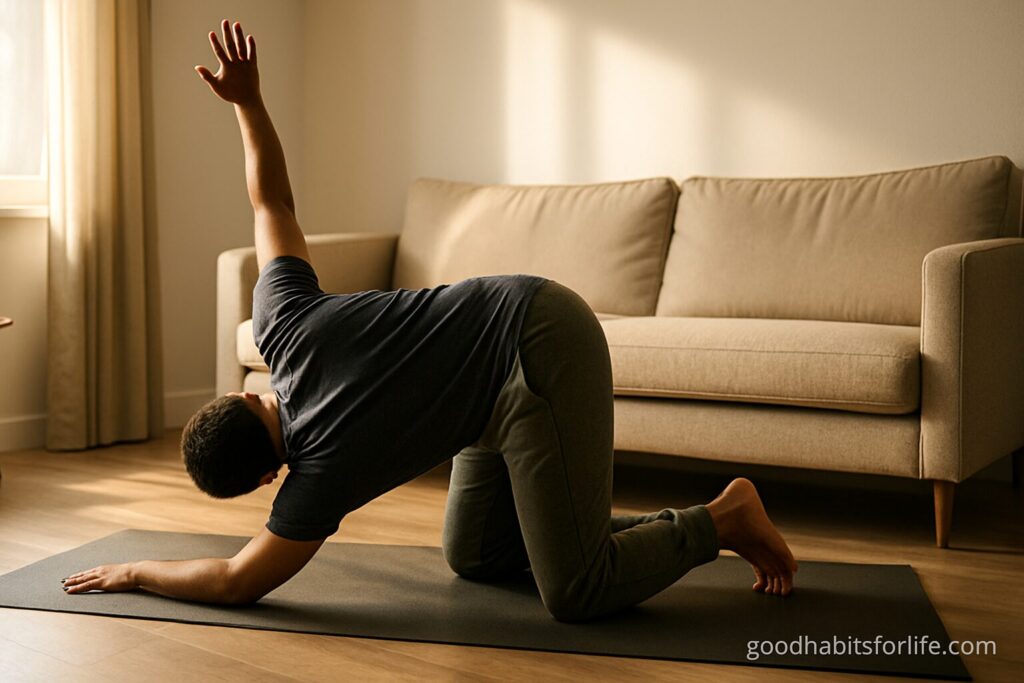
5:00–6:00 — Quadruped T-Spine Rotations
-
On all fours. One hand behind head. Inhale rotate elbow to the sky; exhale thread elbow toward opposite wrist. Switch at 30 seconds.
-
-
6:00–7:00 — Squat-to-Stand + Overhead Raise
-
Feet shoulder-width. Hinge to grab toes/ankles, drop into squat, chest up, then raise arms overhead and stand tall. Smooth and controlled.
-
Finish: Shake out limbs, take two slow breaths, and smile—mobility done. 😄
🗺️ Habit Plan: 7-Day Starter + 30-60-90 Progression
7-Day Starter
-
Day 1–2: Do the 7-minute flow right after brushing teeth. Log it (✓) on a sticky note.
-
Day 3–4: Keep the same time. Add one extra set of ankle rocks for tight ankles (+30 s).
-
Day 5–6: Add 5 deep nasal breaths at the end focusing on long exhalations (↓ stress).
-
Day 7 (Checkpoint): Notice changes: smoother squat? Easier to look over shoulder? Note wins.
30-60-90 Roadmap
-
Days 1–30: Build streak: 5×/week, same time/place.
-
Days 31–60: Personalize: swap one move for your tightest area (e.g., neck CARs or shoulder circles). Keep total ≤10 minutes.
-
Days 61–90: Layer a 1-minute micro-reset mid-day (see Desk Reset below). Add walk 10 min post-flow for bonus energy/posture.
Desk Reset (1 minute): 20 s chin tucks, 20 s band pull-aparts or wall slides, 20 s hip hinges.
🛠️ Techniques & Frameworks
-
CARs (Controlled Articular Rotations): Draw the biggest comfortable circle with a joint (neck, shoulders, hips, ankles) without pain or compensations. Great as a swap-in.
-
Breath-led movement: Move on exhale when reaching/rounding; on inhale when opening/lengthening.
-
The “3S Rule”: Smooth, Small, Symmetric. Start with smooth reps, small ranges, equal time each side—then expand.
-
Traffic-light scale: Green = comfy; Yellow = tight but ok; Red = stop/modify.
-
Progression knobs: Add time (15–30 s), reps, or range—not all at once.
👥 Variations by Audience
-
Students & Professionals: Keep a yoga mat next to desk. Add thoracic rotations and pec doorway stretch post-commute.
-
Parents with toddlers: Do flow while kids play; turn squat-to-stand into a “pick up toy” game.
-
Seniors: Use a chair for balance during lunges and ankle rocks; reduce range and pace; prioritize breathing + posture.
-
Teens/Athletes: After the 7-minute flow, add 2 minutes of dynamic prep (skips, leg swings) before sport.
⚠️ Mistakes & Myths to Avoid
-
Bouncing stretches. Use controlled movement; avoid ballistic bouncing first thing.
-
Holding breath. Breath drives the nervous system; exhale to relax into range.
-
Chasing pain. Mild tightness = ok; sharp pain = stop.
-
All static stretching. Mornings favor dynamic movement; hold long static stretches later in the day or post-activity if desired.
-
Overcomplicating. Consistency beats variety. 7 minutes daily > 30 minutes once.
💬 Real-Life Examples & Scripts
-
If-Then plan: “If the kettle is on, then I start my 7-minute mobility.”
-
Micro-environment: Keep mat + phone stand visible; create a ‘Mobility’ timer preset.
-
Self-talk: “Easy range, smooth breath.” / “Yellow is okay; red means modify.”
-
Two-person pact: Text a ✅ emoji to a friend each morning after finishing.
🧰 Tools, Apps & Resources
-
Timer apps (built-in Clock, Interval Timer): simple alarms for 60-second blocks.
-
Mobility trackers (Any habit app): streaks keep you honest.
-
Props (optional): yoga mat, doorway, mini band, foam roller (for brief pre-flow soft-tissue work if you like).
Pros: cheap, portable, habit-friendly. Cons: none required—avoid gear-hunting as procrastination.
🔑 Key Takeaways
-
Seven minutes is enough to prime joints, posture, and energy.
-
Use dynamic, controlled movements and breath.
-
Pair with an existing habit to lock it in.
-
Modify ranges; pain = no.
-
Track a simple ✓ streak for the first 30 days.
❓FAQs
1) Is 7 minutes really enough to help?
Yes. Gentle, full-body movement boosts circulation and joint lubrication quickly. Consistency matters more than duration.
2) Should I stretch statically in the morning?
You can, but favor dynamic mobility first. Save longer static holds for later or after activity.
3) Can I do this before a workout?
Absolutely. It’s a solid general warm-up; athletes may add sport-specific drills after.
4) What if my knees/low back are sensitive?
Reduce range, add support (chair/wall), and slow down. Skip any move that causes pain and consult a professional if symptoms persist.
5) How fast should I move?
Smooth and controlled—about 4–6 seconds per rep. Quality over quantity.
6) Do I need equipment?
No. A mat is optional for comfort.
7) When will I notice results?
Many feel looser immediately; posture and range typically improve over 2–4 weeks of daily practice.
8) Can I replace a move?
Yes. Swap in neck CARs, shoulder circles, or hamstring hinges to target your tightest area—keep total time at ~7–10 minutes.
9) Morning or evening?
Either works. Morning helps shake off stiffness and sets posture for the day.
10) Will this help with weight loss?
Indirectly—mobility itself is low calorie burn, but it makes daily movement and workouts easier, which supports weight management.
📚 References
-
World Health Organization. Physical activity—facts & guidelines. https://www.who.int/news-room/fact-sheets/detail/physical-activity
-
CDC. How much physical activity do adults need? https://www.cdc.gov/physicalactivity/basics/adults/index.htm
-
NHS. Flexibility exercises. https://www.nhs.uk/live-well/exercise/flexibility-exercises/
-
Harvard Health Publishing. The importance of stretching. https://www.health.harvard.edu/staying-healthy/the-importance-of-stretching
-
Behm DG, Chaouachi A. A review of the acute effects of static and dynamic stretching on performance. Sports Med. 2011. PubMed: https://pubmed.ncbi.nlm.nih.gov/21244105/
-
Cheatham SW, Kolber MJ, Cain M, Lee M. The effects of self-myofascial release using a foam roller on range of motion. Int J Sports Phys Ther. 2015. https://www.ncbi.nlm.nih.gov/pmc/articles/PMC4637917/
-
Cleveland Clinic. Synovial fluid: function & location. https://my.clevelandclinic.org/health/body/21687-synovial-fluid
-
American Council on Exercise. Dynamic warm-up: what it is & how to do it. https://www.acefitness.org/education-and-resources/lifestyle/blog/7443/dynamic-warm-up-what-it-is-and-how-to-do-it/
Disclaimer
This guide provides general fitness information and is not a substitute for personalized medical advice; consult a qualified professional if you have pain, injury, or medical conditions.