
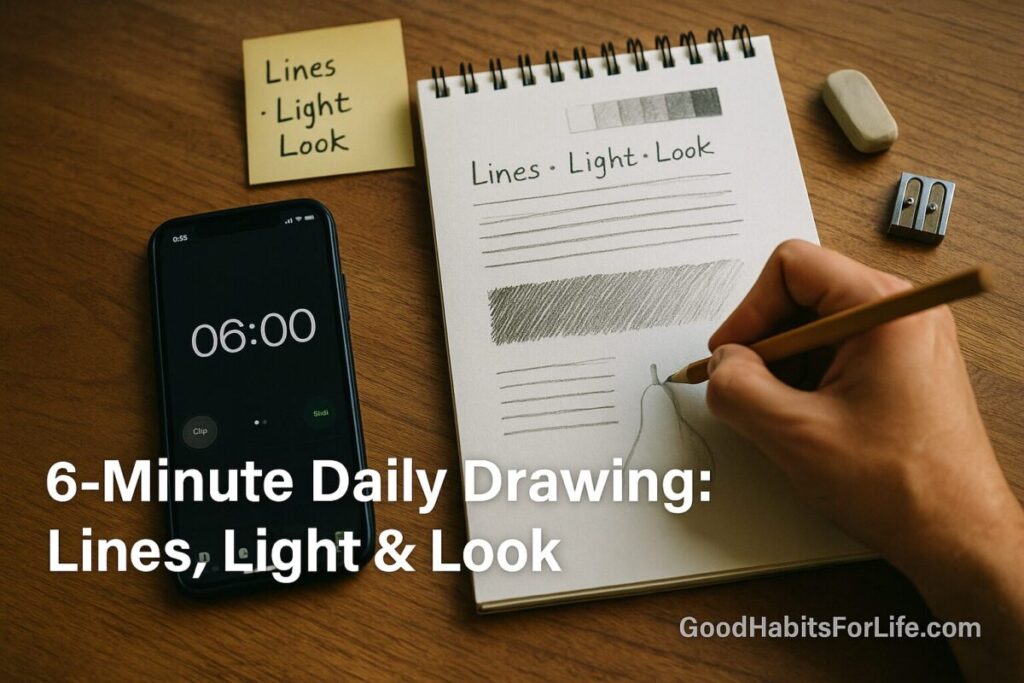
6-Minute Daily Drawing: Lines, Light, and Look
6-Minute Daily Drawing: Lines, Light & Look
Table of Contents
🧭 What This Habit Is (and Why It Works)
The idea: A micro-routine that fits into busy days and still builds real skill. Spend 6 minutes each day on three micro-drills:
-
Lines (2 min): warm up with straight lines, arcs, ellipses, and contours.
-
Light (2 min): add values (light→dark) with quick hatching.
-
Look (2 min): practice pure observation—draw what you see, not what you think.
Why it works (evidence-backed):
-
Drawing improves memory and learning compared with writing alone (“drawing effect”).
-
Short bouts of art-making can reduce stress (lower cortisol) and improve mood.
-
Observation training from the arts transfers to other fields (even clinical diagnosis).
-
Tiny, consistent actions create sticky habits over weeks (habit formation research).
(See References.)
What you’ll notice in 2 weeks:
-
Smoother lines, better proportion, and quicker “seeing” of shapes and shadows.
-
A reliable 6-minute reset that calms and refocuses you between tasks.
✅ Quick Start: Do This Today
-
Pick your trigger: after morning tea ☕ or right before lunch.
-
Set a 6-minute timer.
-
Grab a micro-kit: pen + 10×15 cm note cards (or sketch app).
-
Run the loop:
-
Lines (2 min): rows of straight lines, circles, and ellipses; then 1 blind contour of your mug.
-
Light (2 min): draw a 3-step value scale (light/medium/dark) and shade a simple object.
-
Look (2 min): a tiny observational sketch of whatever’s on your desk.
-
-
Snap & log: take a photo, mark an ✅ in your habit grid, and move on.
Rule of thumb: stop at 6 minutes even if it’s going well—ending on a win makes tomorrow easier.
🛠️ The 7-Day Starter Plan
| Day | Lines (2 min) | Light (2 min) | Look (2 min) |
|---|---|---|---|
| Mon | 30 straight lines + 20 ellipses | 3-step value scale | Your mug from top view |
| Tue | 2 pages of arcs & S-curves | Shade a cube (3 planes) | Keys or earbuds |
| Wed | Contour of your hand (no looking at paper) | Shade a sphere (core shadow) | Fruit (apple/banana) |
| Thu | Parallel lines + cross-contours on cylinders | Hatching: light→dark bar | Water bottle |
| Fri | Ellipses in boxes (cup rims) | Two-value silhouette of an object | Shoe or slipper |
| Sat | Ghosted lines (hover then mark) | Five-step value scale | Plant or leaf |
| Sun | Free warm-ups you enjoyed most | Quick cast-shadow study | Self-portrait (tiny mirror selfie) |
Checkpoint: At the end of Day 7, lay out your cards; circle one improvement and one focus for next week.
🧠 Techniques & Frameworks
🔹 Lines: Control & Confidence
-
Ghosting: hover the pen over the path before committing.
-
Contours & ellipses: draw through the ellipse 2–3 times; aim for evenness.
-
Blind contour: look only at the subject; it trains hand–eye accuracy and seeing.
🔸 Light: Values, Not Details
-
Think in 3 tones: light / mid / dark. Place the darks first; midtones unify, lights are paper.
-
Hatching basics: parallel lines for midtones; cross-hatching for darker areas.
-
Form before texture: make the sphere read as round before adding pores or shine.
🔹 Look: See What’s Really There
-
Plumb lines: compare verticals/horizontals to align angles.
-
Negative shapes: draw the space around the object; it corrects proportion.
-
Big to small: block in overall shape, then refine.
-
Sight-size snapshot: hold your pencil at arm’s length to compare relative sizes.
The “LLL” Cycle (Lines → Light → Look)
Use this in every session to keep practice balanced:
-
Lines warm up motor control; 2) Light builds form; 3) Look anchors you in reality.
Rotate subjects weekly (desk objects → kitchen → plants → faces → streets).
👥 Variations by Audience
-
Students: keep index cards in your backpack; pair with study breaks to refresh focus.
-
Professionals: 6 minutes between meetings; sketch your workspace to reset attention.
-
Parents: draw with kids after homework; make it a “quiet 6” family ritual.
-
Seniors: larger markers and thicker paper for ease; focus on high-contrast still life.
-
Teens: use phone camera roll for reference; limit zooming—embrace bold, simple shapes.
⚠️ Mistakes & Myths to Avoid
-
Myth: “I need 1 hour to improve.” Reality: tiny daily reps beat rare long sessions.
-
Myth: “Talent first, practice later.” Skill grows from repeatable drills and feedback.
-
Mistake: chasing detail too early. Lock in big shapes and values before textures.
-
Mistake: new tools every week. Stick to one pen/pencil for a month—reduce friction.
-
Mistake: skipping logging. A one-line checkmark sustains streaks and motivation.
🗂️ Real-Life Examples & Copy-Paste Scripts
Daily Card Back (write this once):
-
Lines: _______
-
Light: _______
-
Look: _______
-
1 word on how I feel: _______
Accountability DM (copy-paste):
“I’m doing a 6-minute drawing habit for 7 days. If I don’t send a photo by 8 pm, send me 🧱.”
Self-talk to beat perfectionism:
“Done at 6, not perfect at 60.”
Quick prompt list (rotate weekly):
-
Desk: mug, pen, charger, stapler, watch, glasses
-
Kitchen: cup, spoon, fruit, kettle, bottle
-
Nature: leaf, flower, pebble, shell, twig
-
Faces: eye, nose, mouth (from a mirror selfie)
-
City: bike wheel, door handle, shoe, keyhole
Mini critique checklist (30 seconds):
-
Did I start big → small?
-
Are my darkest darks actually dark?
-
Any angles obviously off?
-
One thing I’ll try tomorrow: _______.
🧰 Tools, Apps & Resources
Analog basics (fastest to start):
-
Pen or 2B pencil + small cards/notebook. Pros: portable, cheap. Cons: limited layers/undo.
-
Clip board or phone stand. Pros: stable viewpoint. Cons: one more item to carry.
Digital (phones/tablets):
-
Krita (free, desktop), Autodesk SketchBook (free), Procreate (iPad).
-
Pros: layers, timelapse, brushes. Cons: screen time, choice overload.
-
Reference photos (royalty-free):
-
Pexels (license), Pixabay (license summary).
-
Pros: safe to use, huge variety. Cons: beware AI-generated oddities; always double-check composition.
-
Timers & tracking:
-
Any 6-minute timer; Forest or Focus To-Do (Pomodoro) for streaks; a paper grid on your wall works great.
📌 Key Takeaways
-
A 6-minute routine is enough to build real drawing skill if you repeat it daily.
-
The LLL loop (Lines, Light, Look) balances control, form, and observation.
-
Pair with a consistent trigger and log your streak to make it stick.
-
Keep the kit tiny and the prompts simple; progress comes from reps, not gear.
❓FAQs
1) Can 6 minutes really improve my drawing?
Yes—short, frequent sessions build motor control and perception faster than sporadic long ones. Evidence shows drawing enhances memory and observation; consistency compounds these gains.
2) What if I miss a day?
Never double the next day. Just do today’s 6 minutes. Focus on keeping gaps to one day max.
3) Should I learn anatomy/perspective first?
Not for this habit. Start with LLL; add fundamentals in separate weekend blocks if you’d like.
4) Pencil or pen?
Either. Pen prevents over-erasing and builds confident lines; pencil is forgiving for value studies.
5) Where do I find subjects?
Draw what’s within arm’s reach. Switch rooms each week. Use Pexels/Pixabay for variety.
6) How do I know I’m improving?
Keep Day-1 and Day-7 cards; compare line smoothness, proportion, and value range. Ask a friend to spot the differences.
7) Is copying photos “cheating”?
No—observational accuracy is the goal here. Photos are fine; just cite sources if you share publicly.
8) Can kids do this?
Absolutely. Make it a family “quiet 6” with shared prompts and stickers for streaks.
9) What size paper is best?
Small surfaces (A6/5×7 in) encourage bold decisions and reduce fear of the blank page.
10) How long until it becomes automatic?
Habit research suggests several weeks; many people find a groove around the 6–8 week mark.
📚 References
-
Wammes, J. D., Meade, M. E., & Fernandes, M. A. (2016). The drawing effect: Evidence that drawing improves memory. Quarterly Journal of Experimental Psychology. PubMed
-
Kaimal, G., Ray, K., & Muniz, J. (2016). Reduction of cortisol levels and responses following art making. Art Therapy Journal. NIH/PMC summary
-
Naghshineh, S., et al. (2008). Formal Art Observation Training Improves Medical Students’ Visual Diagnostic Skills. Journal of General Internal Medicine. PubMed
-
Fancourt, D., & Finn, S. (2019). What is the evidence on the role of the arts in improving health and well-being? WHO Europe Scoping Review. WHO
-
Project Zero, Harvard Graduate School of Education. Studio Habits of Mind / Studio Thinking Framework. Harvard GSE
-
MoMA Learning. Elements of Art: Line; Value (Light & Dark). MoMA Learning
-
Tate. Art Terms: Tone/Value. Tate
-
Lally, P., van Jaarsveld, C. H. M., Potts, H. W. W., & Wardle, J. (2009). How are habits formed in the real world? European Journal of Social Psychology. UCL summary
-
Pexels. Pexels License. Pexels
-
Pixabay. Pixabay Content License Summary. Pixabay
Disclaimer
This article offers general educational information and is not a substitute for professional mental-health or medical advice.