
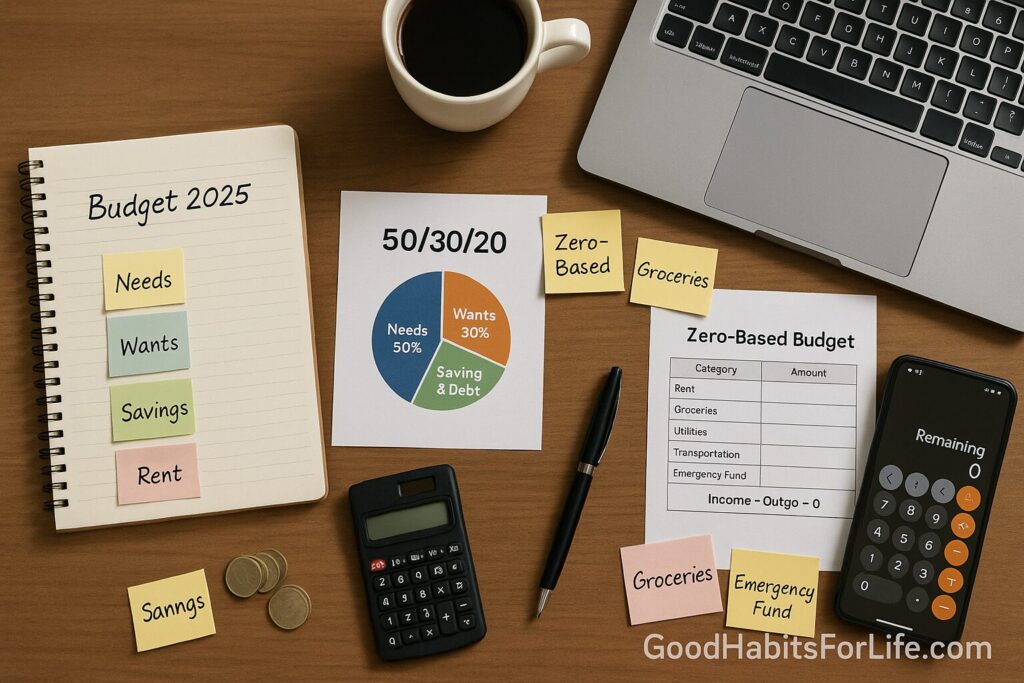
50/30/20 vs ZeroBased: Which Budget Works in 2025?
50/30/20 vs Zero-Based: Which Budget Works in 2025?
Table of Contents
🧭 What & Why: 50/30/20 vs Zero-Based
50/30/20 rule (what it is): A simple budget split of your after-tax income into 50% needs, 30% wants, and 20% saving/debt payoff. It’s popular because it’s fast to set up and easy to remember. NerdWalletMaPS
Zero-based budgeting (what it is): You assign every unit of income a job—spending, saving, giving, or debt—so that income − outgo = 0 by month-end (you still keep money in the bank; it just has a named purpose). It offers granular control and shines when your income or expenses swing. NerdWalletFidelity
Why budget at all in 2025? Inflation has eased from its peak but remains above pre-2020 norms in many economies, so intentional spending and regular reviews matter. OECD+1Bureau of Labor Statistics
Evidence that budgeting helps: People exposed to targeted financial-education nudges were far more likely to adopt and keep budgeting a year later—habits stick with support. Government of Canada
✅ Pros, Cons & Who Each Fits
50/30/20 rule
Pros
-
Ultra-fast setup; easy mental model for families and beginners.
-
Natural guardrails on lifestyle creep (needs ≤50%, wants ≤30%).
-
Works well with automated saving (“pay yourself first”). Consumer Financial Protection Bureau
Cons
-
Not tailored to high-cost areas or special goals; percentages may need tweaks.
-
Can feel too coarse for irregular income months.
Best for
-
Salaried income, beginners, busy professionals, or anyone who wants a “good-enough” budget quickly.
Zero-based budgeting
Pros
-
Maximum clarity and control; aligns every rupee/dollar with goals.
-
Great for variable income (freelancers, sales, gig workers).
-
Surfaces waste and frees cash for debt/saving faster. NerdWallet
Cons
-
More time-intensive until it becomes routine.
-
Over-precision can feel tiring if you track too many categories.
Best for
-
Households with irregular income, aggressive debt payoff, or many competing goals.
🛠️ Quick Start: Do This Today (20 Minutes)
-
Get your monthly take-home (salary after tax, average if variable).
-
Pick your method (50/30/20 or zero-based).
-
Set caps or jobs:
-
50/30/20 example (₹100,000 take-home): Needs ₹50,000; Wants ₹30,000; Saving/Debt ₹20,000.
-
Zero-based sketch: Rent ₹22,000; Groceries ₹9,000; Transport ₹6,000; Utilities ₹4,000; Insurance ₹3,000; Phone/Net ₹1,500; Medical ₹2,500; Debt ₹8,000; Goals/Savings ₹20,000; Fun ₹8,000; Sinking funds ₹6,000; Buffer ₹2,000 → Total = ₹100,000 (zero left unassigned).
-
-
Automate the “20” (or your saving/debt jobs) on payday.
-
Weekly 10-minute review: reconcile, adjust categories, and note one improvement for next week.
-
Build an emergency cushion alongside debt payoff; many regulators suggest 3–6 months of essential expenses over time. Start with one month. FINRA
📅 30-60-90 Budget Habit Plan
-
Days 1–30 (Install the system):
-
Choose your method; set categories; automate transfers on payday.
-
Track every spend (zero-based) or just totals (50/30/20).
-
Win today: plug one leak (unused subscription, high data plan).
-
-
Days 31–60 (Stabilize & save):
-
Add sinking funds (insurance, school fees, travel, maintenance).
-
Build your first month of emergency cash. FINRA
-
-
Days 61–90 (Optimize):
-
Negotiate bills (insurance, broadband).
-
If needs >50% (50/30/20), trim or temporarily re-weight to 60/20/20 until rent/transport improve.
-
Review progress; lock a monthly money date.
-
🧠 Techniques & Frameworks That Help
-
Pay-yourself-first: Automate saving/debt on payday so lifestyle expands only after goals are funded. Consumer Financial Protection Bureau
-
Cash-flow calendar: Map bill due dates vs paydays so timing—not just totals—works. (CFPB’s bill calendar is handy.) Consumer Financial Protection Bureau
-
Sinking funds: Mini-savings buckets for non-monthly costs (car service, school books, festivals).
-
Percentage tweaking: 50/30/20 is a starting point; adjust to 60/25/15 in high-rent cities or 40/30/30 during aggressive debt payoff. MaPS
-
One-number focus: If tracking everything is hard, track just savings rate weekly—behavior improves with simple feedback loops. Government of Canada
👥 Variations: Students, Parents, Professionals, Seniors
-
Students: Zero-based with weekly cycles works well. Add “textbooks/tech,” “activities,” and a small “fun” category to prevent blow-outs.
-
Parents: Use sinking funds for school fees, medical, birthdays, travel. Share the money calendar; batch-shop to cut wants.
-
Busy professionals: 50/30/20 plus automation = least effort. Add a “household manager” app/calendar.
-
Seniors/retirees: Zero-based can align pensions + withdrawals with health/insurance and predictable bills; set a guardrail withdrawal rate.
⚠️ Mistakes & Myths to Avoid
-
Myth: “Zero-based means draining to ₹0/$0.”
Reality: It means every unit is assigned a purpose; you still hold cash in accounts. NerdWallet -
Myth: “50/30/20 is only for the U.S.”
Reality: It’s a global rule-of-thumb; adjust percentages for your location. MaPS -
Mistake: No emergency fund. Even a small buffer prevents budget derailments. FINRA
-
Mistake: Tracking fatigue. Too many categories kill momentum—combine small spends into a single “everyday” line and review weekly.
-
Mistake: Never revisiting caps. Prices move; review monthly while inflation remains above pre-2020 norms. OECD
💬 Real-Life Examples & Scripts
Example A — 50/30/20 (₹100,000 take-home):
-
Needs (₹50,000): Rent 22,000; Groceries 9,000; Transport 6,000; Utilities 4,000; Insurance 3,000; Phone/Net 1,500; Health 2,500; Other 2,000.
-
Wants (₹30,000): Eating out 8,000; Entertainment 4,000; Shopping 8,000; Travel fund 10,000.
-
Saving/Debt (₹20,000): Emergency 8,000; Retirement/Invest 6,000; Debt 6,000.
Example B — Zero-Based (US $4,000 take-home):
Assign every dollar: Rent 1,200; Utilities 200; Groceries 450; Transport 250; Insurance 200; Phone/Net 70; Debt 500; Emergency 400; Retirement/Invest 400; Sinking Funds (car/medical/gifts) 200; Fun 100; Buffer 30 → $4,000 assigned.
Copy-paste scripts
-
Payday automation: “Transfer 20% to ‘Savings & Debt’ on payday; split: 40% emergency, 40% debt, 20% long-term.”
-
Bill negotiation: “I’ve been a customer for X years. Competitor offers ₹/$. Can you match or move me to a lower tier today?”
-
Family check-in (monthly): “What went well? What felt tight? One change for next month?”
🧰 Tools, Apps & Resources
Free, official planners
-
CFPB worksheets & bill calendar (U.S.). Consumer Financial Protection BureauConsumer Financial Protection Bureau
-
FCAC Budget Planner (Canada). Government of Canada
-
MoneyHelper Budget Planner (U.K.). MaPS
Apps (pros/cons)
-
YNAB (Zero-based, paid): Excellent rule-based flow; cost may deter.
-
Monarch Money / PocketGuard / Copilot: Clean automation; subscription.
-
Excel/Google Sheets: Free, flexible; manual effort but powerful for zero-based.
-
Bank apps: Improving category insights; limited goal tools.
Tip: Start with a free government planner or a simple spreadsheet. Add a paid app only if it saves you time or boosts follow-through. MaPS
🔑 Key Takeaways
-
Pick one method and start—perfect is the enemy of done.
-
50/30/20 = speed & simplicity; zero-based = control & flexibility.
-
Automate saving/debt and hold a growing emergency cushion. FINRA
-
Review weekly, refine monthly—especially while prices stay above pre-2020 baselines. OECD
-
Use official planners first; layer in apps if needed. Government of CanadaMaPS
❓ FAQs
1) Which budget is best for high-inflation periods?
Either works, but zero-based helps you react faster category-by-category. Review caps monthly while inflation remains elevated vs pre-2020 norms. OECD
2) I’m salaried and busy. Is 50/30/20 enough?
Yes—set the caps, automate transfers, and add sinking funds. Re-weight temporarily if your “needs” exceed 50%. MaPS
3) I have irregular income. What should I use?
Try zero-based with a one-month baseline and a buffer; assign dollars each time you’re paid. NerdWallet
4) How big should my emergency fund be?
Aim eventually for 3–6 months of essential expenses; start with one month and grow steadily. FINRA
5) Do I need to track every transaction?
Only for zero-based (at least early on). With 50/30/20, many people track category totals weekly and hit their % caps—good enough for momentum. Consumer Financial Protection Bureau
6) Can I mix methods?
Yes. Many use 50/30/20 caps but assign “jobs” to the 20% saving bucket the zero-based way.
7) What about debt payoff?
Use the 20% (or a larger slice) for debt. In zero-based, give debt a fixed job each payday and track wins monthly.
8) How do I involve my partner/family?
Hold a 10-minute money date weekly. Share the bill calendar and agree on one change per month. Consumer Financial Protection Bureau
📚 References
-
Consumer Financial Protection Bureau — Budgeting: how to create a budget and stick with it. https://www.consumerfinance.gov/… Consumer Financial Protection Bureau
-
MoneyHelper (U.K.) — Budgeting & free Budget Planner. https://www.moneyhelper.org.uk/… MaPS
-
FINRA — Financial Foundations: emergency funds (3–6 months). https://www.finra.org/… FINRA
-
FCAC (Government of Canada) — Budget Planner & make a budget. https://www.canada.ca/… Government of CanadaGovernment of Canada
-
Investopedia — Zero-Based Budgeting: what it is and how to use it. https://www.investopedia.com/… Investopedia
-
Fidelity — What is a zero-based budget? https://www.fidelity.com/… Fidelity
-
BLS — Consumer Price Index Summary (July 2025). https://www.bls.gov/news.release/cpi.nr0.htm Bureau of Labor Statistics
-
OECD — Consumer Prices (updates 2025). https://www.oecd.org/… OECD+1
-
CFPB — Cash-flow budget tool (PDF) & Monthly budget worksheet. https://files.consumerfinance.gov/… Consumer Financial Protection Bureau+1
-
FCAC — Budgeting follow-up study: sustained adoption. https://www.canada.ca/… Government of Canada
Disclaimer: This article is for education only and isn’t financial advice; consider speaking with a qualified adviser for your situation.