
30Day Quit Sprint: A WeekbyWeek Map: AI workflows (2025)
30Day Quit Sprint: A WeekbyWeek Map: AI workflows (2025)
Table of Contents
🧭 What This 30-Day Sprint Is (and Why It Works)
The 30-Day Quit Sprint is a structured, time-boxed plan to move you from “thinking about quitting” to smoke-free in four focused stages. It blends evidence-based methods (behavioral coaching, Nicotine Replacement Therapy (NRT) or prescription meds, social support) with AI-assisted workflows (personalized prompts, craving scripts, tracking dashboards).
Why it works
-
Gives a clear, short horizon (30 days) that feels achievable.
-
Uses behavior + pharmacotherapy together—consistently shown to improve quit rates.
-
Builds daily feedback loops ( urges, triggers, wins) so you can adapt quickly.
-
Adds AI micro-coaching between human touches to fill the support gaps.
✅ Quick Start: Do These 7 Things Today
-
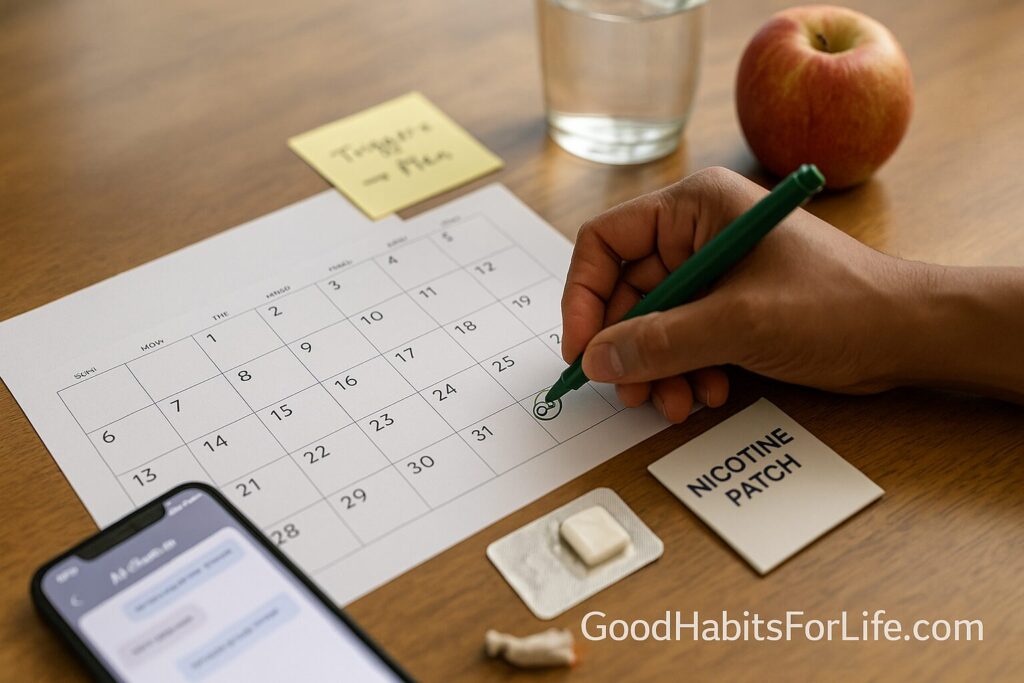
Pick a Quit Date within 7 days. Put it on your calendar and tell one person.
-
Choose your aid(s): Patch + gum/lozenge, or discuss varenicline/bupropion with a clinician.
-
Enroll in support: Call 1-800-QUIT-NOW (or your country’s quitline), install a stop-smoking app, and line up a buddy.
-
Set up an AI “quit copilot”: Create a trigger diary + craving-response script (see “AI Workflows”).
-
Clean your environment: Remove lighters/ashtrays; wash fabrics; stock quit kit (water bottle, sugar-free mints, gum).
-
Plan your replacements: “When urge hits → 4-7-8 breaths + 2-minute walk + gum.”
-
Track baseline: Cigarettes/day, strongest trigger times, morning craving score (0–10), money spent.
🛠️ Week-by-Week Map (Days 1–30)
Week 0–1: Prepare & Pre-Load (Days −3 to 7)
Goals: lock in quit date, reduce cues, start NRT/meds plan, rehearse craving scripts.
To-dos:
-
Doctor/pharmacist chat about NRT/meds and timing.
-
Start patch on Quit Day; keep short-acting NRT (gum, lozenge, spray) with you.
-
Trigger audit: morning coffee, commute, meals, stress bursts, social events.
-
If cutting down helps you: set rules (e.g., only outdoors, half as many), then stop on Quit Day.
-
Practice exits: 10 “urge drills” daily—stand → drink water → slow exhale → 10 squats → message your AI copilot “urge 7/10”.
-
AI: generate 10 alternative routines for your top 3 triggers; print a 1-page plan.
Checkpoint: Quit date booked; medications/NRT in hand; buddy + quitline saved; scripts ready.
Week 2: Quit & Stabilize (Days 8–14)
Focus: nicotine withdrawal management, routine redesign.
-
Use combo NRT: patch for base + gum/lozenge for spikes (follow package or clinician guidance).
-
Protect mornings: hydrate, protein breakfast, sunlight walk 10–15 minutes.
-
Move micro-bursts: 2 minutes of brisk steps or wall pushups when urges spike.
-
Change context: swap coffee for tea for 2 weeks, or change mug/seat to break associations.
-
AI: daily reflection (“What triggered the strongest urge? What worked?”); generate a micro-goal for tomorrow.
Checkpoint: No cigarettes for ≥3 consecutive days OR rapid return to plan after any slip.
Week 3: Rewire & Reward (Days 15–21)
Focus: identity shift and reward bundling.
-
Identity reps: “I’m a non-smoker investing in my lungs.”
-
Bundle rewards: pair your favorite podcast with walks; save cigarette money for a visible treat jar.
-
Social scripts: practice polite refusals (see Scripts).
-
Sleep & stress: aim 7–9 hours; 10-minute wind-down; breathwork before bed.
-
AI: create a future-self letter and a lock-screen image of your reasons.
Checkpoint: Urges down in intensity/frequency; money-saved tracker feels motivating.
Week 4: Future-Proof & First Milestones (Days 22–30)
Focus: relapse prevention, high-risk scenarios, long-term supports.
-
Plan for triggers: alcohol, parties, conflict, travel, boredom.
-
Carry a relapse-rescue kit: short-acting NRT, mints, “reset” card, buddy text.
-
Schedule a 30-day celebration and 90-day check-in.
-
AI: build a “If-Then” library (e.g., If offered a cigarette → say script B + hold water bottle + text buddy).
-
Optional: continue patch taper per guidance; keep short-acting NRT handy for spikes.
Checkpoint: 30-day smoke-free streak or clear, rapid-reset process after any slip.
🧠 Techniques & Frameworks That Raise Success
-
5 A’s & 5 R’s: Ask, Advise, Assess, Assist, Arrange and Relevance, Risks, Rewards, Roadblocks, Repetition.
-
CBT for triggers: identify cue → thought → urge → action; replace with cue → thought (“urge will peak & pass”) → action (walk + gum).
-
WOOP: Wish, Outcome, Obstacle, Plan (write 1 WOOP per top trigger).
-
Urge Surfing: ride the urge wave for 2–3 minutes; track peak-to-zero time.
-
Implementation Intentions: “If I finish lunch, then I chew a lozenge and step outside for sunlight + 20 breaths.”
-
Stacked Habits: anchor new routines to stable cues (wake, commute, lunch).
🤖 AI Workflows That Make Quitting Easier
Set up once; reuse daily.
-
Trigger Diary Template
Prompt: “Create a 7-day smoking trigger diary with columns: time, location, people, emotion (0–10), urge (0–10), action taken, alternative plan.”
Export to Google Sheets/Notion; fill in on phone. -
Craving Script Generator
Prompt: “Act as my quit coach. For the following triggers, write 3 short self-talk lines, a 90-second action, and an if-then plan: [list triggers].”
Print a one-pager. -
Daily Debrief & Micro-Goal
Prompt (every night): “Summarize my day: strongest urge, what worked, money saved. Propose one micro-goal for tomorrow in 20 words.” -
Relapse-Reset Macro
Prompt: “I slipped and smoked [X]. Diagnose the likely trigger, update my if-then plan, and write a 2-sentence compassionate reset note to myself.” -
Motivation Assets
Prompt: “Write a 120-word future-self letter for Day 30 and a 1-line mantra. Suggest a minimalist phone lock-screen.”
Optional: ask an image model for a poster of your smoke-free milestone. -
Progress Dashboard
Prompt: “Build a simple table I can paste into Sheets with formulas to track days smoke-free, urges/day, NRT use, money/time saved.”
Keep privacy in mind; avoid storing identifiable health data in public tools.
👥 Audience Variations
Students/Teens: tighten environment (no smoking in dorm/hostel room), social scripts for parties, budget tracker for savings toward tech/textbooks.
Parents/Caregivers: make a visible countdown for kids; use stroller walks or playground time as urge-surfing windows.
Busy Professionals: calendar block 2×10-minute “urge windows,” keep NRT at desk/car, use standing meetings + walks post-lunch.
Seniors: coordinate with clinician for meds and other conditions; gentle movement (short walks, chair exercises); prioritize sleep & hydration.
⚠️ Mistakes & Myths to Avoid
-
“Cold turkey is the only ‘real’ way.” Evidence supports NRT/meds and coaching; use all the help you can.
-
“One cigarette won’t matter.” It resets learning; treat it as a slip → analyze → reset.
-
Skipping breakfast & water. Low energy/dehydration amplifies urges.
-
Keeping triggers around. Ditch lighters/ashtrays; change coffee routine for 2 weeks.
-
Under-dosing NRT. Follow guidance; many people benefit from patch + short-acting.
-
White-knuckling alone. Add quitline/app/buddy/AI copilot.
🗣️ Real-Life Examples & Copy-Paste Scripts
-
Polite decline: “I’m on a 30-day quit sprint—root for me? I’ll take a water instead.”
-
Self-talk during urge: “This wave peaks in 2 minutes. Breathe, sip, walk—then gum.”
-
At a party: “I’m stepping outside for fresh air, not smoke. Back in 2.”
-
After a slip: “Data, not drama. Trigger was stress at 4 p.m.; new plan is 5-minute walk + text buddy.”
-
Ask for support: “If you see me fidget, please hand me a mint and ask about my streak.”
🧩 Tools, Apps & Resources (Pros & Cons)
-
National/State Quitlines (e.g., 1-800-QUIT-NOW, UK/NZ equivalents)
Pros: free coaching, NRT vouchers in some regions. Cons: scheduled calls; varies by location. -
Smokefree.gov & Smokefree Apps (NCI)
Pros: structured texts, tracking, tips. Cons: phone notifications can be easy to ignore—pair with buddy. -
NRT (patch, gum, lozenge, spray, inhaler)
Pros: reduces withdrawal; combo use is effective. Cons: skin/mouth irritation; follow usage instructions. -
Prescription meds (varenicline, bupropion)
Pros: proven efficacy, especially varenicline. Cons: prescription needed; side effects—discuss with clinician. -
Wearables & step counters
Pros: instant micro-rewards and urge diversion. Cons: novelty fades—tie to specific if-then plans. -
AI copilots & habit trackers (Notion/Sheets + LLM prompts)
Pros: personalized, always-on support. Cons: needs setup; protect privacy.
📌 Key Takeaways
-
Combine behavioral support + NRT/meds for the best odds.
-
Use a four-stage, 30-day map with daily tracking and checkpoints.
-
Deploy AI workflows for triggers, scripts, and progress dashboards.
-
Prepare for high-risk moments in advance with if-then plans.
-
Treat slips as data—reset rapidly and continue.
❓ FAQs
Q1. Is 30 days enough to be smoke-free?
Thirty days is a powerful starter horizon. Many people feel substantially better by then; continue supports for 8–12 weeks for stability.
Q2. Should I taper or quit abruptly?
Both can work. Many people pick a date and stop completely while starting NRT/meds. Some prefer a brief taper; choose the path you’ll stick with.
Q3. Do e-cigarettes help with quitting?
Some evidence suggests nicotine e-cigarettes can help adults quit compared with some other methods. Not risk-free; use short-term as a bridge, then taper off.
Q4. How do I handle weight gain fears?
Focus on protein-rich meals, fiber, water, and light daily movement. Even if weight rises slightly, your health risk drops markedly after quitting.
Q5. What if I live with a smoker?
Create smoke-free zones, agree on no offers, and schedule solo resets (walks, showers, calls) after meals or arguments.
Q6. Are cravings dangerous?
No—uncomfortable but temporary. Most peak within 2–3 minutes. Use breathwork + short-acting NRT + movement.
Q7. How long should I use NRT?
Typically 8–12 weeks, sometimes longer. Follow product instructions or clinician advice; step down gradually.
Q8. Can AI really help?
Yes—as a structure & accountability tool. It won’t replace medical care or human support, but it fills gaps between sessions.
Q9. What if I relapse after 30 days?
Restart. Analyze the trigger, update if-then plans, and resume supports. Each attempt teaches you what to fortify.
📚 References
-
World Health Organization (WHO). Tobacco. https://www.who.int/news-room/fact-sheets/detail/tobacco
-
Centers for Disease Control and Prevention (CDC). Smoking Cessation: Fast Facts & Benefits of Quitting. https://www.cdc.gov/tobacco/
-
Cochrane Review. Hartmann-Boyce J, et al. Nicotine replacement therapy for smoking cessation. https://www.cochranelibrary.com/
-
Cochrane Review. Hartmann-Boyce J, et al. Electronic cigarettes for smoking cessation. https://www.cochranelibrary.com/
-
U.S. National Cancer Institute. Smokefree.gov & Apps. https://smokefree.gov/
-
U.S. Preventive Services Task Force (USPSTF). Tobacco Smoking Cessation in Adults, Including Pregnant Persons: Interventions. https://www.uspreventiveservicestaskforce.org/
-
National Institute for Health and Care Excellence (NICE). Stop smoking interventions and services. https://www.nice.org.uk/
-
Free Quitline Network (U.S.). 1-800-QUIT-NOW. https://www.naquitline.org/
-
Whittaker R, et al. Mobile phone text messaging to support smoking cessation. Cochrane Review. https://www.cochranelibrary.com/
⚖️ Disclaimer
This article is for education only and is not medical advice; consult a qualified clinician for personalized guidance, medications, and safety.